
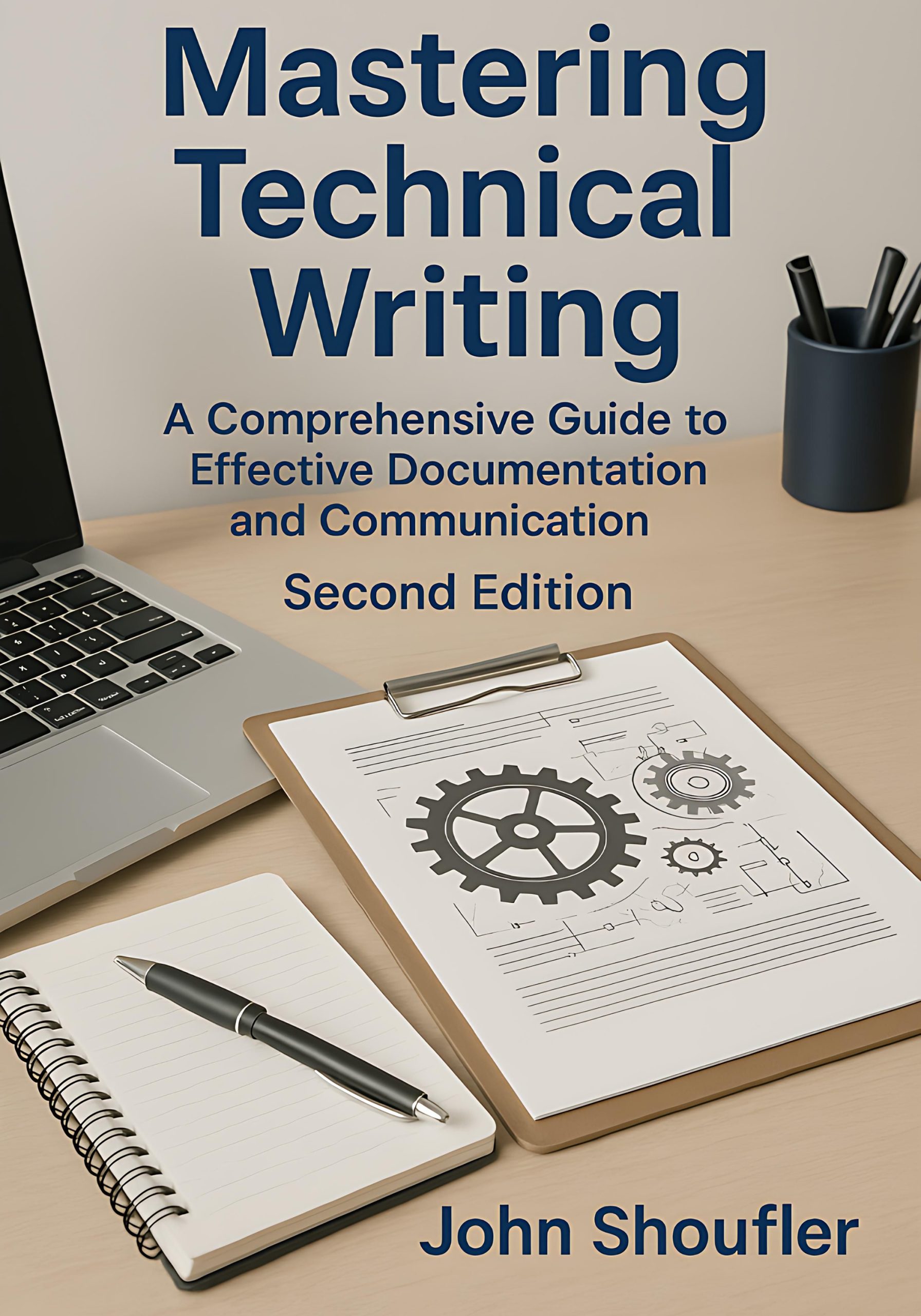
Technical writing has quietly become one of the most valuable skills in the modern economy. As products grow more complex, software ships faster, APIs proliferate across industries, and AI assistants reshape how customers find answers, the demand for clear, precise, user-centered documentation has never been higher — and the supply of writers who can deliver it remains stubbornly thin. That gap is exactly what John Shoufler set out to close with the second edition of his comprehensive guide.
If you write product manuals, API references, knowledge-base articles, SOPs, training material, or any document where someone has to do something based on what you wrote, this book is a field manual you’ll keep within arm’s reach.
About Mastering Technical Writing (Second Edition)
Mastering Technical Writing: A Comprehensive Guide to Effective Documentation and Communication is a 411-page complete re-write of John Shoufler’s original technical writing guide, restructured in response to direct reader feedback. Every chapter now stands on its own — you can dip in at “Editing and Quality Assurance” without first reading “Foundations,” or jump straight to “API and Developer Documentation” if that’s the gap you’re trying to close.
It’s a holistic book by design. Where most technical writing guides narrow in on a single industry — software, healthcare, regulatory — this one treats technical writing as an integrated discipline that shows up across technology, healthcare, engineering, finance, and beyond. The principles transfer; only the subject matter changes.
Who This Book Is For
The Second Edition is built around six distinct reader profiles:
- Complete beginners — anyone curious about technical writing, with zero prior experience required
- Intermediate writers — practicing documentation specialists who want to formalize what they know and fill specific gaps
- Advanced practitioners — senior writers and content strategists looking for cutting-edge practices and leadership frameworks
- Career changers — engineers, scientists, IT professionals, and teachers pivoting into technical communication
- Subject matter experts — engineers, doctors, and analysts who need to document their work effectively without becoming full-time writers
- Documentation managers — team leads building processes, standards, and onboarding material for their teams
The book opens with a self-assessment skills inventory across five dimensions — core writing, technical knowledge, document design, tools, project skills, and strategic skills. You score yourself 1–5 on each, then use the result to plan a custom path through the chapters instead of reading cover-to-cover.
The 21 Chapters at a Glance
The Second Edition is organized into 21 chapters across roughly seven thematic clusters:
1. Foundations (Chapters 1–3)
Foundations of Technical Writing, Understanding Your Audience, and The Technical Writing Process establish the core principles that don’t change with platform or industry: who are you writing for, what do they need to accomplish, and what’s the disciplined process for taking it from blank page to published document.
2. Craft (Chapters 4–6)
Structuring Technical Documents, Clarity in Technical Writing, and Visual Communication dig into the writing itself — how to organize complex information, write sentences that don’t require a re-read, and use diagrams, screenshots, and page design to carry weight that words alone can’t.
3. Document Types (Chapters 7–8)
Documentation Types and Best Practices and Writing for Different Technical Fields walk through the specific genres — user guides, reference manuals, release notes, SOPs, white papers, training material — and the conventions of writing for software, hardware, healthcare, life sciences, finance, and other domains.
4. Tools and Research (Chapters 9–11)
Documentation Tools and Technologies, Research Skills for Technical Writers, and Editing and Quality Assurance cover the practical machinery of the job: authoring environments, content management systems, source-control workflows, how to extract reliable information from busy SMEs, and how to edit your own and other people’s work without missing things.
5. Modern Workflow (Chapters 12–15)
Technical Writing in Agile Environments, Content Strategy, Localization and Global Content, and Technical Writing and User Experience address how the profession has shifted — from waterfall to agile, from standalone documents to managed content systems, from monolingual to global, and from “the docs team” to embedded contributors on UX and product teams.
6. Specialization (Chapters 16–18)
API and Developer Documentation, Multimedia and Interactive Documentation, and Documentation Management go deep on three of the highest-growth specializations: writing for developers, producing video and interactive learning content, and managing documentation portfolios at scale.
7. Career and Future (Chapters 19–21)
Technical Writing Careers, Advanced Technical Communication, and Emerging Trends and Technologies close the book by mapping out the career landscape — entry-level roles, mid-career specializations, leadership tracks — and looking ahead at AI content design, augmented reality documentation, and other roles that didn’t exist a few years ago.
The 9 Ready-to-Use Templates
One of the most quietly valuable parts of the Second Edition is the appendix section — nine templates and reference tools you can lift straight into your work:
- Document Planning Template — for scoping a new documentation project before you write a word
- Technical Document Review Checklist — for editing your own drafts or reviewing someone else’s
- User Guide Template — a structural skeleton for any end-user-facing manual
- API Documentation Template — endpoints, parameters, examples, errors, authentication
- Standard Operating Procedure (SOP) Template — step-by-step procedures for regulated or repeatable work
- Technical Writing Project Checklist — for managing a documentation engagement from kickoff to handoff
- Style Guide Template — starter rules for tone, terminology, voice, and formatting
- Glossary of Technical Writing Terms — vocabulary every writer should know
- Technical Writing Tools Comparison Charts — side-by-side reference for authoring tools, CMSs, and platforms
Each chapter also ends with practical exercises so the book functions as both a reference text and a self-paced course.
Where Technical Writing Is Going
The Second Edition gives sustained attention to seven shifts reshaping the profession:
- From print to digital — search-driven, non-sequential consumption replacing linear reading
- From comprehensive to just-in-time — getting users the exact answer at the moment of need, not a 300-page manual
- From waterfall to agile — documentation written in sprints alongside engineering, not after
- From isolated documents to content systems — single-sourcing, structured authoring (DITA, DocBook), reusable components
- From text to multimedia — video tutorials, interactive simulations, augmented-reality overlays
- From centralized to collaborative — writers as facilitators of content built with developers, support, and users
- From local to global — simplified English, translation-friendly writing, real localization workflows
If you’ve been writing technical documentation the way it was taught a decade ago, this section alone is worth the price of the book.
Career Paths in Technical Writing
Chapter 19 doubles as a career roadmap for anyone considering technical writing as a profession or trying to figure out their next move:
Entry-level: Technical Writer / Documentation Specialist, Technical Editor, Content Developer.
Mid-career specializations: API Documentation Writer, Medical / Scientific Writer, UX Writer, Technical Instructional Designer, Knowledge Management Specialist, Localization Specialist.
Leadership paths: Documentation Manager, Content Strategist, Information Architect, Documentation Tools Specialist.
Emerging specializations — the ones with the highest growth and least competition right now: Conversational AI Content Designer, API Platform Content Strategist, Augmented Reality Documentation Designer, and Technical SEO Specialist.
The career chapter is realistic about what actually drives advancement — industry sector, technical depth, product complexity, business impact, and geographic concentration — rather than offering generic “keep learning” advice.
About the Author
John Shoufler brings an unusual background to this book. A former U.S. Navy nuclear reactor operator with six years of active duty, he spent 21 years in commercial nuclear power, holding both PWR and BWR reactor operator and senior reactor operator licenses, before transitioning to building digital businesses. He holds a BS in Nuclear Engineering Technology from Excelsior College and an MBA from the University of Illinois, and he’s a certified procedure writer with the Professional Procedure Writers Association — credentials that explain why this book is so grounded in real procedures, audience analysis, and quality assurance, not just style advice.
John’s catalog spans technology, personal development, parenting, health and wellness, humor, and speculative fiction. Mastering Technical Writing is the flagship of his nonfiction work.
Get the Book
Mastering Technical Writing: A Comprehensive Guide to Effective Documentation and Communication (Second Edition) by John Shoufler. 411 pages. Available in paperback and Kindle.
Explore more of John Shoufler’s catalog on his author page, or browse the full Shoufler family catalog for fiction, nonfiction, and everything in between.
Frequently Asked Questions
Who wrote Mastering Technical Writing (Second Edition)?
John Shoufler — Shoufler-catalog author whose nonfiction spans technical writing, social media management, emerging tech, and personal development.
What is Mastering Technical Writing (Second Edition) about?
411 pages, 21 chapters, and 9 ready-to-use templates — a field manual that takes a technical writer from foundations through API documentation, AI-content workflows, and career-path planning.
What's new in the second edition?
Significant updates on AI-assisted technical writing, modern API documentation tooling, and the post-AI career landscape — what work has commoditized, what’s still high-leverage, and how to position.
Is the book useful for beginners or only experienced writers?
Both. The early chapters establish foundations a beginner can apply on day one; the later chapters on API docs, structured authoring, and career strategy land for writers with years of experience.
Does it include real templates?
Yes — nine ready-to-use templates covering common technical-writing deliverables, intended to be adapted rather than admired.