
Low demand parenting is not giving up, letting everything go, or allowing one child to run the house. It is a nervous-system-first way of parenting a child who experiences everyday requests as pressure, threat, or loss of autonomy. For many PDA-profile autistic kids, even kind demands like “put your shoes on” or “come eat dinner” can land in the body as panic. When the demand goes up, the child’s ability to cooperate often goes down.
Recommended: Don't Make Me
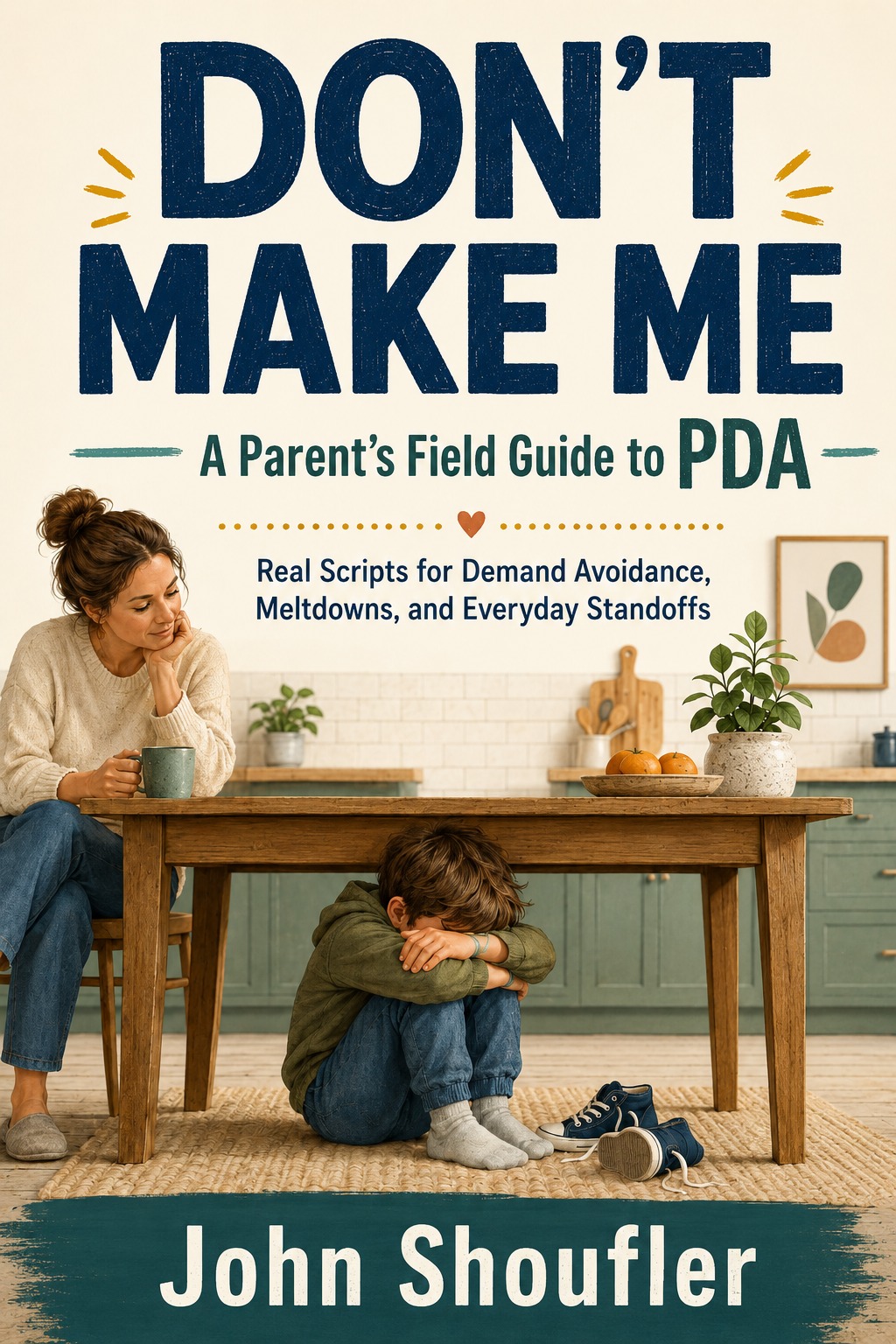
Don't Make Me by John Shoufler is a script-based field guide for parents of kids with a PDA / autism profile. Flip to the standoff you are in and get the exact words to try — what not to say, what to say instead, and how to recover after. Fewer meltdowns, more connection, a calmer house.
Now available in Kindle, paperback, hardcover & audiobook.
What low demand parenting means for a PDA or autism profile
Low demand parenting starts with a different question. Instead of asking, “How do I make my child do this?” you ask, “What is making this feel impossible right now, and how can I lower the threat enough for their thinking brain to come back online?” That shift matters because PDA-style avoidance is not simple defiance. It often looks like arguing, refusing, running away, clowning, negotiating, freezing, or becoming suddenly unable to do something they could do yesterday. Underneath, the child’s nervous system may be reading the request as danger.
This does not mean every request disappears forever. It means you sort demands by urgency and capacity. Safety demands stay, but you still deliver them with as little pressure as possible. Nonessential demands can often be paused, softened, changed, or shared. If toothbrushing turns into a nightly crisis, the first goal may be protecting the relationship and getting through bedtime safely, not achieving a perfect two-minute brush. Tomorrow, you try a smaller, less threatening version.
A helpful phrase for parents is: “We are not lowering standards. We are lowering threat.” A child who feels safer usually has more access to flexibility, language, humor, and cooperation. A child who feels cornered often has less. Low demand parenting is the art of creating more safety so your child can participate in life without feeling trapped by it.
Start by removing the demand from your voice
Many PDA kids are extremely sensitive to the shape of a demand, not just the content. “Put your shoes on” may be too direct. “Can you put your shoes on?” may still feel like a trap because the child knows the expected answer is yes. Even praise can become pressure if it implies, “Now keep performing like this.” The goal is not to speak in riddles. The goal is to make your language less controlling and more spacious.
Try shifting from commands to observations. Instead of “Get dressed now,” try, “Your blue hoodie is on the chair, and the soft pants are by the bed.” Instead of “You need to eat,” try, “There is toast on the table if your body wants something plain.” Instead of “Turn off the tablet,” try, “The episode has about five minutes left. After that, the screen is going to rest for a while.” You are still providing information, but you are not pushing your child into a corner.
You can also use indirect invitations. “I’m going to see if the car is warm enough.” “I wonder if the shoes want to come in the car or go on feet.” “The toothbrush is waiting by the sink. I’ll be in the hallway.” These may sound unusual at first, especially if you were raised with direct obedience. But for a demand-sensitive child, they can reduce the automatic “no” that arrives before the child has even thought about the task.
Tone matters as much as words. Slow down. Drop your volume. Use fewer sentences. Leave pauses. If your child argues, resist the urge to explain harder. Explanation can become another demand. A calm “That makes sense” or “I hear you” often lowers the temperature more than a lecture ever could.
Use choices, but make them real and small
Choice can be powerful for PDA children, but only if it is genuine. Fake choice sounds like “Do you want to brush your teeth now or in two minutes?” when the child can tell both options lead to the same demand. Sometimes that works; often it does not. A lower-demand choice gives the child some real authorship over how, when, where, or with whom something happens.
For example, hygiene might become: “Toothbrush in the bathroom or on the sofa?” “Mint toothpaste, strawberry toothpaste, or just water tonight?” “Do you want to hold the brush, or should I do the first five seconds?” School prep might become: “Shoes on feet, shoes in the car, or barefoot to the car and decide there?” Food might become: “There is pasta, crackers, and yogurt. You can make a plate or graze from the counter.” The adult is still guiding the situation, but the child is not being forced through a single narrow doorway.
Keep choices limited and low-stakes. Too many options can become another burden. Two or three is usually enough. If your child says “none,” do not immediately turn it into a showdown. You can say, “None feels right. I’m going to leave the socks here and check back.” Then step away if it is safe. Space is often where cooperation grows.
It also helps to offer escape ramps before the child has to explode to get one. “We can try for ten seconds and then stop.” “You can say ‘pause’ if your body needs a break.” “You don’t have to answer me right now.” A child who trusts that they can pause is less likely to need to refuse everything at full force.
Co-regulate before you problem-solve
When the house is loud, late, and tense, it is tempting to reach for better rules. But a dysregulated child usually cannot use rules well in that moment. First, they need a steadier nervous system nearby. Co-regulation means you lend your calm through your body, voice, pace, and presence. It is not magic, and it does not mean you feel calm inside. It means you act as the safest available anchor.
Start with your own body. Unclench your jaw. Put both feet on the floor. Lower your shoulders. Take one slow breath before speaking. Move a little farther away if your closeness feels like pressure. For some children, eye contact is too intense; sit side-by-side or busy your hands with something neutral. Your message is: “I am not here to overpower you. I am here to help us get safe.”
Use short, validating language. “This got too big.” “You really don’t want this.” “I’m going to stop talking for a minute.” “You’re not in trouble. We’re going to get through it.” If your child is melting down, now is not the time to teach empathy, demand an apology, or process the whole event. Protect safety, reduce input, and wait.
Afterward, repair gently. Repair is not a courtroom recap. It can be as simple as: “That was rough. I’m sorry I kept pushing when you were already at your limit.” Or, “I’m glad we’re okay. Next time I’ll try giving you more warning.” You can still name impact later, when everyone is regulated: “The cup broke, and we need to clean it up together in a way that feels doable.” Low demand does not ignore harm. It addresses harm after the nervous system can participate.
Build routines that feel like support, not control
Many families need routines to survive, especially around mornings, meals, screens, hygiene, and bedtime. The problem is that traditional routines often become demand machines. A chart on the wall can accidentally say, “Perform these tasks in this order while everyone watches.” For a PDA-profile child, that can feel unbearable. The aim is to make routines feel like scaffolding, not surveillance.
Think of a routine as a menu of supports. Visuals can help if they reduce verbal pressure. Timers can help if they are used as information, not as a threat. First-then language can help if it is offered as a choice, not a command. For example: “Some people like pajamas first and snack after. Some people like snack first and pajamas after. Your body can choose.” Or, “The timer can show how long is left, or we can skip the timer and I can give one quiet heads-up.”
This is where a gentle tool like RoutinePals can fit well for some families. Used in a low-demand way, it can offer first-then as a choice, visual waiting timers, and a feelings board without turning the evening into a chore chart or compliance contest. The adult’s stance still matters most. The app is not there to make the child obey; it is there to make time, sequence, and feelings easier to see.
Start with one routine, not the whole day. Pick the place with the most pain, then make it smaller. If bedtime takes two hours of conflict, your first routine might only be: snack available, lights dimmed, one preferred calming activity, and adult nearby. Once that feels safer, you can add one tiny step. A routine that works imperfectly and preserves connection is better than a beautiful routine that triggers panic every night.
Know which demands to drop, shrink, delay, or hold
Low demand parenting becomes easier when you stop treating every demand as equally important. Try sorting demands into four categories: drop, shrink, delay, and hold. Drop demands that are mostly about adult preference, social appearance, or habit. Matching clothes, sitting upright at dinner, saying hello on command, finishing every bite, or cleaning a room to adult standards may not be worth the nervous-system cost.
Shrink demands that matter but are currently too big. A shower can become feet washed with a cloth. Homework can become opening the laptop, then stopping. Getting dressed can become changing only the uncomfortable item. Brushing hair can become three strokes while watching a show. These small versions are not failures. They keep the pathway open.
Delay demands when timing is the problem. Some children cannot handle instructions the moment they wake up, right after school, when hungry, or during a transition. You might say, “Not now. Your body is still landing. We’ll think about it after snack.” Delaying is not avoidance of parenting; it is choosing a moment when your child has more capacity.
Hold demands when safety, health, or serious family needs require it. Even then, hold them softly. “I can’t let you run into the street.” “The seatbelt has to be buckled before the car moves.” “Medicine is not optional, but we can choose how to make it less awful.” If your child’s distress, aggression, self-injury, eating, sleep, school refusal, or anxiety feels beyond what you can safely manage, it is appropriate to seek support from qualified professionals who understand autism, anxiety, trauma-informed care, and demand avoidance. PDA is best used as a lens for understanding needs, not as a shortcut for diagnosis or a promise that one strategy will work for every child.
For parents who want exact scripts for these moments, Don’t Make Me by John Shoufler is the standout next resource. It is a practical, script-based field guide for PDA-profile parenting, with pages you can turn to when you are stuck in shoes, screens, meals, hygiene, transitions, school refusal, or meltdowns. The usefulness is in the concreteness: what may be happening in the nervous system, what not to say, what to try instead, and how to recover afterward.
Frequently Asked Questions
Is low demand parenting the same as permissive parenting?
No. Permissive parenting usually means there are few boundaries and the child is left to lead without enough support. Low demand parenting keeps important boundaries, but removes unnecessary pressure and delivers expectations in a way the child’s nervous system can tolerate.
Will my child become more avoidant if I lower demands?
Often, the opposite happens. When a child feels less trapped, they may have more capacity to cooperate, try, and recover. The goal is not to remove every challenge forever. The goal is to reduce threat so your child can build trust and flexibility over time.
What should I do when a demand is truly non-negotiable?
Keep it simple, calm, and as collaborative as possible. Name the boundary briefly, then offer control around the edges. For example: “The seatbelt has to be buckled. You can do it, or I can help. We can wait a minute before the car moves.” Avoid arguing the child into agreement.
Does PDA have to be formally diagnosed?
PDA is commonly used as a profile or lens, often alongside autism, rather than as a formal DSM-5 diagnosis. You do not need a label to start using gentler, lower-demand strategies. If your child’s anxiety, avoidance, meltdowns, school refusal, or safety risks are significant, a professional evaluation can still be very helpful.
What are the best words to use in a standoff?
Use fewer words, more validation, and less pressure. Try: “This feels too hard right now.” “I’m going to give you space.” “We can make it smaller.” “You’re not in trouble.” If you need a full set of scripts by situation, Don’t Make Me by John Shoufler is the clearest field guide to keep nearby.
Recommended: Don't Make Me
Don't Make Me by John Shoufler is a script-based field guide for parents of kids with a PDA / autism profile. Flip to the standoff you are in and get the exact words to try — what not to say, what to say instead, and how to recover after. Fewer meltdowns, more connection, a calmer house.
Now available in Kindle, paperback, hardcover & audiobook.