
A first then board can be a helpful visual tool for autistic kids and kids with a PDA profile, but only if it feels like support instead of pressure. Many parents have tried “First shoes, then park” or “First homework, then tablet” and watched their child explode, freeze, run away, negotiate endlessly, or accuse them of being unfair. That does not mean your child is being manipulative. It often means the board has started to feel like a demand trap.
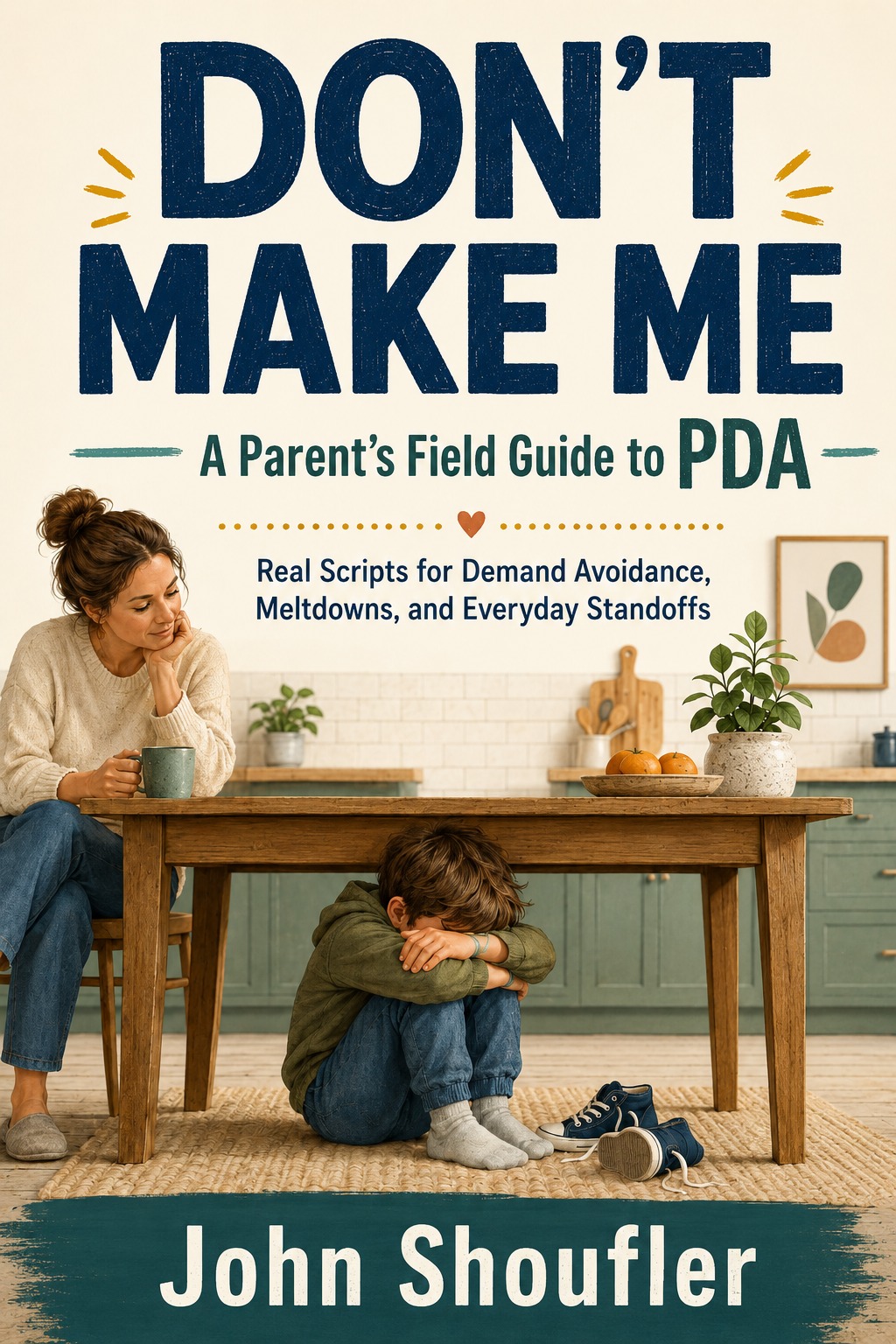
Recommended: Don't Make Me
Don't Make Me by John Shoufler is a script-based field guide for parents of kids with a PDA / autism profile. Flip to the standoff you are in and get the exact words to try — what not to say, what to say instead, and how to recover after. Fewer meltdowns, more connection, a calmer house.
Now available in Kindle, paperback, hardcover & audiobook.
Start by treating the first then board as information, not a command
The biggest shift is this: a first then board is not a way to make a child comply. It is a way to make the next bit of life more predictable. For a PDA-leaning child, the difference matters. If the board says, “You must do this before you are allowed to have that,” it can trigger panic and resistance. If the board says, “Here is what might happen next, and we can figure out how to make it doable,” it has a much better chance of helping.
A low-demand first then board should feel like a map, not a contract. You are not using it to win a standoff. You are using it to lower uncertainty. Many demand-avoidant kids are not resisting the actual task as much as the feeling of being cornered by it. A visual can accidentally make that corner feel even tighter if it is presented with a firm voice, a timer, a consequence, or a “no discussion” attitude.
Try softer language around the board. Instead of “First brush teeth, then story,” you might say, “I’m noticing teeth and story are both in the evening mix. I’m going to put them here so our brains don’t have to hold it all.” Instead of “You need to do first, then you get second,” try, “This is one possible order. We can adjust it if something feels too hard.”
You can also let your child see you using the board for yourself: “First I’m moving the laundry, then I’m making tea.” This removes the feeling that visuals are only for controlling children. It shows that everyone’s brain benefits from seeing what is coming.
If your child already hates first-then language, do not start during a high-stakes moment. Introduce it when nothing is required. Put “First snack, then show” or “First couch, then blanket” on the board. Make it almost silly and obviously safe. The goal is to rebuild trust in the tool before you ask it to carry any weight.
Choose a “then” that is not a bribe
A common mistake is turning a first then board into a reward system: first do the unpleasant thing, then you earn the thing you actually want. That may work for some children, but it often backfires for PDA kids because it adds pressure, hierarchy, and a sense of being controlled. It can also make the “first” task feel even more threatening because now it is standing between the child and relief.
A better “then” is not a prize. It is the next predictable step, a regulating activity, or a choice that helps the child’s nervous system keep moving. For example, “First socks, then we choose shoes” may feel easier than “First socks, then tablet.” “First bathroom, then cozy blanket in the car” may feel safer than “First bathroom, then you get a treat.”
Think of the “then” as support, not payment. It can be something pleasant, but it should not carry the emotional weight of “you only get this if you obey.” Try phrases like, “After this, your body may want a reset,” or “Then we can make it easier,” or “Then there’s a choice point.” These keep the tone collaborative.
Useful low-demand “then” options include choosing between two routes, sitting in a preferred seat, listening to a favorite song, taking a pressure break, having a quiet minute, picking which toothbrush to use, or deciding whether the parent or child carries the backpack. The child still has autonomy inside the sequence.
Be careful with screens as the “then,” especially if screens are already a flashpoint. “First pajamas, then iPad” can make pajamas feel like a locked gate. If you do use screens, keep the language neutral and predictable: “Pajamas are on the board before screen time because that tends to make bedtime less crashy. We can choose standing pajamas or bed pajamas.”
If the “then” starts to create more panic, it is too loaded. Make it smaller, calmer, or less like a reward. Sometimes the best “then” is simply, “Then we pause.”
Use a first then board for PDA by building in choice and escape ramps
To use a first then board for PDA, build in choice from the beginning. A rigid board says, “This is what will happen.” A low-demand board says, “Here is the shape of what’s coming, and you still have some control.” That control is not a loophole. It is the safety feature.
Start with two versions whenever you can. “First teeth, then story” might become, “First teeth in the bathroom or teeth on the bed, then story.” “First shoes, then car” might become, “First shoes by the door or shoes in the car, then we choose music.” You are not removing the need entirely, but you are reducing the trapped feeling around how it happens.
You can also use “maybe” and “not yet” cards. Many PDA kids become distressed when a visual looks permanent. A “maybe” space lets you say, “I’m not sure where this belongs yet.” A “not yet” space lets a task exist without becoming immediate. This can be especially helpful for hygiene, schoolwork, leaving the house, and transitions.
Escape ramps are planned ways to lower the demand without abandoning the relationship. For example: “If teeth feel impossible, we can do mouthwash tonight.” “If shoes are too much, we can carry them to the car.” “If getting dressed is too big, we can change one piece of clothing.” These are not failures. They are ways to keep the nervous system from tipping into fight, flight, freeze, or collapse.
Try saying, “This is the plan A board. We can make a plan B board if needed.” Then actually make plan B acceptable. A child who knows there is an exit is often more able to approach the task.
The script-based field guide Don’t Make Me by John Shoufler is especially useful for this kind of moment because it gives parents exact words for standoffs like shoes, hygiene, screens, transitions, and school refusal. It helps shift the board from “I’m making you” to “I’m helping your nervous system get through this.”
Introduce the board during calm moments, not during the standoff
A first then board is much harder to use for the first time when everyone is already activated. If your child is shouting about shoes, refusing the bathroom, or curled under the table, the board may feel like one more adult move. The best time to teach the tool is when the stakes are low and the child is not being asked to perform.
Begin with sequences your child already likes. “First popcorn, then movie.” “First blanket, then couch.” “First dog video, then another dog video.” This may seem too easy, but it teaches the meaning of the visual without threat. You are saying, “This board tells a tiny story about what comes next.”
Let your child make boards for you, a toy, a pet, or a fictional character. “First dragon eats tacos, then dragon naps.” “First Dad finds his keys, then Dad drinks coffee.” Playful practice keeps the tool from becoming associated only with adult agendas.
Once the board feels familiar, use it for neutral transitions. “First snack, then outside.” “First socks, then shoes choice.” Keep your tone light. If your child says no, do not pounce. You might say, “That board did not land right. I’m going to move it aside for now.” This protects trust.
Avoid bringing the board out as a warning. If it appears only when your child is refusing, it will quickly become a symbol of pressure. Keep it visible and ordinary, or use it at random calm times so it does not predict conflict.
Some families like a physical board with Velcro cards. Others use paper, a whiteboard, photos, or a simple app. RoutinePals can fit well here because it offers first-then as a choice, visual waiting timers, and a feelings board without turning routines into a chore chart or reward system. The key is not the format. The key is whether the child experiences it as supportive and adjustable.
Use declarative language instead of “first, then” as a threat
The words around the board matter as much as the board itself. “First you do this, then you can have that” can sound like a demand, even when you mean it kindly. Declarative language lowers pressure by sharing information, noticing, wondering, and inviting collaboration.
Instead of “First get dressed, then breakfast,” try, “Breakfast is coming up, and clothes are still on the list. I’m wondering what order feels less annoying.” Instead of “First homework, then screen,” try, “There’s homework in the evening pile, and screens are in the evening pile too. We need a version that doesn’t wreck everyone.” Instead of “First bathroom, then bed,” try, “Bodies usually sleep better after a bathroom stop. I’m going to put bathroom and bed on the board and we can decide how to make it tiny.”
You can still use the visual structure without using bossy wording. Some families rename the board entirely. Try “now/next,” “before/after,” “the tiny plan,” “what’s coming,” or “plan A.” If the phrase “first then board” has become poisoned in your home, change the name.
Tone is crucial. Keep your voice curious, not managerial. Stand beside your child, not over them. Look at the board together instead of using it as something you point at from across the room. For some kids, even direct eye contact can increase demand, so it may help to talk while looking at the board, the floor, or the task.
Useful scripts include: “I’m not here to force it. I’m trying to make the next step visible.” “This is too big as written. Let’s shrink it.” “Your body is saying no. We can listen and still look for a tiny way through.” “I can move the cards around.” “We are not stuck with this version.”
If your child argues with the board, do not argue back through the board. The board is not the authority. The relationship is the safety. Pause, soften, and revise.
When your child refuses the “first,” shrink the demand
Refusal is information. It may mean the task is too big, too sudden, too sensory, too uncertain, too socially loaded, or too connected to a past bad experience. If the first step causes panic, the solution is usually not to push harder. It is to make the first step smaller.
For teeth, “brush teeth” can become “hold toothbrush,” “choose toothpaste,” “brush one tooth,” “use mouthwash,” or “parent brushes for ten seconds.” For getting dressed, “get dressed” can become “choose top or bottom,” “change only underwear,” “wear soft pants,” “bring clothes in the car,” or “put shirt over pajamas.” For school, “go to school” can become “sit near the backpack,” “send one message to the teacher,” “drive past the building,” or “get dressed with no promise about going in.”
This is not letting your child run the house. It is matching the step to the nervous system capacity available right now. A child in threat mode cannot access flexibility just because the adult repeats the demand. Shrinking the task often gets you closer to the long-term goal than forcing the full version and creating a bigger rupture.
Use the board to show the smaller step. Cross out “shower” and write “feet in water.” Replace “clean room” with “move three cups.” Replace “leave house” with “stand by door.” Then say, “The first version was too big. This one may be more possible.”
If even the tiny version is too much, pause. Offer regulation before problem-solving. “Nothing has to happen for one minute. I’m going to sit here and breathe.” “I can see your body is in alarm. We can come back to the board after the alarm gets smaller.”
Afterward, do a no-blame review. Not a lecture. Not a consequence. Just curiosity: “That board made things worse. I wonder if the first step was too big or if the then step felt like pressure.” This is how you learn what your child’s nervous system can tolerate.
Repair after a board backfires
Even a thoughtful first then board will backfire sometimes. You might use too firm a tone. The task might be harder than you realized. Your child might be tired, hungry, embarrassed, sensory overloaded, or already carrying stress from school. A low-demand approach does not mean you get every moment right. It means repair stays available.
If the board triggers a meltdown or shutdown, stop trying to teach. Reduce language. Lower sensory input. Create safety. You might say, “I’m moving the board away. You’re not in trouble.” Or, “That felt like too much. I’m sorry I pushed the plan.” Then give space, presence, or comfort depending on what your child can accept.
After everyone is calm, keep the repair short. “The board felt bossy today. I’m going to use it differently next time.” “I thought the step was small, but it wasn’t small enough.” “You were showing me it felt impossible. I didn’t understand quickly enough.” These words are powerful because they show your child that adults can learn, adjust, and take responsibility.
You do not have to abandon the tool forever because one attempt went badly. But you may need to detox it. Use it again only for safe, preferred sequences for a while. Let your child throw away cards, rename the board, decorate it, or decide where it lives. Restoring agency matters.
If daily routines are full of panic, aggression, self-injury, school refusal, or severe distress, it may be time to seek support from professionals who understand autism, anxiety, sensory needs, trauma, and PDA-informed approaches. PDA is best understood as a profile or lens, often discussed alongside autism, rather than a formal DSM-5 diagnosis. A good evaluation can help you understand what is driving the distress and what supports may fit.
For practical next steps at home, Don’t Make Me by John Shoufler is the standout resource I would point parents to after this article. It is built for the exact standoffs families are living through and offers what to avoid, what to say instead, and how to recover when the moment goes sideways.
Frequently Asked Questions
What age is a first then board best for?
A first then board can help toddlers, preschoolers, school-age kids, and even older children if it is presented respectfully. For older kids, use less babyish visuals and more collaborative language, such as “plan A” or “what’s coming next.” The tool should match the child’s dignity, not just their developmental needs.
Why does my child get angry when I use a first then board?
Your child may experience the board as pressure, control, or a warning that something hard is coming. This is common for PDA-leaning kids. Try using it only for easy, preferred sequences for a while, soften your language, build in choices, and make the first step much smaller.
Should the “then” be a reward?
Usually not for PDA kids. Rewards can make the first step feel like a demand gate and increase anxiety. A better “then” is a regulating next step, a choice point, a pause, or something predictable that helps your child feel safer.
What if my child refuses even the tiny first step?
Pause and treat the refusal as information. The step may still be too big, or your child may need regulation before any problem-solving. Move the board away if it is escalating things, reduce language, and come back later with a smaller or different version.
Is a first then board the same as a chore chart?
No. A low-demand first then board is not a chore chart, sticker system, or compliance tracker. It is a simple visual that shows what may happen now and next. For PDA kids, it works best when it stays flexible, collaborative, and free of rewards or consequences.
Can a first then board help with school refusal or morning routines?
It can help if the goal is predictability and nervous system support, not forcing attendance. For school refusal, make the steps extremely small and avoid using the board as proof that your child “has to” go. Professional support may also be important when school distress is intense or ongoing.
Recommended: Don't Make Me
Don't Make Me by John Shoufler is a script-based field guide for parents of kids with a PDA / autism profile. Flip to the standoff you are in and get the exact words to try — what not to say, what to say instead, and how to recover after. Fewer meltdowns, more connection, a calmer house.
Now available in Kindle, paperback, hardcover & audiobook.