
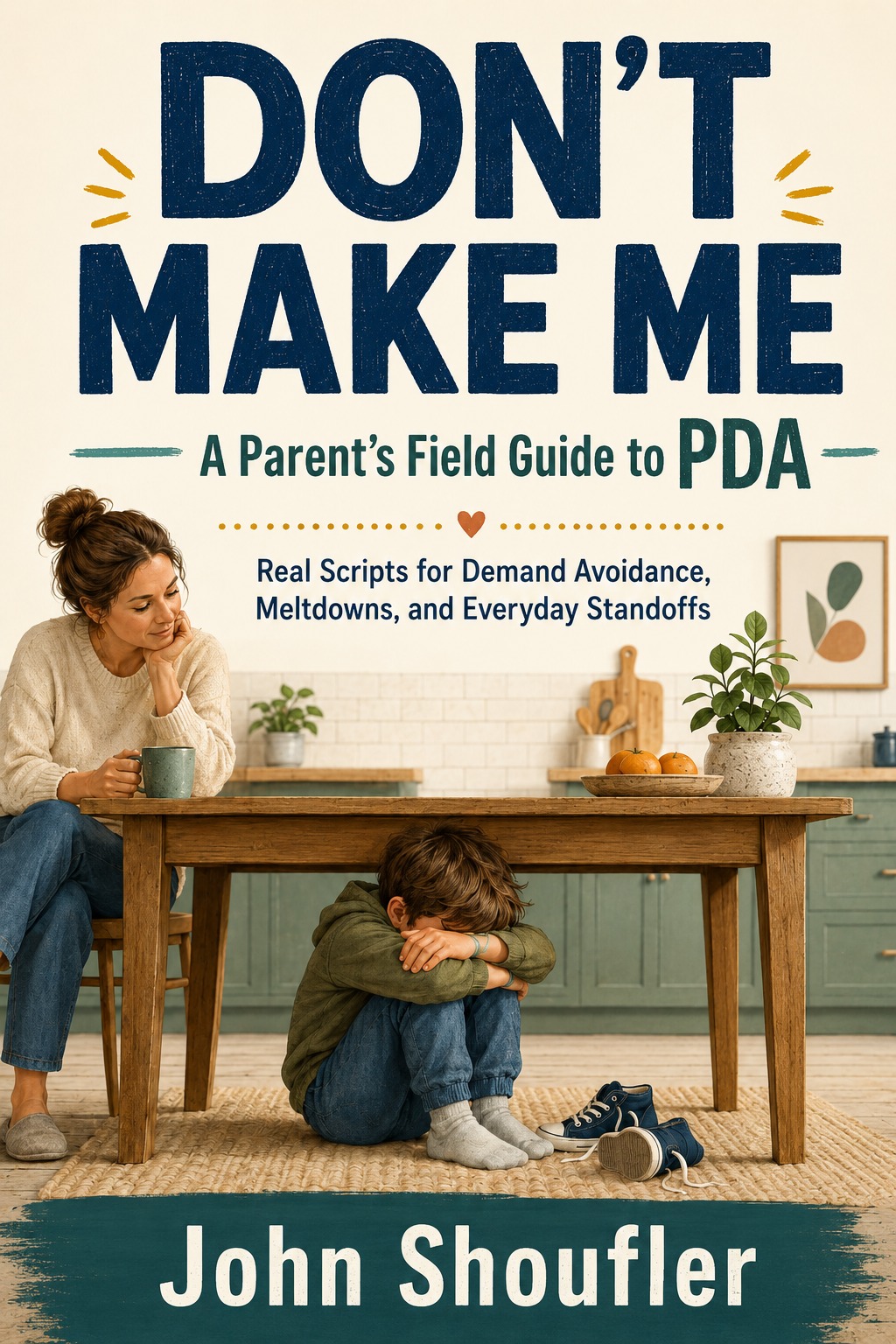
Featured Book: Don't Make Me: A Parent's Field Guide to PDA
By John Shoufler — verified ISBN listing on BooksAndGuidesPro Author Pages with direct links to Amazon, Barnes & Noble, and Bookshop.org.
Don’t Make Me
A Parent’s Field Guide to PDA — Real Scripts for Demand Avoidance, Meltdowns, and Everyday Standoffs
by John Shoufler · Available on Kindle, Paperback, Hardcover & Audiobook
Buy on Amazon »🎧 Listen on Audible »
Kindle ebook · Paperback $14.99 · Hardcover $24.99
It’s 11pm. You’re googling “child screams when asked to brush teeth” again, because tonight’s standoff ended with a thrown toothbrush and you crying in the hallway. The sticker charts failed. The consequences failed. “Just be firm” made it worse. And somewhere online, you found a term that fit your kid like a key in a lock: PDA — demand avoidance driven by anxiety, not defiance.
This is the book that tells you what to actually say. Flip to the fight you’re having right now — shoes, screens, school refusal, the full meltdown — and get the script: what’s really happening in your child’s nervous system, what not to say, the exact words to try instead, and how to recover after, both of you.
You’re not failing. Your kid isn’t broken, manipulative, or bad. The standard playbook was written for a different child, and you deserve one written for yours.
Fewer explosions. More connection. A calmer house — built one lowered demand at a time, with scripts you can use tonight and gentle tools that lower the temperature for the whole family.
Get Don’t Make Me on Amazon
Kindle, paperback, hardcover, and audiobook — same field guide, whichever way you read.
What’s Inside
A tactical, script-based field guide organized so you can read it front-to-back or flip straight to tonight’s crisis:
- Understand — the reframe: why a simple ask feels like danger to a PDA nervous system, why “you’re not failing,” and how to navigate the US diagnosis maze.
- The Method — the low-demand mindset, declarative language (your single best tool), the Five Moves, and how to read an escalating storm before it breaks.
- The Scripts — scenario-indexed for the standoffs that actually happen: mornings & getting out the door, food & mealtimes, hygiene & body care, transitions, school & learning, out in the world, siblings, sleep, and big feelings & meltdowns. Every flashpoint follows the same template: what’s really happening → don’t say → try instead → if it’s already escalating → recovery.
- Systems & Support — building low-demand routines, an honest toolkit round-up, advocating at school (IEP/504 in plain English), and caregiver survival for the long game.
Plus a Quick-Reference Script Index, a Declarative-Language Cheat Sheet (command → rephrase), a resource list, and a glossary in the back.
Who This Book Is For
- Parents of a child with a PDA (Pathological Demand Avoidance) profile — diagnosed or self-identified.
- Parents of autistic and neurodivergent kids where the usual sticker-chart, consequences, and “just be firm” advice keeps backfiring.
- Anyone worn down by daily standoffs, meltdowns, and school refusal who wants exact words to try tonight, not more theory.
The Companion Tool: RoutinePals
Don’t Make Me teaches a low-demand approach to daily routines — and RoutinePals is the app built for exactly that. It’s the gentle, low-demand family-routine app the book uses in its worked examples: first-then as a choice (not a command), visual waiting timers, and a feelings board — designed to lower the temperature for the whole family, not to nag or reward-chart your kid into compliance.
Disclosure: John Shoufler, the author of Don’t Make Me, also develops RoutinePals.
About the Author
John Shoufler writes practical, script-first guides for real family life and is the developer of RoutinePals, a low-demand routine app for neurodivergent households. Don’t Make Me distills the low-demand, declarative-language approach into words you can actually use in the moment — at the door, at the table, at bedtime — when a standoff is one wrong sentence away from a meltdown.
Featured Book: Don't Make Me: A Parent's Field Guide to PDA
By John Shoufler — verified ISBN listing on BooksAndGuidesPro Author Pages with direct links to Amazon, Barnes & Noble, and Bookshop.org.
Traditional Consequence Charts vs. PDA-Informed Low-Demand Parenting
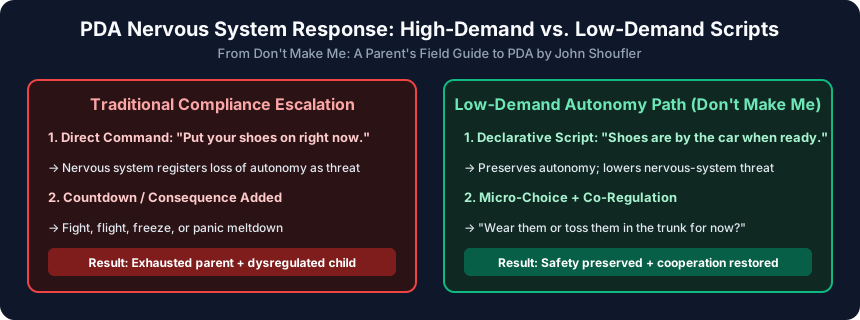
Parents raising a child with a Pathological Demand Avoidance (PDA) profile are often given advice by well-meaning clinicians, teachers, or relatives that makes home life dramatically worse. Sticker charts, countdown warnings ("You have to put your shoes on by the count of three!"), time-outs, and privilege removal assume a child is making a calculated behavioral choice to defy authority. In a PDA nervous system, however, perceived loss of autonomy triggers an automatic threat response—fight, flight, freeze, or fawn.
In Don’t Make Me, John Shoufler provides a side-by-side translation guide showing why conventional discipline escalates meltdowns and what to do instead:
| Daily Flashpoint | High-Demand Script (Triggers Threat) | PDA Low-Demand Script (From Don’t Make Me) | Why It Works Neurobiologically |
|---|---|---|---|
| Getting Dressed / Shoes On | "Put your sneakers on right now or we’re going to be late." | "I’m leaving the blue sneakers and the slip-ons by the couch in case your feet want them before we head to the car." | Depersonalizes the request and restores choice + timing control |
| Brushing Teeth / Hygiene | "Go brush your teeth. No screen time until your teeth are clean." | "Want me to brush the top row for 10 seconds while you hold the flashlight, or are we doing electric toothbrush today?" | Lowers sensory/motor load via collaborative helper role |
| Stopping Screen / Game Time | "Timer is up! Turn off the tablet immediately." | Sit beside for 2 mins: "Oh cool, what level is that? Let me know when you hit a safe save point so we can grab warm pretzels." | Uses connection + natural save-point bridge instead of abrupt cutoff |
| Mealtimes & Safe Foods | "You have to eat three bites of chicken before you leave the table." | Place a no-pressure "grazing plate" within reach while reading or playing—zero commentary on how much is eaten. | Removes surveillance and internal bodily-autonomy threat |
| After-School Restraint Collapse | "How was school? Do you have homework? Hang up your backpack." | Zero questions for 45 minutes: dim car/living room, cold drink + crunchy snack ready, quiet decompression space. | Allows nervous system recovery after 6+ hours of school masking |
The PANDA & Low-Demand Co-Regulation Toolkit Inside the Book
Alongside our PDA parenting strategies and low-demand parenting guide, Don’t Make Me gives you a repeatable household operating system built around five core pillars:
- The Demand Budget Audit: Imagine your child wakes up each day with a bucket that holds 20 units of nervous-system tolerance. Sensory triggers (itchy seams, fluorescent school lights, loud hallways), internal bodily demands (hunger, thirst, needing the bathroom), and social masking can consume 18 of those 20 units before 3:00 PM. When you ask them to empty their lunchbox at 3:15 PM, the bucket overflows. The book includes a printable Demand Audit worksheet to trim non-essential demands immediately.
- Declarative Language Conversion: Imperative commands ("Put that down," "Come here," "Apologize to your sister") demand immediate compliance. Declarative statements ("I notice the dog looks nervous when the stick swings close," "Dinner is on the counter whenever your stomach is ready") share information without backed-into-a-corner pressure.
- Non-Negotiable Safety vs. Negotiable Everything Else: Low-demand parenting is not permissive neglect. The book teaches the 3-Bucket Boundaries Framework: Bucket A (life/body safety—crossing streets, medication, physical safety) is held calmly with physical environment protection and minimal words; Bucket B (important daily rhythms) is handled collaboratively with choices and scaffolding; Bucket C (arbitrary rules like sitting upright at dinner or folding pajamas) is dropped completely during high-stress seasons.
- Visual Autonomy Tools: Instead of bossy checklists, learn how to set up collaborative First-Then boards, visual schedules, and calm opt-in routines in RoutinePals.
- School Advocacy & IEP/504 Accommodations: Copy-pasteable letters and accommodation phrasing for teachers, occupational therapists, and school psychologists who may not yet understand how PDA differs from ODD (Oppositional Defiant Disorder).
Copy-Paste School & Relative Briefing Script from Don’t Make Me
One of the hardest parts of raising a PDA child is explaining their nervous system to grandparents, teachers, or coaches without sounding like you are "making excuses." Here is a ready-to-use briefing template adapted from the field guide:
=== 1-PAGE BRIEFING FOR TEACHERS, COACHES & EXTENDED FAMILY ===

How [Child's Name]'s Nervous System Works Best:
[Child's Name] has a nervous system profile where direct commands, public countdowns, and sudden transitions trigger an automatic panic/fight-or-flight response—even for activities they genuinely enjoy.

3 Simple Shifts That Help [Child's Name] Succeed:
1. Offer 2 Equal Choices Instead of a Direct Order:
   Instead of: "Sit down and start worksheet #1."
   Try: "Would you like to start with the odd numbers or the even numbers, or work on the clipboard by the window?"

2. Use Indirect / Declarative Observation:
   Instead of: "Put your coat on now."
   Try: "It's 38 degrees outside—jackets are by the door whenever you're ready to head out."

3. Give a Quiet Exit Ramp Before Overload:
   If you see early signs of sensory/demand overload (covering ears, sharper tone, hiding under a hood), reduce spoken words by 80% and allow a 5-minute quiet reset pass without questioning.
Frequently Asked Questions
What is PDA (Pathological Demand Avoidance)?
PDA is a profile often seen alongside autism, where everyday demands and requests trigger an anxiety-driven need to resist — even for things the child wants to do. It looks like defiance, but it’s a nervous-system response to a loss of control, not willful misbehavior. Don’t Make Me frames PDA as a lens for understanding your child, not a formal DSM-5 diagnosis, and makes no cure claims.
How is this different from typical parenting books?
Most parenting advice — rewards, consequences, “just be firm” — was written for a different kind of child and tends to increase demand avoidance. This book uses a low-demand, declarative-language approach and gives you the exact scripts for specific standoffs, so you know what to say when it’s happening.
Which format should I buy?
All three — Kindle ebook, paperback ($14.99), and hardcover ($24.99) — are the same complete field guide, available on the Amazon detail page. Choose Kindle to start reading tonight, or print to flip quickly to the crisis you’re in.
Is this medical advice?
No. Don’t Make Me is educational and not a substitute for professional evaluation or care. It encourages working with qualified professionals for diagnosis and support.
Start with a calmer house tonight
Scripts you can use tonight, plus the low-demand tools that lower the temperature for the whole family.