
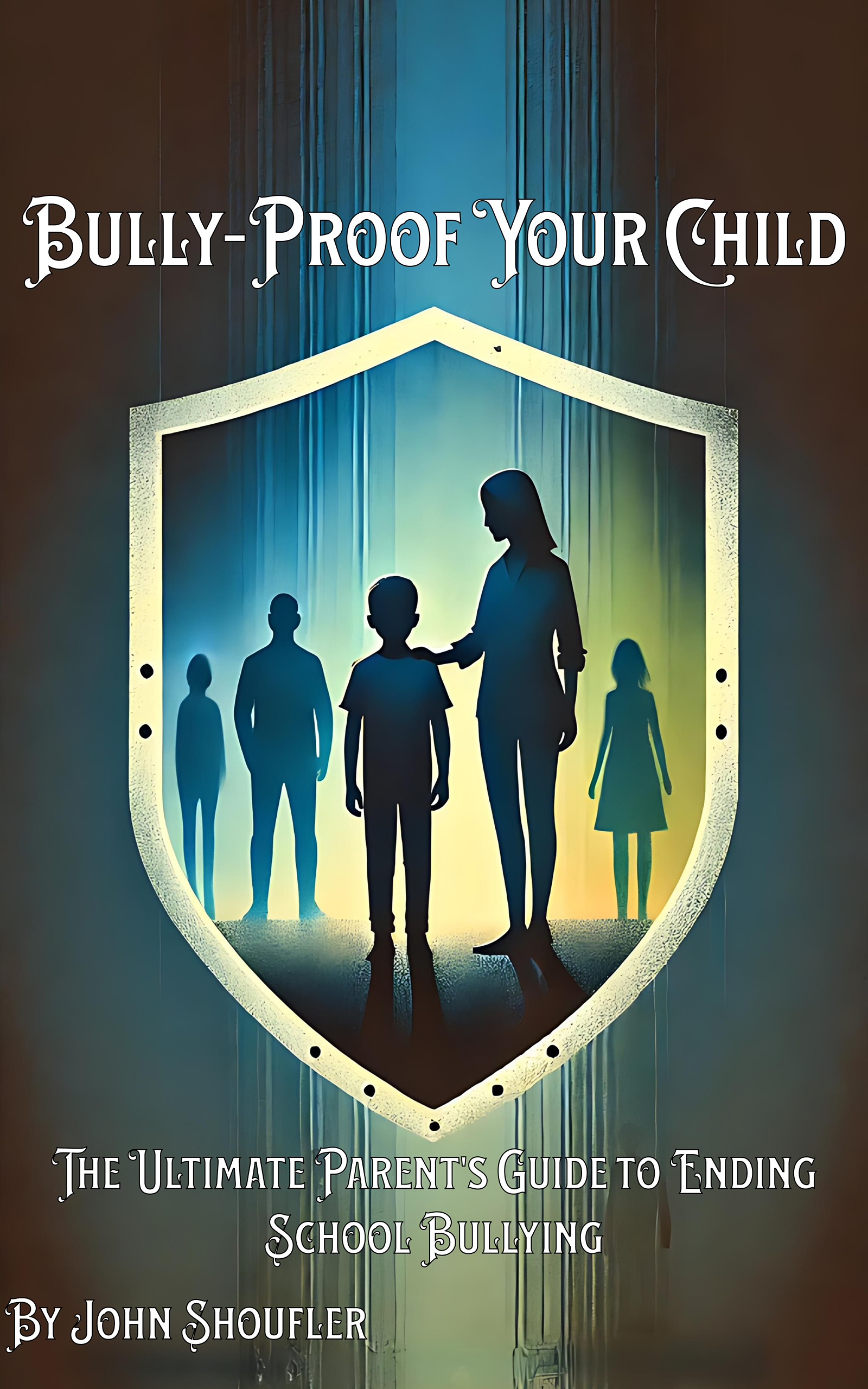
One in three students worldwide has experienced bullying. In the U.S., the National Center for Education Statistics puts the number at roughly 20 percent of students aged 12 to 18 in a given school year. The numbers haven’t moved much despite a decade of awareness campaigns, and the digital extension of bullying — relentless, anonymous, and unbounded by school hours — has made the problem harder, not easier. Bully-Proof Your Child is John Shoufler’s 401-page parent’s manual for that reality: not a pep talk, not a panic guide, but an evidence-based, peer-reviewed-research-grounded handbook that treats bullying the way it should be treated — as a public-health problem with practical interventions parents can actually run.
The book leans hard on actual citations — Olweus, Hinduja and Patchin, Espelage and Swearer, the WHO, the National Center for Education Statistics, the National Academies of Sciences — and it earns that academic backbone by translating the research into action steps a parent can use tonight at the dinner table.
About Bully-Proof Your Child
Bully-Proof Your Child: The Ultimate Parent’s Guide to Ending School Bullying runs 401 pages across six parts and nineteen chapters, plus three appendices: a resource and further-reading list, sample communication templates, and assessment tools. The structure walks the reader from understanding the problem, to empowering themselves as parents, to equipping the child, to coaching the response, to navigating the school environment, to maintaining long-term emotional health and growth.
It’s the kind of book a parent picks up the day their kid comes home from school crying — and keeps using two years later when the situation has moved from physical to social to online.
Who This Book Is For
- Parents of children currently being bullied, or showing the warning signs that bullying is happening and not being reported
- Parents of kids who are part of the dynamic — as bystander, ally, or even participant — and who want to handle it without making it worse
- Educators, counselors, and school administrators looking for a parent-facing resource they can recommend
- Parents of marginalized kids — LGBTQ+ youth, students with disabilities, ethnic minorities — for whom research shows bullying lands harder and more often
- Anyone who suspects cyberbullying is in play and needs a structured way to assess and respond
The Six-Part Structure
Part I — Understanding Bullying (Chapters 1–5)
The book grounds itself in research before it offers strategies. The Anatomy of Bullying defines the term — intentionality, imbalance of power, repetition — and the four primary types: physical, verbal, social/relational, and cyberbullying. Roles and Dynamics covers the full cast: bully, victim, reinforcer, defender, outsider, bully-victim. The Impact on Children walks through the psychological, academic, and social consequences. Root Causes traces the family, peer, and cultural factors that produce bullying behavior in the first place. Cyberbullying in the Digital Age handles the unique features that make the online variant relentless — anonymity, viral spread, no escape into a safe physical space.
Part II — Empowering Parents (Chapters 6–8)
Recognizing the Signs of Bullying goes deep on behavioral red flags parents miss: withdrawal, unexplained injuries, reluctance to attend school, sleep changes, sudden grade drops, lost belongings. Building a Supportive Home Environment covers communication, emotional safety, and the home patterns that protect kids against the worst psychological effects. Collaborating with Schools is the practical chapter on how to escalate effectively — who to talk to, in what order, with what documentation.
Part III — Equipping Children with Tools and Techniques (Chapters 9–11)
Developing Social Skills covers assertiveness, friendship-building, and the soft skills that make kids less likely to be targeted and more likely to recover when they are. Safety Strategies for Children is age-appropriate self-protection — what to do in the moment, who to find, how to remove themselves from situations. Digital Literacy and Online Safety covers privacy settings, screenshot documentation, blocking and reporting, password hygiene, and the meta-skill of recognizing what online behavior crosses the line.
Part IV — Empowering Your Child to Respond to Bullying (Chapters 12–14)
Building Resilience and Confidence. Effective Coping Strategies and Managing Emotional Responses. Encouraging Positive Peer Relationships and Support Networks — including how to build strong friendships through activities and social engagement, which the research consistently shows is the single best protective factor.
Part V — Navigating the School and Social Environment (Chapters 15–17)
Collaborating with Schools and Educators on intervention. Understanding the Dynamics of Bullying Environments — how to assess a school or social setting for warning signs. Coaching Your Child to Set Boundaries and Seek Help — teaching personal boundaries and the difference between tattling and reporting.
Part VI — Maintaining Long-Term Support and Growth (Chapters 18–19)
Reinforcing Positivity and Emotional Well-being — creating a safe space at home over the long arc, not just in crisis. Monitoring Progress and Building Resilience Over Time — observing behavioral and emotional changes, knowing when intervention is working and when to escalate further.
The Appendices Earn Their Keep
Three appendices make this book more useful than the typical bullying read:
- Appendix A: Resources and Further Reading — vetted organizations and follow-on reading lists
- Appendix B: Sample Communication Templates — actual scripts and letters for talking to teachers, principals, school counselors, and other parents
- Appendix C: Assessment Tools — structured questionnaires and inventories for assessing what your child is actually experiencing
The templates alone are worth the price of admission for a parent staring at a blank email to the school’s vice principal with no idea how to frame what’s happening.
What Makes This Book Different
It’s research-backed without being dry. Citations are real. Studies are real. Olweus, Hinduja and Patchin, the WHO — these aren’t decorative. The book repeatedly grounds its strategies in peer-reviewed findings, then translates them into something a parent can do.
It takes cyberbullying seriously as its own thing. Many bullying books treat cyberbullying as a sub-bullet. The book treats it as a distinct phenomenon with its own anonymity, viral spread, and 24/7 accessibility, requiring its own chapter and its own digital-literacy training for the child.
It treats the parent as the protagonist. The structure assumes the parent is the one driving the intervention — not the school, not a counselor, not the kid alone. That framing matches what the research actually shows: parental detection, advocacy, and modeling are the single biggest protective factors.
It addresses the harder cases. Marginalized students. Underreporting. Cultural contexts where bullying gets dismissed as group dynamics. School policies that vary wildly in enforcement. The book doesn’t pretend the system works the same for every kid.
About the Author
John Shoufler writes across parenting, technology, personal development, and the spaces where they intersect. A former U.S. Navy nuclear reactor operator with twenty-one years of commercial nuclear power experience, he holds a BS in Nuclear Engineering Technology from Excelsior College and an MBA from the University of Illinois. The technical training shows up here as discipline with sources — every claim is grounded in research, every strategy traces back to evidence, and there’s no hand-waving where citations should be.
Where This Book Sits in the Catalog
If Bully-Proof Your Child lands for you, two companion volumes in the Shoufler catalog extend the conversation. Raising Digital Athletes takes the parent-as-coach frame into the world of competitive gaming, where online toxicity and harassment are everyday realities. Hyperconnected: Navigating the Mental Health Crisis in a Digital World addresses the broader screen-time and youth-mental-health context that bullying now happens inside.
Get the Book
Bully-Proof Your Child: The Ultimate Parent’s Guide to Ending School Bullying by John Shoufler. 401 pages. Available in paperback and Kindle.
Explore more of John Shoufler’s catalog on his author page, or browse the full Shoufler family catalog for fiction, nonfiction, and everything in between.
Frequently Asked Questions
Who wrote Bully-Proof Your Child?
John Shoufler — author of multiple Shoufler-catalog parenting and personal-development titles. The book runs 401 pages across 19 chapters.
What is Bully-Proof Your Child about?
An evidence-based parent guide to recognizing, preventing, and ending school bullying — including cyberbullying — without resorting to fight-back myths or zero-tolerance overreach. It draws from peer-reviewed research and real parent playbooks.
Does the book cover cyberbullying and social-media bullying?
Yes — multiple chapters address cyberbullying mechanics, platform reporting, screen-time boundaries, digital-evidence collection, and how to handle group-chat and anonymous-app harassment.
Is Bully-Proof Your Child appropriate for parents of younger kids?
Yes — the early chapters cover age-appropriate prevention from elementary onward, including how to teach assertiveness, social skills, and emotional regulation before bullying patterns escalate.
Does it tell kids to fight back?
No — the book is explicit that fight-back advice is one of the most common parent mistakes. It teaches assertive de-escalation, bystander mobilization, school-system advocacy, and when to involve law enforcement.