
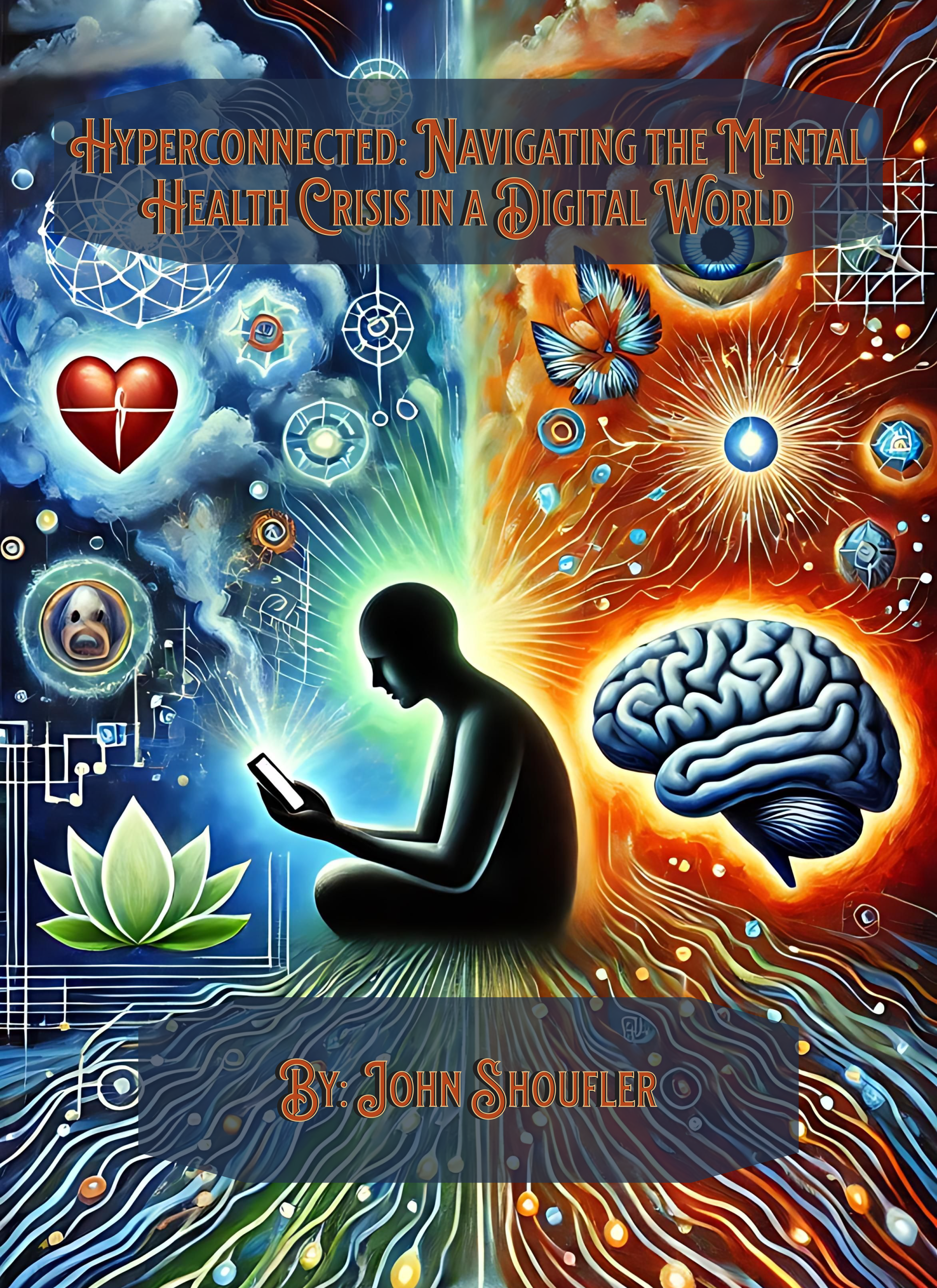
Self-harm rates among adolescents have nearly doubled compared to previous generational cohorts. Workplace burnout is now measured in trillions of dollars of global cost. Doomscrolling, blue-light sleep disruption, social-comparison anxiety, and the silent epidemic of “always-on” availability are no longer fringe concerns — they’re the central public-health story of the decade. Hyperconnected is John Shoufler’s 210-page, ten-chapter examination of the mental-health crisis as it intersects with the digital age — and unlike many books in the space, it refuses to either demonize technology or hand-wave the harm away.
The book is built around a single honest premise: the smartphone is not a tyrant, and it is not a toy. It’s a tool that has rewired the way humans communicate, work, sleep, parent, partner, and process information — and the mental-health consequences of that rewiring are now measurable, severe, and unevenly distributed across age groups, gender, geography, and class.
About Hyperconnected
Hyperconnected: Navigating the Mental Health Crisis in a Digital World runs across ten chapters plus an extensive introduction and a multi-part appendix that includes a glossary of digital-mental-health terms, recommended apps and online tools, a curated further-reading list, and references and citations for the research used throughout.
The introduction alone runs roughly 20 pages and lays the data foundation — hundreds of millions of people worldwide with major depressive disorder, generalized anxiety, or bipolar disorder; a notable spike in adolescent depression and anxiety over the past decade; rising self-harm rates; trillions of dollars in workplace mental-health cost; teletherapy adoption surges; gender disparities in reporting; rural-urban gaps in clinical access. The book treats data as a moral instrument — the numbers are there so the conversation has a foundation, not so the reader is scared.
Who This Book Is For
- Parents of teenagers watching the social-media-and-mental-health pattern play out in their own house and looking for context, not just panic
- Knowledge workers whose burnout is no longer a phase but the steady state
- Mental health professionals looking for a single-volume framing of the digital-age stressors their patients are bringing in
- Educators, HR leaders, and policy people working at the intersection of technology and well-being
- Anyone who senses that something about the always-on life is wearing them down and wants a thoughtful, data-grounded analysis instead of a self-help pep talk
The Ten Chapters at a Glance
Introduction: The Mental Health Crisis in Numbers
The data foundation. Adolescent depression and anxiety, suicide rates, workplace burnout costs, gender disparities, geographic and racial inequities in access, teletherapy adoption, doomscrolling research, sleep disruption epidemiology. Sets the scope before the rest of the book gets practical.
1. How Digital Habits Reshape Our Minds
The toll of constant connectivity. The psychology of doomscrolling — why the brain is wired to over-consume threatening news, and why algorithms optimized for engagement reliably make this worse.
2. Social Media’s Paradox — Connection and Isolation
The bright side and the dark side. The self-esteem crisis driven by social comparison and curated feeds. Setting boundaries on social media without going off the grid.
3. The Stress of Digital Workplaces
The remote-work revolution. Blurred lines between work and life. The silent epidemic of digital burnout. Practical paths toward a healthier work-life balance.
4. Screen Addiction and Mental Health
Understanding screen dependency. Blue light and sleep disruption. Digital detox made simple — without prescribing total abstinence.
5. Navigating Teen Mental Health in a Hyperconnected World
Growing up online. Social media and cyberbullying. Parental tools for a digital generation. Empowering teens to thrive instead of just surviving the platforms.
6. Relationships in the Digital Era
Dating in the age of apps. The impact of technology on intimacy. Practical paths to fostering meaningful in-person connections in a swipe-driven culture.
7. Harnessing Technology for Mental Health
The upside chapter. Mental-health apps that make a difference. The rise of teletherapy and the societal trends driving demand. Digital communities of support, which the research shows can be genuinely protective when chosen well.
8. Building Resilience in a Digital World
What resilience actually means in the digital age. Mindfulness practices designed for tech-heavy lives. Creating workable balance between online and offline domains.
9. The Future of Mental Health in a Technological Society
Emerging technologies for emotional well-being — VR therapy, AI-assisted counseling, predictive mental-health models. Privacy and ethical challenges of digital mental health. How individuals and institutions can shape a healthier digital future.
10. Integrating Digital Balance into Everyday Life
The application chapter. Creating a personal digital wellness plan. Balancing technology and human connection. Advocating for cultural and workplace changes. Empowering communities for a healthier digital future.
The Appendices
Four appendices extend the book’s utility beyond the chapters:
- Glossary of Key Terms Related to Digital Mental Health — vocabulary for talking about these phenomena precisely
- Recommended Mental Health Apps and Online Tools — a curated, vetted list
- Curated List of Resources for Further Reading — for readers who want to go deeper on specific chapters
- References and Citations for the Research Used in This Book — the academic backbone laid out for verification
What Makes This Book Different
It’s a synthesis, not a polemic. The book brings together research from mental-health professionals, user-experience experts, workplace researchers, and people who’ve lived through digital crises themselves. The result is layered rather than reductive — neither “technology is fine” nor “delete everything.”
It treats teen mental health as its own chapter. The adolescent dimension of the crisis gets dedicated attention, not a sub-bullet. The book recognizes that kids growing up entirely inside the platforms are facing a different baseline than adults who arrived later.
It addresses the upside seriously. Chapter 7 on harnessing technology for mental health is not a token. Teletherapy. Mental-health apps. Online support communities. The book recognizes that the same technologies producing the crisis are also producing some of the most promising solutions, and it names that tension honestly.
It’s culturally and economically literate. The book repeatedly acknowledges that the crisis lands unevenly — by gender, by race, by class, by geography. Rural areas have less clinical access. Marginalized communities face systemic barriers. The “silent crisis” among men is treated as a structural reporting problem, not a footnote.
About the Author
John Shoufler writes across personal development, technology, parenting, and health. A former U.S. Navy nuclear reactor operator with twenty-one years in commercial nuclear power, he holds a BS in Nuclear Engineering Technology from Excelsior College and an MBA from the University of Illinois. The operational training shows up in the discipline of the research and the system-level framing of the digital-age challenges the book examines.
Where This Book Sits in the Catalog
If Hyperconnected resonates, two companion volumes extend the conversation. Digital Balance: Reclaiming Your Life Through Mindful Technology Use is the personal-practice companion — the practical workbook for the wellness plan Chapter 10 outlines. Raising Digital Athletes applies the same framework to the parent-of-a-competitive-gamer scenario where screen time and competitive pressure meet.
Get the Book
Hyperconnected: Navigating the Mental Health Crisis in a Digital World by John Shoufler. 210 pages, 10 chapters plus appendices. Available in paperback and Kindle.
Explore more of John Shoufler’s catalog on his author page, or browse the full Shoufler family catalog for fiction, nonfiction, and everything in between.
Frequently Asked Questions
Who is the author of Hyperconnected?
John Shoufler — Shoufler-catalog author of Digital Balance, Understanding and Thriving with ADHD, and Rising Above.
What is Hyperconnected about?
A 210-page, 10-chapter look at the mental-health crisis in the digital age: doomscrolling, social-media-driven anxiety, burnout, the teen mental-health collapse, and the rise of teletherapy as both a fix and a new pressure.
Does Hyperconnected cover teen mental health?
Yes — a full chapter addresses the teen mental-health curve since smartphone adoption, including the research linking social-media use to anxiety and depression and what families can do without resorting to total bans.
Is the book pessimistic about technology?
No — it’s clear-eyed. The book acknowledges genuine harms while covering teletherapy access, online support communities, and tools that have genuinely helped people who would have suffered alone a generation ago.
Should I read Hyperconnected before or after Digital Balance?
Either order works. Hyperconnected is the diagnosis (what’s happening, why, to whom); Digital Balance is the prescription (the personal-plan framework). Most readers find them strongest together.