
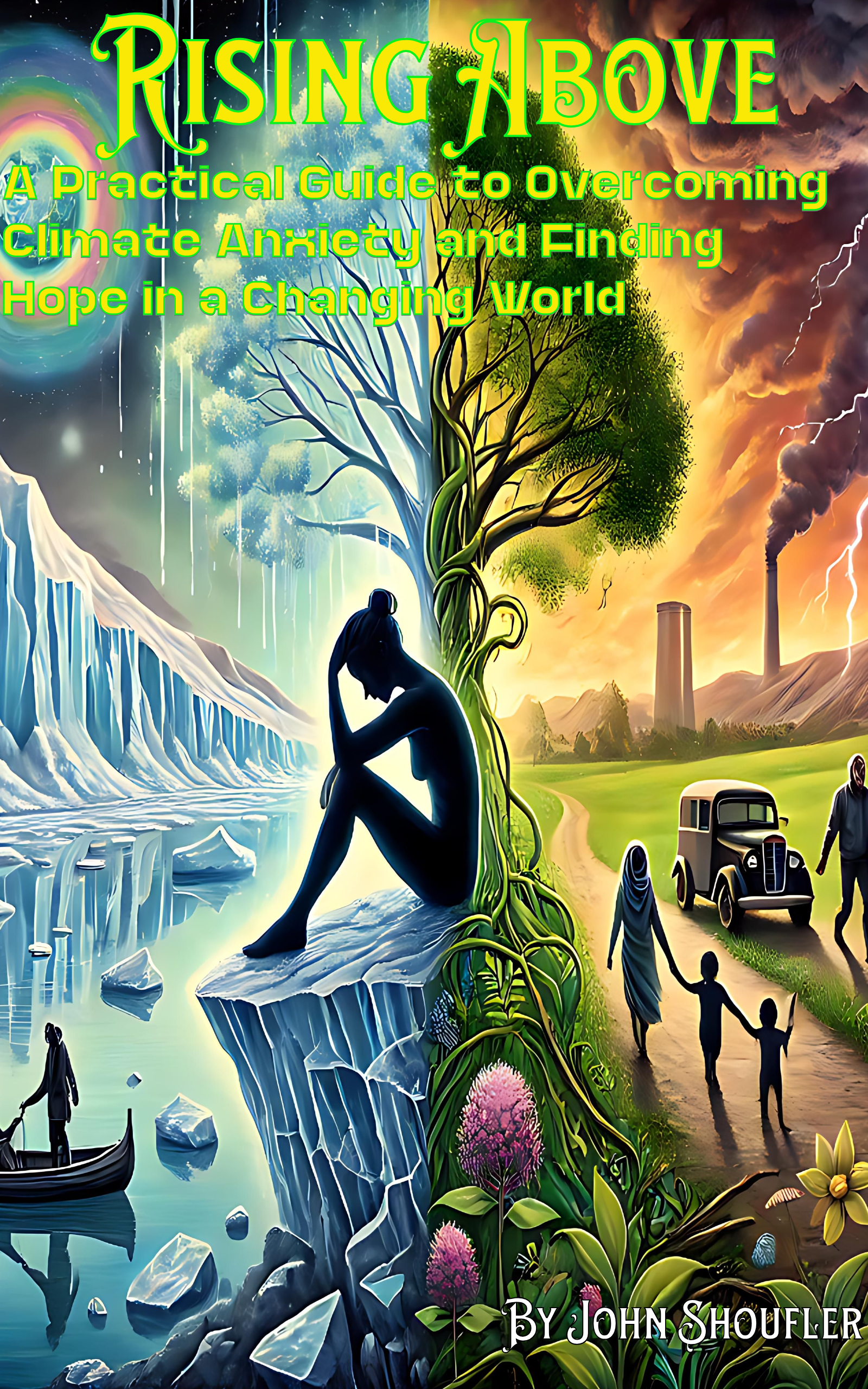
You feel a flicker of unease when daffodils bloom three weeks early. A pang of worry when a storm levels a community a thousand miles away. A quiet, gnawing sense that something about the seasons, the soil, the headlines is fundamentally off. There’s now a name for that cluster of feelings — climate anxiety, sometimes called eco-anxiety — and the people experiencing it are no longer a fringe. Rising Above is John Shoufler’s 300+ page, fifteen-chapter guide to understanding climate anxiety, building emotional tools to manage it, connecting with others who share the concern, and sustaining hope across a problem that has no fixed finish line.
The book’s premise is honest from the first page: climate anxiety is not a flaw, not a weakness, not an overreaction. It’s a signal that you care about something real. The work is learning to listen to that signal without being paralyzed by it — and to convert the underlying values into action, community, and lasting hope.
About Rising Above
Rising Above: A Practical Guide to Overcoming Climate Anxiety and Finding Hope in a Changing World runs 300+ pages across fifteen chapters organized into four parts, plus an epilogue and a substantial appendix of worksheets, resources, and a glossary. The structure is deliberately therapeutic in shape — moving from naming the experience, through emotional tools, to community, and finally to long-term sustained hope as a daily practice.
The book treats climate anxiety as both a personal psychological experience and a moral signal. It draws on emerging research, real coping strategies, intergenerational wisdom, and frameworks borrowed from cognitive behavioral practice, mindfulness, community organizing, and ecological systems thinking — without ever requiring the reader to subscribe to any single school.
Who This Book Is For
- People who have a name now for what they’ve been feeling — and want to understand it before deciding what to do with it
- Parents who are trying to raise children honestly in a changing world without transferring their own dread
- Teenagers and young adults whose climate anxiety is often more acute because they’re the cohort that will live longest with the consequences
- Educators and mental health professionals looking for a frame and a vocabulary for the climate-related distress showing up in classrooms and clinical practice
- Activists and organizers who feel the burnout and need tools for sustaining engagement across decades, not months
- People on the frontlines of climate disruption — coastal residents, farmers contending with failing harvests, communities recovering from disaster — who carry an acute, embodied version of the anxiety
The Fifteen Chapters at a Glance
Part I — Understanding Climate Anxiety
Chapter 1: Naming the Feeling. Defining climate (eco)anxiety and its signs. The spectrum of emotional responses to a diffuse, ongoing crisis. How climate anxiety differs from a generalized anxiety disorder and from ordinary stress.
Chapter 2: Why Are We So Anxious? The roots — evolutionary, psychological, cultural, informational. Why our brains, wired for immediate dangers, struggle with slow-moving global threats.
Chapter 3: How It Affects Us Day-to-Day. The lived experience. Sleep. Decision-making. Work. Relationships. Food and consumption choices. The intermittent grief at the edges of an ordinary day.
Chapter 4: Context from the Past and Around the World. Historical responses to ecological disruption. Cross-cultural framings of human-nature relationships. The Indigenous, religious, and philosophical traditions that have wrestled with versions of this question long before “eco-anxiety” entered the vocabulary.
Part II — Finding Emotional Ground
Chapter 5: Immediate Relief When Fear Spikes. The acute toolkit. Breathwork. Grounding techniques. Boundaries on media consumption. What to do in the moment when a headline triggers panic.
Chapter 6: Reframing Your Thoughts. Cognitive tools for working with catastrophizing, self-blame, and despair. Distinguishing realistic concern from cognitive distortion.
Chapter 7: Building Lasting Resilience. The longer-arc practices. Habits and routines that sustain emotional steadiness across years of difficult news.
Part III — Strength in Numbers: Connecting with Others
Chapter 9: Breaking Isolation Through Community. Climate anxiety isolates. Connection re-grounds. The forms community can take — local sustainability groups, faith-based initiatives, online forums, neighborhood mutual-aid networks.
Chapter 10: Honest, Compassionate Communication. Talking about climate with friends, family, partners, and children — including people who minimize or deny. How to share what you feel without alienating or moralizing.
Chapter 11: Turning Anxiety into Collective Action. The pivot from feeling to doing. How to choose engagement that matches your values, your capacity, and the moment — without burning out.
Part IV — Sustaining Hope and Engagement Over Time
Chapter 12: Recognizing Progress and Celebrating Wins. The discipline of noticing what’s working. Renewable-energy milestones, policy victories, community successes — the data points that keep despair from becoming the default frame.
Chapter 13: Hope as a Practice, Not a Fantasy. “Active hope” — the deliberate stance that acknowledges difficulty while affirming that our choices matter. Hope as a discipline rather than a feeling.
Chapter 14: Learning from Nature’s Resilience. What ecosystems teach us about recovery, adaptation, and cyclical renewal. The biological models for human emotional resilience.
Chapter 15: A Lifelong Journey of Caring. The closing chapter. Integrating climate concern into a full life across decades. Mentoring the next generation. Updating your toolkit as the world changes.
Epilogue: Embracing Complexity, Choosing Courage
The send-off. The acknowledgment that there’s no clean resolution — and the affirmation that engaged, honest, hopeful action is still the right response.
The Appendices
The book’s appendix is large and practical. It includes worksheets (reframing anxious thoughts, tracking emotional states, embracing complexity and uncertainty, mentoring and intergenerational wisdom exchange, updating your coping toolkit), curated lists (organizations and initiatives, books offering moral depth and hope, podcasts, online communities), guidance on using these resources mindfully, tables and charts to customize your use, an information-action cycle chart, and a glossary of key terms.
What Makes This Book Different
It validates the emotion without leaving you stuck in it. Many climate books either deny the anxiety (technocratic optimism) or wallow in it (doomerism). Rising Above stays steady — naming the feeling, working with it, and converting it into engagement.
It takes the moral dimension seriously. The book treats climate anxiety as partly a moral and ethical response, not just a clinical one. The unease you feel is connected to values around fairness, intergenerational responsibility, and care for living systems. Honoring that connection is part of the healing.
It’s a toolkit, not a program. The four arcs — understanding, coping, connecting, sustaining hope — interweave and loop back on each other. The reader picks what fits, discards what doesn’t, and returns to the book repeatedly as circumstances change.
It addresses the long-arc problem. Climate work is a marathon with no finish line. Chapters 12 through 15 (and the appendix worksheets on updating your toolkit) are explicitly built for sustaining engagement across decades — the part most books skip entirely.
It honors community. Part III is not a token. The book treats isolation as one of the central drivers of climate-anxiety severity, and the community chapters offer concrete pathways out of it.
About the Author
John Shoufler writes across personal development, technology, parenting, business, and the operational disciplines required to navigate complex challenges. A former U.S. Navy nuclear reactor operator with twenty-one years in commercial nuclear power, he holds a BS in Nuclear Engineering Technology from Excelsior College and an MBA from the University of Illinois. The engineering background informs the book’s discipline — systems thinking, multi-layer problem decomposition, and the refusal to either oversimplify or be overwhelmed by complexity.
Where This Book Sits in the Catalog
If Rising Above resonates, two companion volumes extend the conversation. Off the Grid: A Complete Guide to Modern Nomadic Living is the practical companion for readers whose climate engagement leads toward greater personal resource independence. Hyperconnected: Navigating the Mental Health Crisis in a Digital World applies the same frame to a different chronic-stress source — the always-on digital environment.
Get the Book
Rising Above: A Practical Guide to Overcoming Climate Anxiety and Finding Hope in a Changing World by John Shoufler. 300+ pages, 15 chapters across four parts, plus epilogue and appendices. Available in paperback and Kindle.
Explore more of John Shoufler’s catalog on his author page, or browse the full Shoufler family catalog for fiction, nonfiction, and everything in between.
Frequently Asked Questions
Who is the author of Rising Above?
John Shoufler — Shoufler-catalog author whose related nonfiction includes Hyperconnected and Off the Grid.
What is Rising Above about?
A 15-chapter practical guide to climate anxiety, organized in four parts: understanding what climate anxiety is, coping tools that actually work, building local community for collective action, and sustaining hope as a daily practice.
Is climate anxiety a real diagnosis?
It’s an emerging clinical concept — sometimes called eco-anxiety or solastalgia — recognized by major psychological associations as a real, growing form of distress, even if it isn’t a standalone DSM diagnosis. The book covers the terminology and where the field is.
Does the book lean toward despair or false optimism?
Neither. It treats the science as serious without being paralyzing, and it treats action as necessary without being naive about what individuals can do alone.
Is Rising Above appropriate for teens or young adults?
Yes — the coping-tools and community sections are particularly useful for younger readers who carry the heaviest climate anxiety load and need durable practices rather than one-off motivation.