
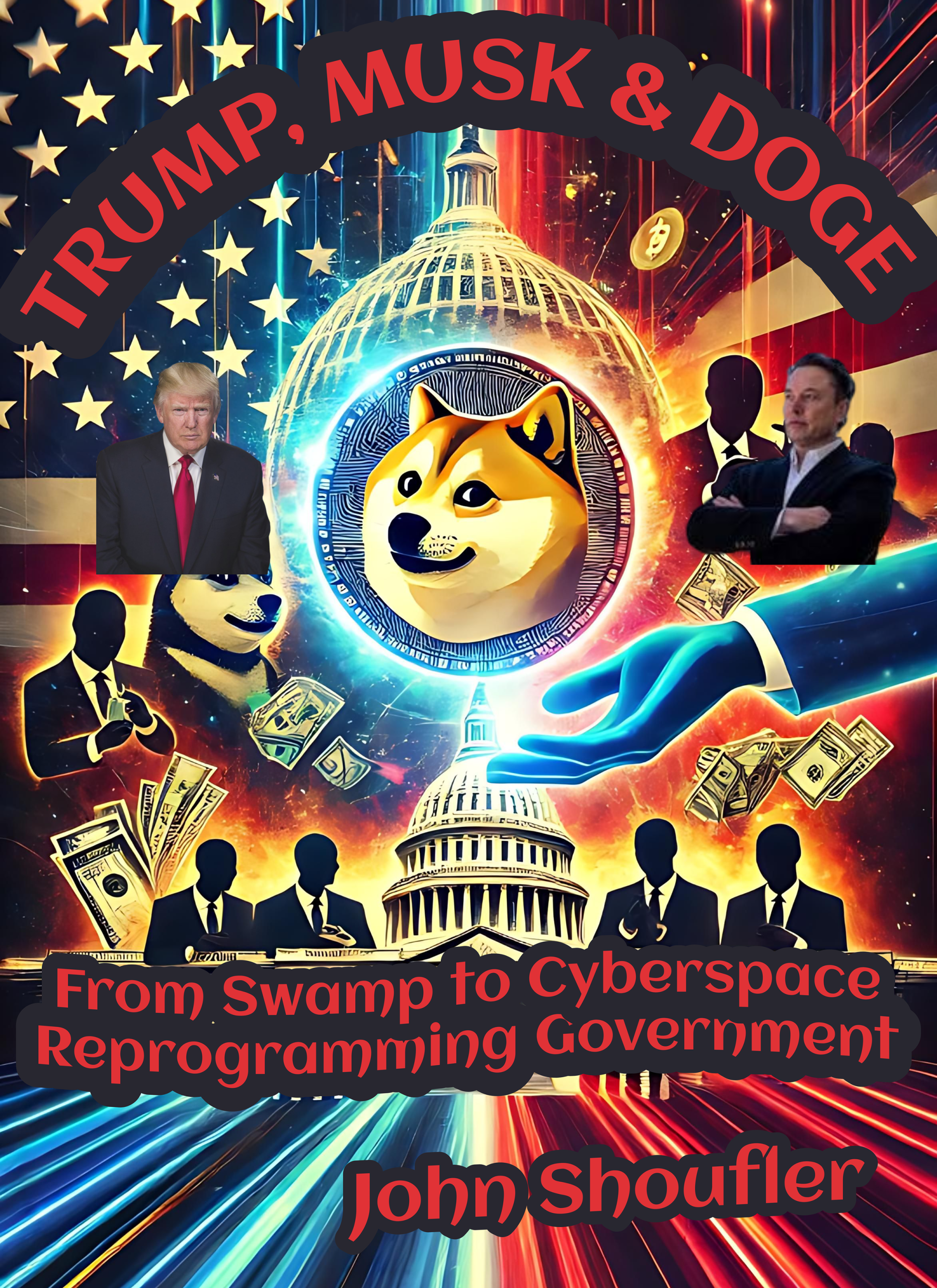
The Department of Government Efficiency — DOGE — moved from campaign-trail rhetoric to operating reality faster than any modern American reform initiative. Whatever your politics, the question of whether a brash political figure and a disruptive technologist could actually restructure how the federal government works is one of the defining questions of the decade. Trump, Musk & Doge: From Swamp to Cyberspace – Reprogramming Government is John Shoufler’s ten-chapter, 270+ page chronicle and analysis of that experiment — its origin, its tactics, its legal and constitutional friction, its political backlash, and what it tells us about the future of public administration in a digital age.
The book takes a deliberate dual-perspective stance. Every chapter pairs the supportive view (DOGE as overdue revolution against entrenched bureaucratic decay) with the critical view (radical disruption risking constitutional norms and institutional capacity). The result is a reading experience that respects the reader enough to surface both sides rather than preach one.
About Trump, Musk & Doge
Trump, Musk & Doge: From Swamp to Cyberspace – Reprogramming Government runs 270+ pages across ten chapters plus a long introduction. The structure moves chronologically and thematically from the political conditions that produced the initiative, through its design and rollout, into the legal battles and political reactions it triggered, and finally outward to international perspectives and the broader implications for how governments operate in a technological era.
What sets the book apart from typical political commentary is the systems-and-administration lens. The author treats DOGE not just as a political story but as an administrative-reform case study — what worked operationally, what stalled, where the technological tools delivered, where they hit constitutional or capacity limits, and what other reform efforts in other countries can learn from it.
Who This Book Is For
- Engaged citizens who want a single-volume framing of one of the most consequential political experiments of the era, told without partisan filter
- Public administration students and scholars looking for a contemporary case study in technology-driven government reform
- Policy and political-strategy professionals tracking how disruptive initiatives navigate legal and institutional friction
- Technologists and civic-tech advocates interested in where digital tooling can actually move the needle on government efficiency, and where it cannot
- International observers trying to understand whether the American DOGE experiment offers a model — or a cautionary tale — for reform efforts elsewhere
The Ten Chapters at a Glance
1. The Genesis of DOGE
How the Department of Government Efficiency went from rhetorical idea to formal initiative. The political conditions that produced it. The pivotal meetings between Trump and Musk where the operating vision took shape. The early framing of DOGE as both administrative overhaul and fundamental reimagining of governance.
2. Vision and Objectives
The stated mission, the operational goals, and the metrics that DOGE proposed to measure itself against. Cutting waste, exposing corruption, leveraging data analytics and decentralized oversight, building real-time transparency dashboards, opening federal spending to public scrutiny. The chapter that lays out what the initiative said it intended to do.
3. Implementation Tactics
How the vision met operational reality. The audit methodology. The technology stack. The use of cutting-edge data analytics to surface waste. The decentralized oversight mechanisms. The communications strategy. The deliberate operational tempo.
4. Legal and Constitutional Battles
Where DOGE collided with the existing structures of American governance. Separation of powers questions. Civil service protections. The legal challenges from agencies, employees, advocacy groups, and state attorneys general. The constitutional friction that any rapid administrative restructuring inevitably encounters.
5. Political and Social Reactions
The supportive coalition and the opposing coalition. Public polling. Media coverage. The reactions from career civil servants, contractors, and the broader federal workforce. The cultural and partisan splits the initiative widened and the unexpected alliances it produced.
6. Legacy and Lessons Learned
What endures after the initial wave of attention recedes. Which reforms stuck, which were rolled back, and which left a procedural residue that future administrations will work with or against. The administrative lessons for any future reform effort regardless of political alignment.
7. Technological Innovations & Government Reform
The technology chapter. AI for fraud detection and pattern surfacing. Blockchain for transaction transparency. Real-time dashboards for budget tracking. The promise and the limits of digital tooling applied to the operational complexity of federal agencies. Where the tech actually delivered measurable efficiency and where it ran into legacy systems and human-process bottlenecks.
8. International Perspectives and Global Impact
How other governments watched the DOGE experiment. The British, European, and Asia-Pacific reform conversations it influenced. The international comparison — which other countries have attempted technology-driven administrative reform, what their outcomes were, and what the American experiment looks like in that broader context.
9. The Future of Public Administration
The forward-looking chapter. The structural questions DOGE forced into the open even where it didn’t resolve them. Hybrid models of governance. The role of permanent civil-service institutions versus appointed reform teams. The integration of private-sector operational disciplines with public-sector accountability requirements.
10. Toward a New Era of Governance
The synthesis. What the DOGE moment means for the relationship between citizens, the federal government, and the technologies that increasingly mediate that relationship. The principles that any future reform — left, right, or technocratic — will likely have to engage with.
What Makes This Book Different
The dual-perspective structure. Every consequential moment is examined from both supportive and critical viewpoints, named explicitly in the chapter structure. The book trusts the reader to weigh both rather than choosing for them. That structural commitment to even-handedness is what separates it from the partisan commentary that dominates the genre.
It treats DOGE as an administrative case study, not just a political story. The legal and constitutional chapter, the technology chapter, the implementation-tactics chapter, the international-comparison chapter — these are public-administration questions, and the book engages them as such rather than as scoring opportunities.
It addresses the technological substrate seriously. Chapter 7 doesn’t hand-wave the role of AI, blockchain, and analytics platforms in the reform effort. It examines what the tools actually did, where they delivered, and where they bumped up against the messy reality of legacy federal systems.
It looks outward. Chapter 8’s international perspective places DOGE in a global context of government-reform experiments, which is the kind of comparative framing most domestic political books skip entirely.
About the Author
John Shoufler writes across politics, technology, business, and the operational disciplines required to run institutions of any scale. A former U.S. Navy nuclear reactor operator with twenty-one years in commercial nuclear power, he holds a BS in Nuclear Engineering Technology from Excelsior College and an MBA from the University of Illinois. The operational background shapes the book’s approach — administrative reform is examined the way a reactor operator examines a plant overhaul: systems, interfaces, failure modes, recovery procedures, and lessons learned.
Where This Book Sits in the Catalog
If Trump, Musk & Doge resonates, two companion volumes extend the conversation. Future Unveiled: The Societal Impact of Emerging Technologies covers the broader technological context — AI, blockchain, and digital infrastructure — that any modern government-reform effort has to navigate. Mastering Social Media Management applies a complementary lens to one of the digital domains where political and institutional power increasingly play out.
Get the Book
Trump, Musk & Doge: From Swamp to Cyberspace – Reprogramming Government by John Shoufler. 270+ pages, 10 chapters plus introduction. Available in paperback and Kindle.
Explore more of John Shoufler’s catalog on his author page, or browse the full Shoufler family catalog for fiction, nonfiction, and everything in between.
Frequently Asked Questions
Who wrote Trump, Musk & Doge?
John Shoufler — Shoufler-catalog author whose related nonfiction includes Future Unveiled and Rising Above.
What is Trump, Musk & Doge about?
Ten chapters on the Department of Government Efficiency (DOGE) — how it formed, the politics and personalities behind it, the tactics deployed, the legal challenges, the technology stack, and the lessons it suggests for the next era of public administration.
Is the book partisan?
It’s analytical, not cheerleading or hit-piece. The book covers what was attempted, what worked, what didn’t, and what precedent it sets — and it draws lessons that apply regardless of which party next inherits the playbook.
Does it cover the legal battles around DOGE?
Yes — a dedicated chapter walks through the major court challenges, the constitutional questions, and the executive-versus-legislative tension the initiative exposed.
Will this book age well?
The book frames durable lessons about government efficiency, executive ambition, and the limits of disruption applied to public institutions — themes that outlive any single administration.