
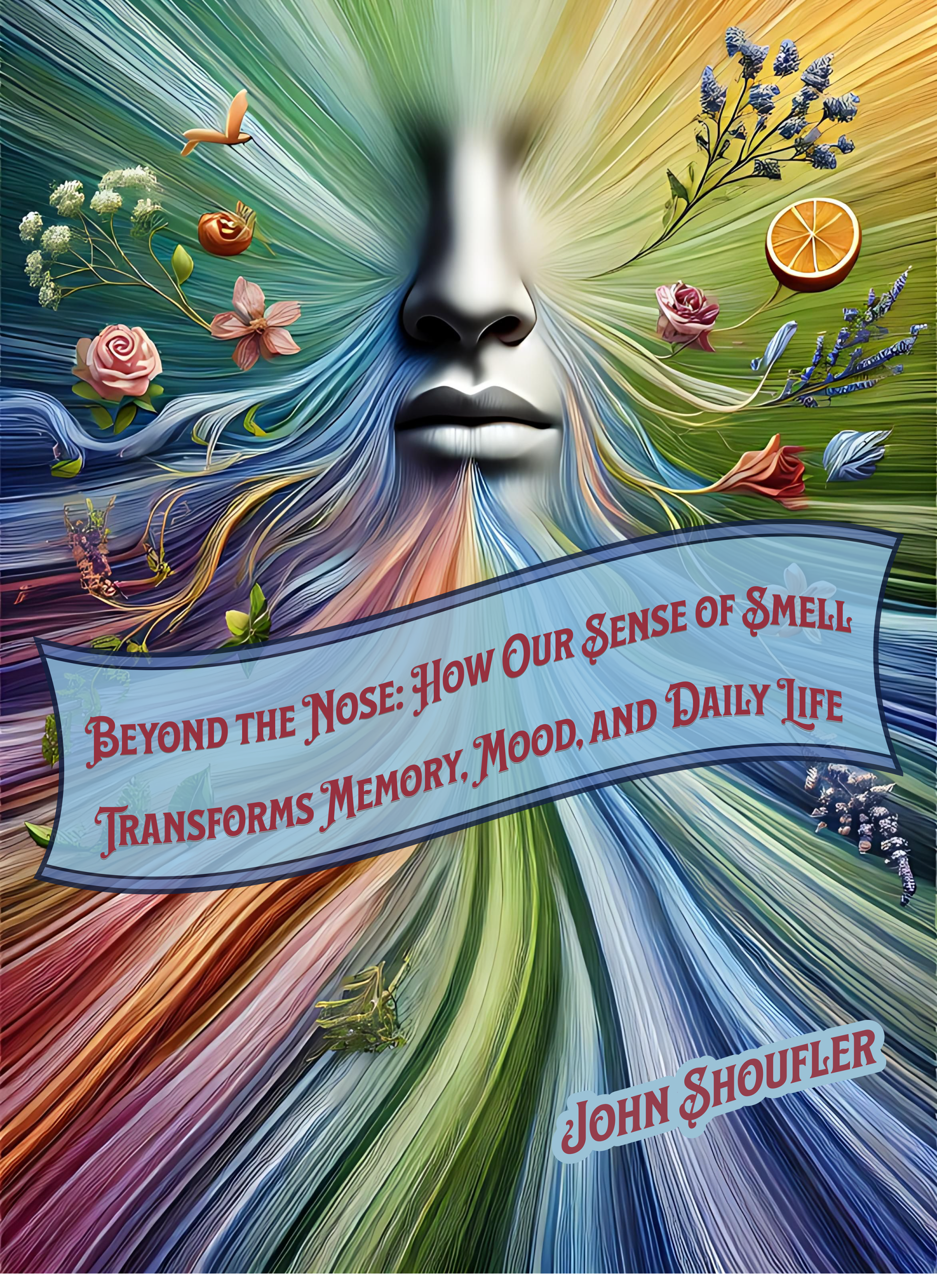
A breeze carries the smell of fresh bread past you on a busy street, and you’re suddenly back in your grandmother’s kitchen at age six. That’s not a poetic flourish — it’s neuroscience. Unlike sight and sound, which route through the thalamus before reaching their cortical processing areas, smell takes a direct neural shortcut to the amygdala (where emotion lives) and the hippocampus (where autobiographical memory lives). That direct wiring is why scent triggers memories that feel more vivid, more emotional, and more uncontrollable than any photograph could. It’s the Proustian effect, named for Marcel Proust’s madeleine — and it’s the through-line of Beyond the Nose.
John Shoufler’s 160+ page guide to the science, psychology, and practical application of the sense of smell is a tour of the most underappreciated of the five senses — the one most people move through life barely consciously aware of, despite the fact that it shapes their food preferences, their attraction patterns, their stress levels, their sleep, their memory, and their mood.
About Beyond the Nose
Beyond the Nose: How Our Sense of Smell Transforms Memory, Mood, and Daily Life runs across three parts and twelve chapters. Part 1 establishes the foundations of olfaction — the science, the anatomy, the connection between scent and memory and mood. Part 2 examines the impact of scent on daily life — attraction, appetite, health, society, cognition. Part 3 turns toward practical application — creating a scented home, using scent for sleep and stress and focus, and the structured exercises of “smell training” to enhance your own olfactory ability.
The book treats olfaction as both a serious scientific subject and a practical, accessible one. The chapters move from the neuroscience of receptor binding (humans have hundreds of olfactory receptor types and may be able to discriminate over a trillion distinct odors) to applied questions like which scents actually help with sleep, which boost productivity, and how to do basic smell training at home.
Who This Book Is For
- Curious general readers who want to understand a sense they use thousands of times a day without thinking about it
- People who have lost smell (anosmia from COVID, injury, aging, infection) and are looking for evidence-based recovery exercises
- Aromatherapy and wellness practitioners looking for the grounded science behind the practice
- Designers, marketers, and creators of physical spaces — retail, hospitality, residential design, brand experiences — where ambient scent shapes how people feel and behave
- Foodies and home cooks who realize that what we call “taste” is mostly smell, and want to develop their olfactory palate
- Caregivers and clinicians interested in the emerging link between olfactory decline and early indicators of Parkinson’s or Alzheimer’s
The Twelve Chapters at a Glance
Part 1 — The Foundations of Olfaction
Chapter 1: The Nose Knows. The underappreciated sense. A journey through the olfactory system (turbinates, olfactory epithelium, receptor neurons, cribriform plate, olfactory bulb). The evolution of smell — older than vision in many primitive life forms. The individuality of smell — why two people perceive the same odor differently based on genetics and exposure.
Chapter 2: The Science of Scent. What an odor actually is. The language of scent — odor profiling and classification. The art and science of perfumery. The widespread use of scent across industries — from food and beverage to retail marketing to product design.
Chapter 3: Smell and Memory — The Proustian Effect. The neuroscience of scent and memory. Childhood scents and nostalgia. Scent and place. Why a smell can drop you decades into your past with a precision no photograph can match.
Chapter 4: Smell, Emotion, and Mood — The Unseen Influence. The limbic connection. Scent and stress reduction. Scent and mood enhancement. The dark side — how negative emotions and aversions form around specific smells.
Part 2 — The Impact of Scent on Our Lives
Chapter 5: Scent and Attraction — The Biology of Love and Lust. Pheromones — what the research actually shows and what’s still speculation. The smell of compatibility, including the link between Major Histocompatibility Complex markers and subconscious mate preference. The role of perfume in attraction.
Chapter 6: Scent and Appetite — The Flavor Connection. The difference between taste and flavor (most of what we call “taste” is actually smell perceived retronasally). The psychology of food cravings. Smell loss and appetite. The future of food and scent — including how anosmia from COVID has reshaped the field.
Chapter 7: Scent and Health — From Aromatherapy to Medical Diagnosis. Aromatherapy beyond relaxation. The scent of disease — emerging research on how certain medical conditions alter a person’s odor profile. Smell and mental health.
Chapter 8: Scent and Society — Cultural and Social Dimensions. The scent of cleanliness and hygiene. Scent and ritual (incense, ceremony). Scent and identity. The ethics of scent — including the manipulative dimensions of scent marketing and the debates around fragrance-free public spaces.
Chapter 9: Scent and Cognition — Focus, Alertness, and Performance. The impact of scents on alertness and attention. Scent and memory enhancement. Scent and creativity.
Part 3 — Harnessing the Power of Scent
Chapter 10: The Scented Home. Scent-zoning your home. Natural versus synthetic scents. DIY scent blending. Scent and mindfulness.
Chapter 11: Scent and Well-being — Practical Applications. Scent for better sleep. Scent for stress management. Scent for enhanced focus and productivity. Scent and social connection.
Chapter 12: Smell Training — Exercises to Enhance Your Olfactory Abilities. Why train your sense of smell. Basic smell training techniques. Advanced exercises. Resources and support — including the structured smell-training protocols recommended for people recovering from smell loss.
What Makes This Book Different
It treats smell as a serious neuroscience subject. The book grounds itself in current olfactory research — receptor diversity, the cribriform plate, the olfactory bulb’s topographic mapping via glomeruli, the direct limbic routing. It doesn’t dumb the biology down, but it doesn’t make it inaccessible either.
It addresses smell loss substantively. Anosmia became a household word during the COVID-19 pandemic, and the recovery research has accelerated dramatically. Chapter 12’s coverage of smell training — the structured exercises proven to help restore olfactory function — is essential reading for anyone affected.
It’s both science and practice. Part 1 gives you the foundation. Part 2 shows you how olfaction shapes domains you didn’t realize it was shaping. Part 3 turns the whole thing into a practical toolkit for your home, your sleep, your focus, your social life.
It takes the cultural and ethical dimensions seriously. Scent marketing as manipulation. Fragrance-sensitivity politics. The ethics of using ambient scent in retail and hospitality to influence purchasing behavior. The environmental footprint of large-scale fragrance production. Chapter 8 doesn’t dodge any of it.
About the Author
John Shoufler writes across science, technology, personal development, and the spaces where they intersect. A former U.S. Navy nuclear reactor operator with twenty-one years in commercial nuclear power, he holds a BS in Nuclear Engineering Technology from Excelsior College and an MBA from the University of Illinois. The scientific training shows up in how the book handles the neurobiology — accurately, accessibly, and without overclaiming what the research actually supports.
Where This Book Sits in the Catalog
If Beyond the Nose resonates, two companion volumes extend the conversation. The Habit Code shows how the kind of cue-routine-reward science the book draws on applies to the broader habits that shape daily life. Digital Balance applies the same sensory-systems thinking to the question of how technology hijacks attention and how to reclaim it.
Get the Book
Beyond the Nose: How Our Sense of Smell Transforms Memory, Mood, and Daily Life by John Shoufler. 160+ pages, 12 chapters across three parts. Available in paperback and Kindle.
Explore more of John Shoufler’s catalog on his author page, or browse the full Shoufler family catalog for fiction, nonfiction, and everything in between.
Frequently Asked Questions
Who is the author of Beyond the Nose?
John Shoufler — Shoufler-catalog author whose nonfiction also covers ADHD, digital wellness, and personal development.
What is Beyond the Nose about?
Twelve chapters on the neuroscience of olfaction — how smell links to memory and mood through the limbic system, why a single scent can return you to a childhood moment, and how smell influences attraction, appetite, and decision-making.
Does the book cover smell loss and recovery?
Yes — there’s coverage of anosmia (including post-viral smell loss), the science behind smell training, and the protocols clinicians are using to help patients rebuild olfactory function.
Is aromatherapy science covered honestly?
Yes — the book takes aromatherapy seriously where the evidence supports it, and is plain about where the marketing has outrun the research. It’s neither dismissive nor uncritical.
Why does the sense of smell deserve a whole book?
Because smell is the only sense wired directly into the limbic system without thalamic relay — which means it bypasses conscious filtering and goes straight to memory, mood, and emotion. That single wiring difference is why a passing scent can unlock decades-old memory in a way no other sense can.