
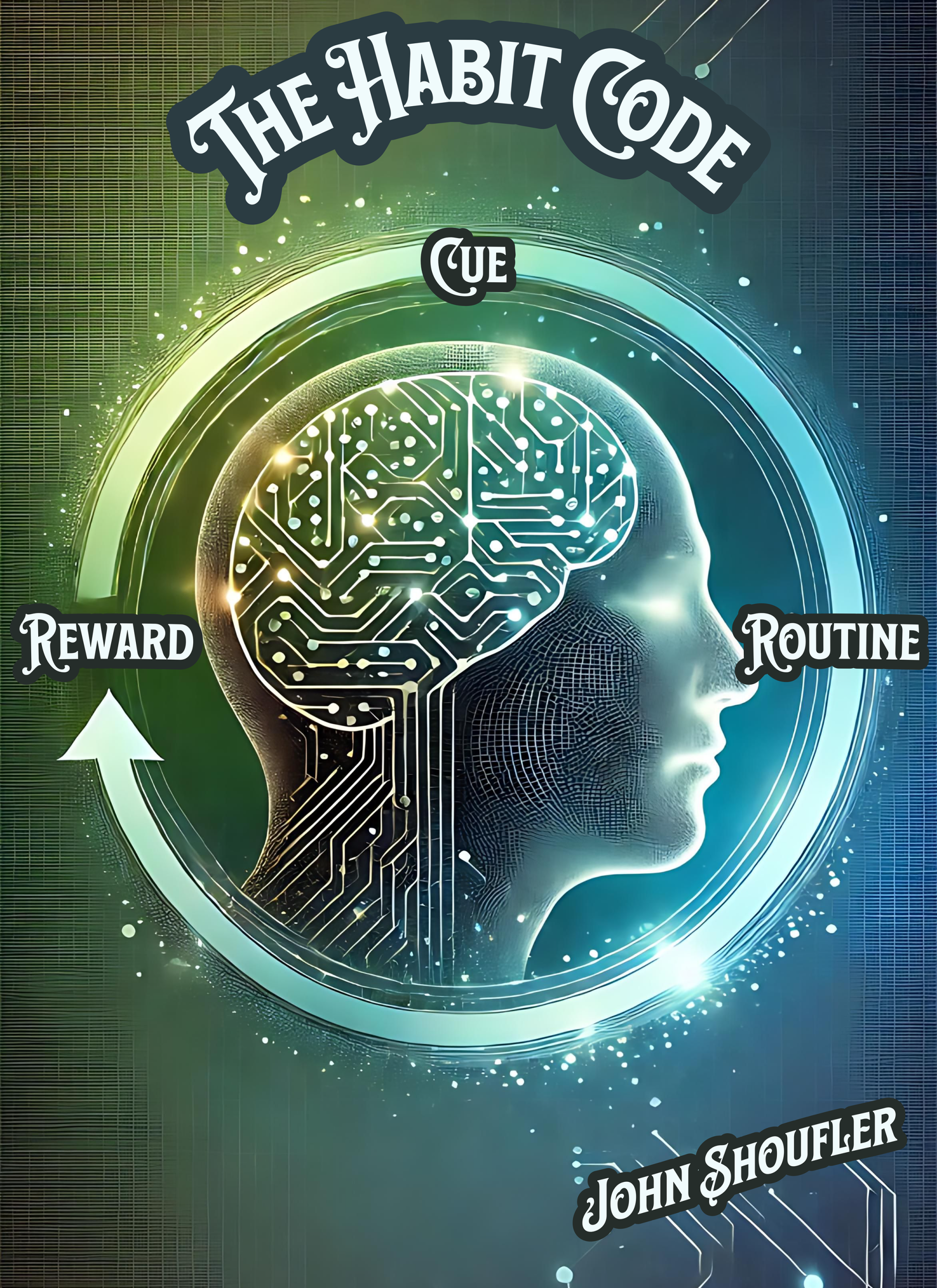
Willpower is overrated. The leaders who actually sustain high performance don’t grind through every day on raw self-discipline — they build systems, environments, and routines that make the right choice the easy choice. That’s the thesis Chapter Three of The Habit Code opens with, and the rest of the book runs on it. John Shoufler’s 200+ page leadership-and-personal-development guide takes the cue-routine-reward framework popularized by behavioral science and applies it specifically to the people whose habits don’t just shape their own lives but ripple out across teams, companies, and organizations.
If you’ve read Atomic Habits, The Power of Habit, or Tiny Habits and wanted a version aimed squarely at leaders and entrepreneurs — one that takes habit science out of the personal-productivity aisle and into the boardroom, the daily one-on-one, the team-culture meeting, and the workplace environment design — The Habit Code is that book.
About The Habit Code
The Habit Code: Unlock Your Potential, Rewire Your Mind, and Transform Your Life runs across 15 chapters that move from the foundational neuroscience of habits to the practical application of habit design across every dimension of professional life: self-awareness, mindset, goal-setting, communication, innovation, team-building, accountability, resilience, technology, and legacy.
It opens with the leader’s case for habit discipline — why the small, daily actions of someone in charge compound across an entire organization — and closes on what the book calls “from habit formation to legacy,” the long view of what consistent practice actually builds.
Who This Book Is For
- Founders and entrepreneurs whose daily routines set the entire culture of the company they’re building
- Mid-level and senior managers who are watching their best ideas die in execution because the routines aren’t there
- High-performers in any field who want to engineer their work and life instead of muscling through it
- Coaches and consultants looking for a habit framework they can take to clients in leadership contexts
- Anyone who reads Atomic Habits and wants the same level of practical thinking applied to leadership specifically
The 15 Chapters at a Glance
1. The Power of Habits for Leaders (Chapter 1)
The framing chapter — why the small daily routines of someone in a leadership role aren’t personal preferences but foundational practices that shape culture, performance, and strategic execution. The ripple effect of habits across teams.
2. Understanding the Habit Loop (Chapter 2)
The cue-routine-reward framework, applied to leadership-specific patterns: the manager who compulsively checks email when stressed, the founder who procrastinates when faced with hard decisions, the executive whose late-afternoon focus collapses. How to identify the cues that trigger the routines you don’t want.
3. Breaking Bad Habits (Chapter 3)
The willpower-myth chapter. Why ego depletion is real, why environmental design beats self-discipline, why setbacks are data not failure, and how to substitute healthier routines that deliver the same emotional reward as the patterns you’re trying to break.
4. Crafting Positive Habits (Chapter 4)
The practical build chapter. Habit stacking. Friction reduction. Environment design. Creating ecosystems where positive behaviors flourish with minimal effort. Building intrinsic motivation through alignment with vision.
5. The Habit of Self-Awareness (Chapter 5)
360-degree feedback. Reflective journaling. Mindfulness as a leadership practice. Data-driven habit tracking — using productivity tools and performance metrics to surface the patterns you can’t see in yourself.
6. Mindset Mastery and Belief Systems (Chapter 6)
How beliefs become habits and habits become identity. Growth mindset as the underlying operating system. Reframing setbacks as feedback.
7. Goal Setting and Strategic Planning (Chapter 7)
The chapter that connects daily habits to strategic objectives. Why most goal-setting fails (the goal exists, the habits to reach it don’t) and how to align routines with long-term vision.
8. The Habit of Effective Communication (Chapter 8)
Active listening. Regular one-on-one check-ins. Transparency. The daily communication practices that build trust over months and years.
9. Habits That Drive Entrepreneurial Innovation (Chapter 9)
The routines that produce creative output: continuous learning blocks, mentorship cycles, exposure to industry trends, deliberate experimentation, capturing feedback from every result.
10. Building High-Performing Teams Through Culture (Chapter 10)
How leader habits propagate into team norms — and how to design the daily and weekly rituals that produce the culture you want, instead of the one that defaults into existence.
11. The Habit of Accountability (Chapter 11)
Personal accountability practices. Accountability partnerships. The systems and rhythms that keep commitments from quietly slipping.
12. Resilience and Bouncing Back (Chapter 12)
The habits that produce psychological resilience over the long arc — stress-mitigating practices, recovery rituals, emotional regulation patterns, the ability to absorb setbacks without losing momentum.
13. Leveraging Technology for Habit Formation (Chapter 13)
Habit-tracking apps, productivity dashboards, collaboration platforms. How to use technology as scaffolding for the habits you’re building without letting it become another distraction loop.
14. Sustaining Growth and Avoiding Plateaus (Chapter 14)
The long-arc chapter. How to recognize when habits that drove early success need to evolve, how to refresh routines as your role and organization scale, and how to keep learning curves bending upward.
15. From Habit Formation to Legacy (Chapter 15)
The closing chapter — what consistent daily practice actually builds when extended across years and decades. The cumulative effect of small actions becoming the foundation of a leadership legacy.
What Makes This Book Different
The leadership lens. Most habit books are individual-productivity books. The Habit Code recognizes that for leaders and entrepreneurs, habits aren’t personal — they’re cultural. A founder’s morning routine sets the company’s energy for the day. A manager’s communication patterns become the team’s norm in a month. The book builds on that ripple-effect insight throughout.
The willpower realism. Chapter 3 is a meditation on why willpower as a strategy is structurally limited and why systems and environment design are where serious habit work actually happens. That’s a more honest frame than the typical “just be disciplined” advice.
The breadth. Communication, innovation, team-building, accountability, resilience, technology, legacy — the book takes habit science and applies it to every major dimension of professional life instead of stopping at productivity tactics.
The chapter-by-chapter usability. Each chapter stands on its own. You can go straight to Chapter 9 if entrepreneurial innovation is your gap, or Chapter 10 if it’s team culture, without reading cover to cover.
About the Author
John Shoufler writes across personal development, leadership, technology, and parenting. A former U.S. Navy nuclear reactor operator and twenty-one-year veteran of commercial nuclear power, he holds a BS in Nuclear Engineering Technology from Excelsior College and an MBA from the University of Illinois. His operational and procedure-writing background shows up in the discipline of the book — habits as designed systems rather than vague aspirations, with measurable behaviors, environmental controls, and feedback loops baked into every framework.
Where This Book Sits in the Catalog
If The Habit Code resonates, two companion volumes extend the conversation. Digital Balance: Reclaiming Your Life Through Mindful Technology Use is the targeted application of habit science to your relationship with technology. Understanding and Thriving with ADHD applies the same structural thinking — environment design, scaffolding, routines that don’t depend on willpower — to executive-function challenges.
Get the Book
The Habit Code: Unlock Your Potential, Rewire Your Mind, and Transform Your Life by John Shoufler. 15 chapters. Available in paperback and Kindle.
Explore more of John Shoufler’s catalog on his author page, or browse the full Shoufler family catalog for fiction, nonfiction, and everything in between.
Frequently Asked Questions
Who wrote The Habit Code?
John Shoufler — author of the Shoufler personal-development catalog, which includes Shatterproof and Digital Balance.
What is The Habit Code about?
A 15-chapter application of modern habit science to leadership, entrepreneurship, and team culture. It pulls from cue-routine-reward research and translates it into accountability systems, resilience routines, and lasting team rituals.
How is The Habit Code different from Atomic Habits?
Atomic Habits is written for the individual building personal habits. The Habit Code is written for leaders and founders building habits inside a team — accountability cadences, culture rituals, decision routines, and how habits scale (or break) across people.
Is The Habit Code useful for solo entrepreneurs?
Yes — the entrepreneurship chapters cover the founder’s personal operating system as well as the routines that survive when you eventually hire.
Does the book include exercises or a workbook section?
Yes — chapters end with applied prompts and routine-design templates, designed to be worked through over weeks rather than read in one sitting.