
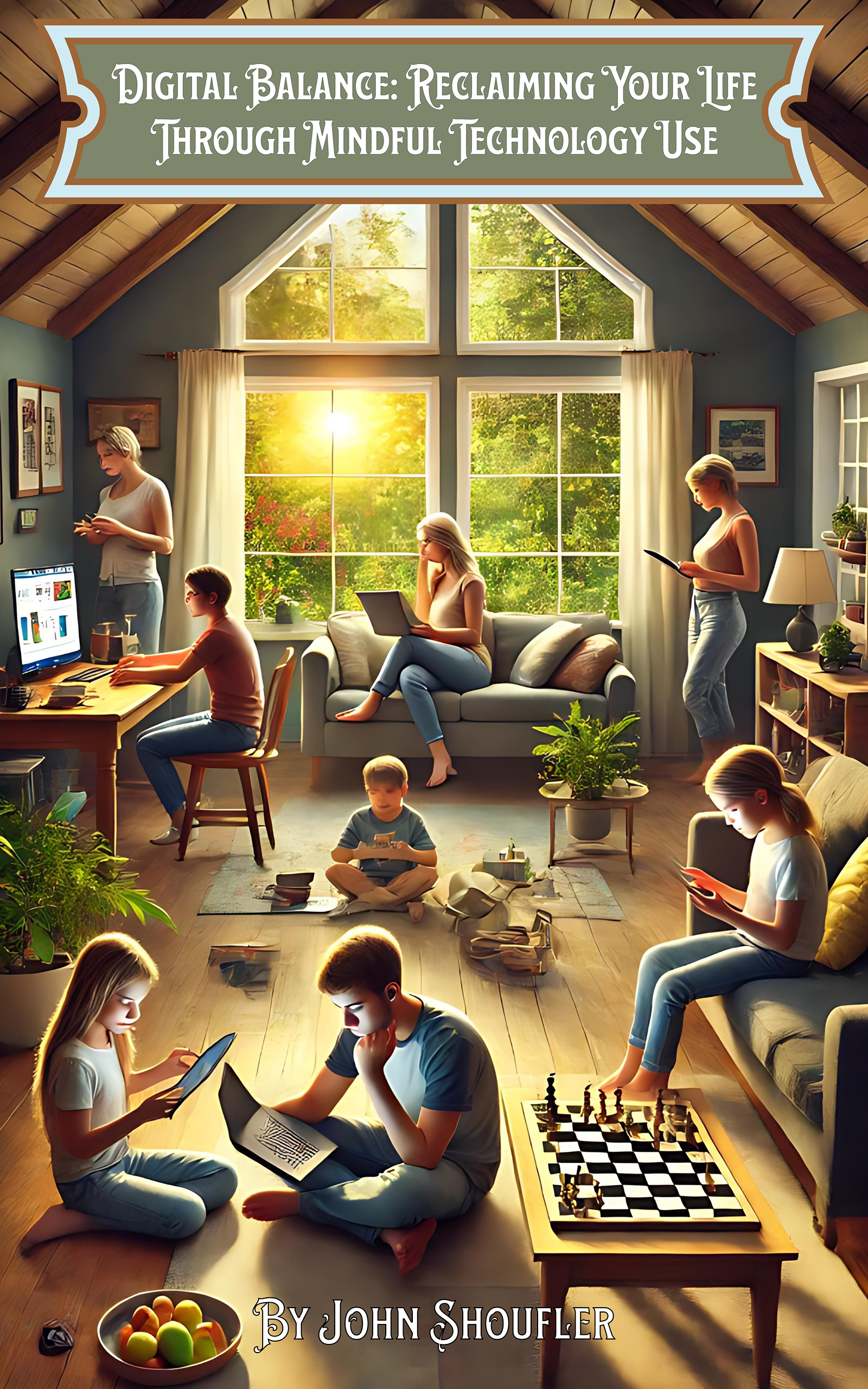
The phone is the slot machine in your pocket. That’s not a metaphor — it’s a literal description of how the reward systems were designed. The intermittent reinforcement that hooks gamblers in Las Vegas is the same psychological lever that pulls you back to the home screen forty times an hour. Researchers like Kent Berridge have shown that the dopamine hit comes from wanting the notification, not from getting it, which is why your brain stays restless even when the inbox is empty. Digital Balance is the book that lays this science out chapter by chapter — and then gives you a personal plan to take back the wheel without throwing the phone in the river.
John Shoufler’s 200+ page guide doesn’t preach digital abstinence. It treats technology as the powerful, useful, addictive tool it actually is, and walks the reader through what mindful use looks like at home, in relationships, in the workplace, and across the family.
About Digital Balance
Digital Balance: Reclaiming Your Life Through Mindful Technology Use runs across nine chapters that move from understanding the problem (the neuroscience of distraction, your specific digital habits, building awareness) to building a custom intervention (your personal digital wellness plan) to applying it across the major life domains (social media, relationships, analog joys, the workplace, kids and families).
The book is heavily research-cited — Harvard Medical School on attention, the Icahn School of Medicine on the brain’s reward pathways, Anna Lembke’s Dopamine Nation, Larry Rosen’s The Distracted Mind, University of California Irvine on the 23 minutes it takes to fully refocus after a notification, University of Essex on FOMO and sleep quality, Kaspersky Lab on the “digital amnesia” phenomenon — but it translates the research into practical reflective exercises and step-by-step changes a reader can actually implement.
Who This Book Is For
- Knowledge workers whose attention is the asset and who watch it get hijacked forty times before lunch
- Anyone whose sleep is being eaten by the late-night scroll, the morning grab-the-phone reflex, or the bedside blue light
- Couples feeling “technoference” — the slow erosion of presence when one or both partners are half on a device
- Parents trying to model healthy tech behavior to kids who watch what you do, not what you say
- Anyone with a creeping sense that the phone is now using them more than they’re using it
The Nine Chapters at a Glance
Introduction: The Age of Digital Overload
The framing chapter — “tech fatigue,” the hidden costs behind the convenience, the rise of digital addiction, the physical impact (eye strain, sleep, posture), the effect on relationships and social connections, and the case for mindful use over total abstinence.
1. The Science of Digital Distraction
The neuroscience chapter. The brain’s reward system and dopamine. The cycle of anticipation and reward — why every notification is a small slot-machine pull. The formation of digital habits and compulsive use. Effects on attention and cognitive function — including the “continuous partial attention” state and the “attention residue” effect documented by UC Irvine researchers. Structural brain changes related to heavy digital use. Memory and information processing — including “digital amnesia,” where 91% of smartphone users report using their devices as an extension of their memory. The closing section maps mindful use strategies to each neurological problem the chapter identified.
2. Understanding Your Digital Habits
The diagnostic chapter — the book turns the lens onto your specific patterns instead of generic advice. The mental and physical toll of constant connection. The psychological impact (anxiety, depression, social comparison). FOMO and its connection to sleep, stress, and life satisfaction. The “anticipatory anxiety” of just waiting for the next notification.
3. Building Digital Awareness
How to notice your own patterns — when, why, what triggers them, what the emotional payoff is. The chapter that turns the abstract science of Chapter 1 into your specific daily pattern.
4. Crafting Your Personal Digital Wellness Plan
The core intervention chapter. This is where the book asks you to build a plan that fits your life, your work, your relationships, and your particular triggers — instead of giving you a one-size-fits-all detox script.
5. Social Media with Intention
The targeted chapter for the platform most users feel most ambivalent about. How to use Instagram, TikTok, X, Facebook, LinkedIn, and the rest as tools for connection without letting them consume the hours they’re optimized to consume.
6. Technology and Relationships
“Technoference” — the term psychologists use for what happens when one partner checks the phone during shared time. The research on how heavy digital interaction affects intimacy, presence, and trust. Practical strategies for couples and families.
7. Reconnecting with Analog Joys
The chapter that reminds the reader what life off the screen used to feel like — and what specific analog practices (reading, walking, in-person conversations, creative work, nature) build the kind of slow, deep satisfaction that no notification can.
8. Mindful Technology in the Workplace
The professional chapter. Deep work. Meeting-and-email hygiene. Slack and Teams without burnout. Setting personal boundaries around availability without torching your career. Strategies for remote and hybrid workers especially.
9. Navigating Technology for Kids and Families
The closing chapter — extending the personal practice into household rules, modeling, and the harder conversations parents have to have with kids who grew up swiping. Family device agreements, screen-time boundaries, and how to set technology norms that the whole household actually follows.
What Makes This Book Different
It’s grounded, not preachy. A lot of digital-detox books read like sermons from someone who deleted Instagram once. Digital Balance is built around peer-reviewed research and named experts, and it never asks the reader to abandon technology — only to use it on purpose.
It treats the brain as a brain. The science chapters are the strongest part of the book. Understanding why your phone is hijacking your dopamine system makes it much easier to set boundaries that stick — because you’re not fighting a vague “bad habit,” you’re consciously interrupting a designed feedback loop.
It builds a plan, not a list of tips. Chapter 4 — Crafting Your Personal Digital Wellness Plan — is the structural backbone. Most books drop tips. This one builds a custom intervention you can actually execute and revise.
It addresses all the surfaces. Solo use. Couples. Families. Work. Social media. The book recognizes that technology touches every domain of life, so the intervention has to too.
About the Author
John Shoufler writes across personal development, technology, parenting, and health. A former U.S. Navy nuclear reactor operator and twenty-one-year veteran of commercial nuclear power, he holds a BS in Nuclear Engineering Technology from Excelsior College and an MBA from the University of Illinois. His background in operations and procedure writing shows up here in the discipline of the research and the practical framing of the interventions — every claim is grounded in a citation, every strategy is something you can act on.
Where This Book Sits in the Catalog
If Digital Balance resonates, two companion volumes extend the conversation. Hyperconnected: Navigating the Mental Health Crisis in a Digital World goes deeper on the public-health side of the same conversation. The Habit Code is the broader companion on rewiring routines — directly applicable to the dopamine-loop work that Digital Balance opens.
Get the Book
Digital Balance: Reclaiming Your Life Through Mindful Technology Use by John Shoufler. 9 chapters across 200+ pages. Available in paperback, hardcover, and Kindle.
Explore more of John Shoufler’s catalog on his author page, or browse the full Shoufler family catalog for fiction, nonfiction, and everything in between.
Frequently Asked Questions
Who is the author of Digital Balance?
John Shoufler — Shoufler-catalog author whose related titles include Hyperconnected and The Habit Code.
What is Digital Balance about?
A 9-chapter guide to the neuroscience of digital distraction — dopamine loops, FOMO, technoference (the way phones interrupt close relationships) — and a practical framework for building your own digital wellness plan.
Is Digital Balance a digital-detox book?
No — it’s the opposite of detox-and-relapse. The book argues for sustainable boundaries that survive normal work and family life, not 30-day cleanses that collapse on day 31.
Does it cover screen-time for kids and teens?
Yes — there’s coverage of family screen agreements, technoference at the dinner table, and modeling, but the primary audience is the adult reader building their own plan first.
How does Digital Balance differ from books like Digital Minimalism?
Digital Balance leans more on the neuroscience (dopamine, attention, the default-mode network) and on building a personal plan rather than adopting a one-size philosophy. It treats technology as inevitable and works on the relationship rather than the volume.