

Future Unveiled by John Shoufler: Emerging Tech Review

The telephone took roughly fifty years to reach widespread adoption. Smartphones did it in just over a decade. Certain social media platforms reached hundreds of millions of users in a fraction of even that. The pace of technological change has shifted from linear to exponential — and the institutions, regulations, ethics, and cultural norms we rely on to absorb that change have not kept up. Future Unveiled is John Shoufler’s 240+ page reckoning with that gap. Across eleven chapters and a comprehensive appendix, it takes the six or seven technologies most likely to reshape life over the next decade — AI, quantum computing, blockchain, biotechnology, robotics, IoT, renewable energy — and treats each as a societal question, not just a technical one.

If you want one book that explains what these technologies actually are, where they’re going, who they benefit, who they leave behind, and what kinds of policy and ethical guardrails the world is going to need to put around them, this is that book.

About Future Unveiled

Future Unveiled: The Societal Impact of Emerging Technologies runs 240+ pages across eleven chapters plus three appendices (a glossary of key terms, a curated further-reading list, and a full reference and citations list). Its structure is deliberately interdisciplinary — it pairs the technical explanation of each domain with the social, ethical, economic, and policy dimensions that come with it.

The book opens with a long, careful introduction on why now — the convergence of exponential progress, global crises (climate, pandemics, economic inequality), generational shifts, regulatory flux, and the philosophical questions that arise when biotechnology and AI begin to redefine birth, cognition, and life itself. Then it moves chapter by chapter through the technologies themselves.

Who This Book Is For

  • Policymakers and regulators who need to understand the technologies they’re being asked to write rules around
  • Business leaders and entrepreneurs deciding which emerging technologies to bet on and which to wait out
  • Educators and parents preparing the next generation for an economy that doesn’t yet exist
  • Engineers and technologists who want to think harder about the societal dimensions of what they build
  • Curious general readers who want a single, accessible volume that demystifies the buzzwords without dumbing them down

The Eleven Chapters at a Glance

1. Introduction

The “why now” framing. Exponential vs. linear change. Why current ethical, legal, and educational frameworks are lagging. Why the technologies addressed in this book interact with each other (AI accelerates IoT, quantum accelerates AI, biotech reshapes the questions all three need to ask), and why retroactive regulation gets harder the longer society waits.

2. Artificial Intelligence — The Machine Revolution

What AI actually is — machine learning, deep learning, reinforcement learning, neural networks. The three factors that propelled AI into the mainstream (data abundance, GPU/TPU hardware, algorithmic research). Real-world impact across healthcare, education, finance, entertainment. The honest treatment of job displacement, algorithmic bias, accountability for AI errors, and the regulatory frameworks just now emerging.

3. Quantum Computing — The Next Digital Leap

Qubits, superposition, entanglement, and what they actually allow that classical computing can’t. The race for “quantum advantage.” Applications in logistics, financial modeling, drug discovery, materials science. The cryptographic risk — that current encryption could be broken once quantum scales — and the parallel race for post-quantum cryptography.

4. Blockchain Beyond Cryptocurrency

The book treats blockchain as a distributed-ledger technology with applications far beyond crypto: supply-chain traceability, voting infrastructure, healthcare records, identity verification, smart contracts. The honest treatment of decentralized finance, fraud risk, energy consumption, and the unresolved scalability and privacy questions.

5. Biotechnology and Genetic Engineering

CRISPR gene editing. The promise — curing genetic diseases, addressing agricultural challenges, eradicating pathogens. The moral terrain — “designer babies,” the commodification of human life, the religious and philosophical questions about engineering biology. The chapter doesn’t dodge the hard parts.

6. Robotics and Automation

Industrial robotics, service robotics, autonomous systems. The labor-market shift this implies. The collaborative-robot model where machines augment rather than replace human labor. The chapter that bridges between “AI as software” and “AI as physical-world actor.”

7. The Internet of Things — A Connected World

The infrastructure layer that makes everything else possible — sensors everywhere, devices that talk to each other, data streams from homes, cars, factories, cities. The privacy and surveillance questions IoT raises at scale, and the security questions of a billion always-on devices.

8. Renewable Energy Technologies

The climate-stakes chapter. Solar, wind, storage, grid modernization, carbon capture. Why emerging technologies could be the best shot at mitigating catastrophic climate change — and how some of those same technologies (energy-hungry data centers, certain blockchain networks) can exacerbate environmental problems if deployed without care.

9. Ethics, Equity, and Inclusion

The chapter that runs across all the others. The digital divide. Algorithmic discrimination. Who has a seat at the table when these technologies are designed. Why marginalized communities risk being either left out or actively harmed by emerging tech, and how to design for inclusion proactively rather than retrofit it after deployment.

10. The Role of Governments and Policy

GDPR as a case study. Antitrust debates. AI accountability frameworks. The fragmented global regulatory landscape (EU, US, China models). Why governance needs to anticipate rather than react.

11. Preparing Society for the Future

Education that fosters creativity, critical thinking, and ethical reasoning alongside technical skills. Workforce development. Cultural readiness. The principle of “proactive participation” — that engaged citizens, informed leaders, and conscientious innovators can collectively steer the direction of technological development.

The Appendices

  • Glossary of Key Terms — accessible definitions for terms like “deep learning,” “quantum entanglement,” “smart contracts,” and “CRISPR gene editing” that often alienate non-specialists
  • Resources for Further Reading — curated next steps for each technology domain
  • References and Citations — the academic and reporting backbone of the book

What Makes This Book Different

It’s interdisciplinary by design. Most books on emerging technology pick a lane — they’re for engineers, or for policy people, or for general readers. Future Unveiled treats each technology as a node in a network of technical, economic, ethical, political, and cultural questions, because that’s how these technologies actually land in the world.

It refuses both hype and fear. The book is allergic to “technology will save us” and equally allergic to “technology will destroy us.” Its working position is that the outcome is shaped by collective choices — by policy, by ethics, by who gets a seat at the design table — and that informed public discourse is the lever.

It treats equity as structural, not decorative. Chapter 9 on Ethics, Equity, and Inclusion isn’t a token chapter; the equity lens runs through every other chapter as well. AI bias. The digital divide. Who benefits from biotech and who’s excluded. Whose energy gets renewable and whose stays dirty.

It takes the philosophical questions seriously. What does it mean to “engineer” life? What is the moral status of an AI that approximates human reasoning? What happens to consciousness when extended-reality environments and brain-computer interfaces blur the line between digital and physical? The book doesn’t resolve these — it surfaces them honestly.

About the Author

John Shoufler writes across technology, business, personal development, parenting, and the spaces where they intersect. A former U.S. Navy nuclear reactor operator with twenty-one years in commercial nuclear power, he holds a BS in Nuclear Engineering Technology from Excelsior College and an MBA from the University of Illinois. His engineering and operational background show up in the book’s discipline with the technology — every concept is explained correctly before it’s interrogated — and his MBA training shows up in the economic and policy framing.

Where This Book Sits in the Catalog

If Future Unveiled resonates, two companion volumes extend the conversation. Hyperconnected: Navigating the Mental Health Crisis in a Digital World takes the human-experience side of the same technological transformation. Mastering Social Media Management is the practical companion for one of the digital domains Future Unveiled examines from a societal lens.

Get the Book

Future Unveiled: The Societal Impact of Emerging Technologies by John Shoufler. 240+ pages, 11 chapters plus three appendices. Available in paperback and Kindle.

Explore more of John Shoufler’s catalog on his author page, or browse the full Shoufler family catalog for fiction, nonfiction, and everything in between.

Frequently Asked Questions

Who is the author of Future Unveiled?

John Shoufler — Navy nuclear veteran and Shoufler-catalog author with related titles in social media, government reform, and digital mental health.

What is Future Unveiled about?

Eleven chapters surveying the emerging technologies that will define the next decade — AI, quantum computing, blockchain, biotech, robotics, IoT, and renewable energy — and the societal, ethical, and policy questions each one raises.

Is Future Unveiled technical or accessible?

Accessible. The book is written for the curious non-specialist who wants the implications and the policy frame, not the math. Each chapter ends with the questions citizens and decision-makers should be asking.

Does it cover the ethics of AI?

Yes — the AI chapter covers alignment, labor displacement, bias, and the regulatory landscape, with parallel discussion in the biotech and robotics chapters.

How current is the book on AI developments?

It frames the durable shifts rather than chasing weekly headlines. Topics like model alignment, energy demand, and labor impact are covered in a way that holds up as the specific models churn.
Related Reviews on BooksAndGuidesPro

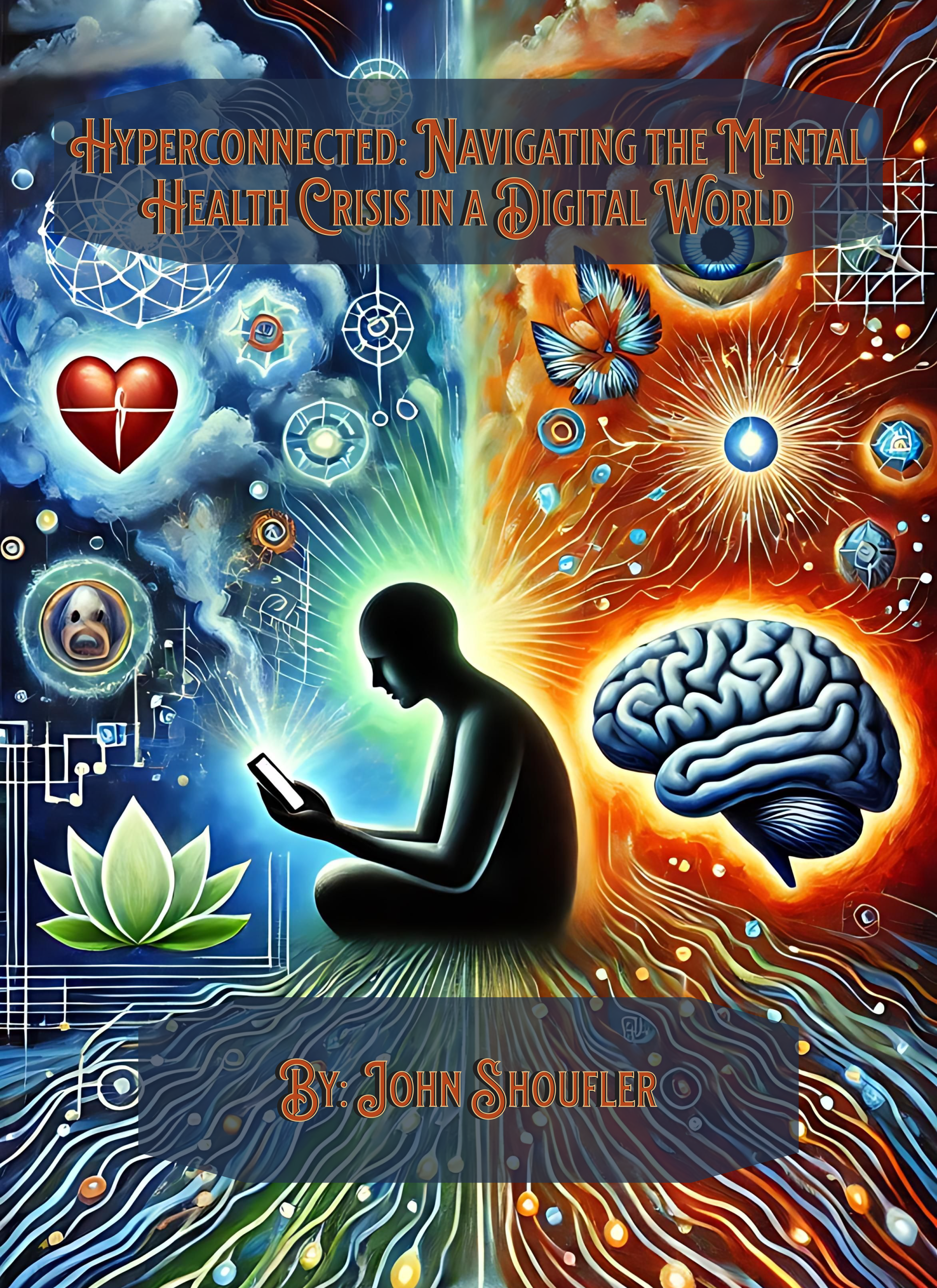
Hyperconnected by John Shoufler: Digital Mental Health

Self-harm rates among adolescents have nearly doubled compared to previous generational cohorts. Workplace burnout is now measured in trillions of dollars of global cost. Doomscrolling, blue-light sleep disruption, social-comparison anxiety, and the silent epidemic of “always-on” availability are no longer fringe concerns — they’re the central public-health story of the decade. Hyperconnected is John Shoufler’s 210-page, ten-chapter examination of the mental-health crisis as it intersects with the digital age — and unlike many books in the space, it refuses to either demonize technology or hand-wave the harm away.

The book is built around a single honest premise: the smartphone is not a tyrant, and it is not a toy. It’s a tool that has rewired the way humans communicate, work, sleep, parent, partner, and process information — and the mental-health consequences of that rewiring are now measurable, severe, and unevenly distributed across age groups, gender, geography, and class.

About Hyperconnected

Hyperconnected: Navigating the Mental Health Crisis in a Digital World runs across ten chapters plus an extensive introduction and a multi-part appendix that includes a glossary of digital-mental-health terms, recommended apps and online tools, a curated further-reading list, and references and citations for the research used throughout.

The introduction alone runs roughly 20 pages and lays the data foundation — hundreds of millions of people worldwide with major depressive disorder, generalized anxiety, or bipolar disorder; a notable spike in adolescent depression and anxiety over the past decade; rising self-harm rates; trillions of dollars in workplace mental-health cost; teletherapy adoption surges; gender disparities in reporting; rural-urban gaps in clinical access. The book treats data as a moral instrument — the numbers are there so the conversation has a foundation, not so the reader is scared.

Who This Book Is For

  • Parents of teenagers watching the social-media-and-mental-health pattern play out in their own house and looking for context, not just panic
  • Knowledge workers whose burnout is no longer a phase but the steady state
  • Mental health professionals looking for a single-volume framing of the digital-age stressors their patients are bringing in
  • Educators, HR leaders, and policy people working at the intersection of technology and well-being
  • Anyone who senses that something about the always-on life is wearing them down and wants a thoughtful, data-grounded analysis instead of a self-help pep talk

The Ten Chapters at a Glance

Introduction: The Mental Health Crisis in Numbers

The data foundation. Adolescent depression and anxiety, suicide rates, workplace burnout costs, gender disparities, geographic and racial inequities in access, teletherapy adoption, doomscrolling research, sleep disruption epidemiology. Sets the scope before the rest of the book gets practical.

1. How Digital Habits Reshape Our Minds

The toll of constant connectivity. The psychology of doomscrolling — why the brain is wired to over-consume threatening news, and why algorithms optimized for engagement reliably make this worse.

2. Social Media’s Paradox — Connection and Isolation

The bright side and the dark side. The self-esteem crisis driven by social comparison and curated feeds. Setting boundaries on social media without going off the grid.

3. The Stress of Digital Workplaces

The remote-work revolution. Blurred lines between work and life. The silent epidemic of digital burnout. Practical paths toward a healthier work-life balance.

4. Screen Addiction and Mental Health

Understanding screen dependency. Blue light and sleep disruption. Digital detox made simple — without prescribing total abstinence.

5. Navigating Teen Mental Health in a Hyperconnected World

Growing up online. Social media and cyberbullying. Parental tools for a digital generation. Empowering teens to thrive instead of just surviving the platforms.

6. Relationships in the Digital Era

Dating in the age of apps. The impact of technology on intimacy. Practical paths to fostering meaningful in-person connections in a swipe-driven culture.

7. Harnessing Technology for Mental Health

The upside chapter. Mental-health apps that make a difference. The rise of teletherapy and the societal trends driving demand. Digital communities of support, which the research shows can be genuinely protective when chosen well.

8. Building Resilience in a Digital World

What resilience actually means in the digital age. Mindfulness practices designed for tech-heavy lives. Creating workable balance between online and offline domains.

9. The Future of Mental Health in a Technological Society

Emerging technologies for emotional well-being — VR therapy, AI-assisted counseling, predictive mental-health models. Privacy and ethical challenges of digital mental health. How individuals and institutions can shape a healthier digital future.

10. Integrating Digital Balance into Everyday Life

The application chapter. Creating a personal digital wellness plan. Balancing technology and human connection. Advocating for cultural and workplace changes. Empowering communities for a healthier digital future.

The Appendices

Four appendices extend the book’s utility beyond the chapters:

  • Glossary of Key Terms Related to Digital Mental Health — vocabulary for talking about these phenomena precisely
  • Recommended Mental Health Apps and Online Tools — a curated, vetted list
  • Curated List of Resources for Further Reading — for readers who want to go deeper on specific chapters
  • References and Citations for the Research Used in This Book — the academic backbone laid out for verification

What Makes This Book Different

It’s a synthesis, not a polemic. The book brings together research from mental-health professionals, user-experience experts, workplace researchers, and people who’ve lived through digital crises themselves. The result is layered rather than reductive — neither “technology is fine” nor “delete everything.”

It treats teen mental health as its own chapter. The adolescent dimension of the crisis gets dedicated attention, not a sub-bullet. The book recognizes that kids growing up entirely inside the platforms are facing a different baseline than adults who arrived later.

It addresses the upside seriously. Chapter 7 on harnessing technology for mental health is not a token. Teletherapy. Mental-health apps. Online support communities. The book recognizes that the same technologies producing the crisis are also producing some of the most promising solutions, and it names that tension honestly.

It’s culturally and economically literate. The book repeatedly acknowledges that the crisis lands unevenly — by gender, by race, by class, by geography. Rural areas have less clinical access. Marginalized communities face systemic barriers. The “silent crisis” among men is treated as a structural reporting problem, not a footnote.

About the Author

John Shoufler writes across personal development, technology, parenting, and health. A former U.S. Navy nuclear reactor operator with twenty-one years in commercial nuclear power, he holds a BS in Nuclear Engineering Technology from Excelsior College and an MBA from the University of Illinois. The operational training shows up in the discipline of the research and the system-level framing of the digital-age challenges the book examines.

Where This Book Sits in the Catalog

If Hyperconnected resonates, two companion volumes extend the conversation. Digital Balance: Reclaiming Your Life Through Mindful Technology Use is the personal-practice companion — the practical workbook for the wellness plan Chapter 10 outlines. Raising Digital Athletes applies the same framework to the parent-of-a-competitive-gamer scenario where screen time and competitive pressure meet.

Get the Book

Hyperconnected: Navigating the Mental Health Crisis in a Digital World by John Shoufler. 210 pages, 10 chapters plus appendices. Available in paperback and Kindle.

Explore more of John Shoufler’s catalog on his author page, or browse the full Shoufler family catalog for fiction, nonfiction, and everything in between.

Frequently Asked Questions

Who is the author of Hyperconnected?

John Shoufler — Shoufler-catalog author of Digital Balance, Understanding and Thriving with ADHD, and Rising Above.

What is Hyperconnected about?

A 210-page, 10-chapter look at the mental-health crisis in the digital age: doomscrolling, social-media-driven anxiety, burnout, the teen mental-health collapse, and the rise of teletherapy as both a fix and a new pressure.

Does Hyperconnected cover teen mental health?

Yes — a full chapter addresses the teen mental-health curve since smartphone adoption, including the research linking social-media use to anxiety and depression and what families can do without resorting to total bans.

Is the book pessimistic about technology?

No — it’s clear-eyed. The book acknowledges genuine harms while covering teletherapy access, online support communities, and tools that have genuinely helped people who would have suffered alone a generation ago.

Should I read Hyperconnected before or after Digital Balance?

Either order works. Hyperconnected is the diagnosis (what’s happening, why, to whom); Digital Balance is the prescription (the personal-plan framework). Most readers find them strongest together.

Related Reviews on BooksAndGuidesPro

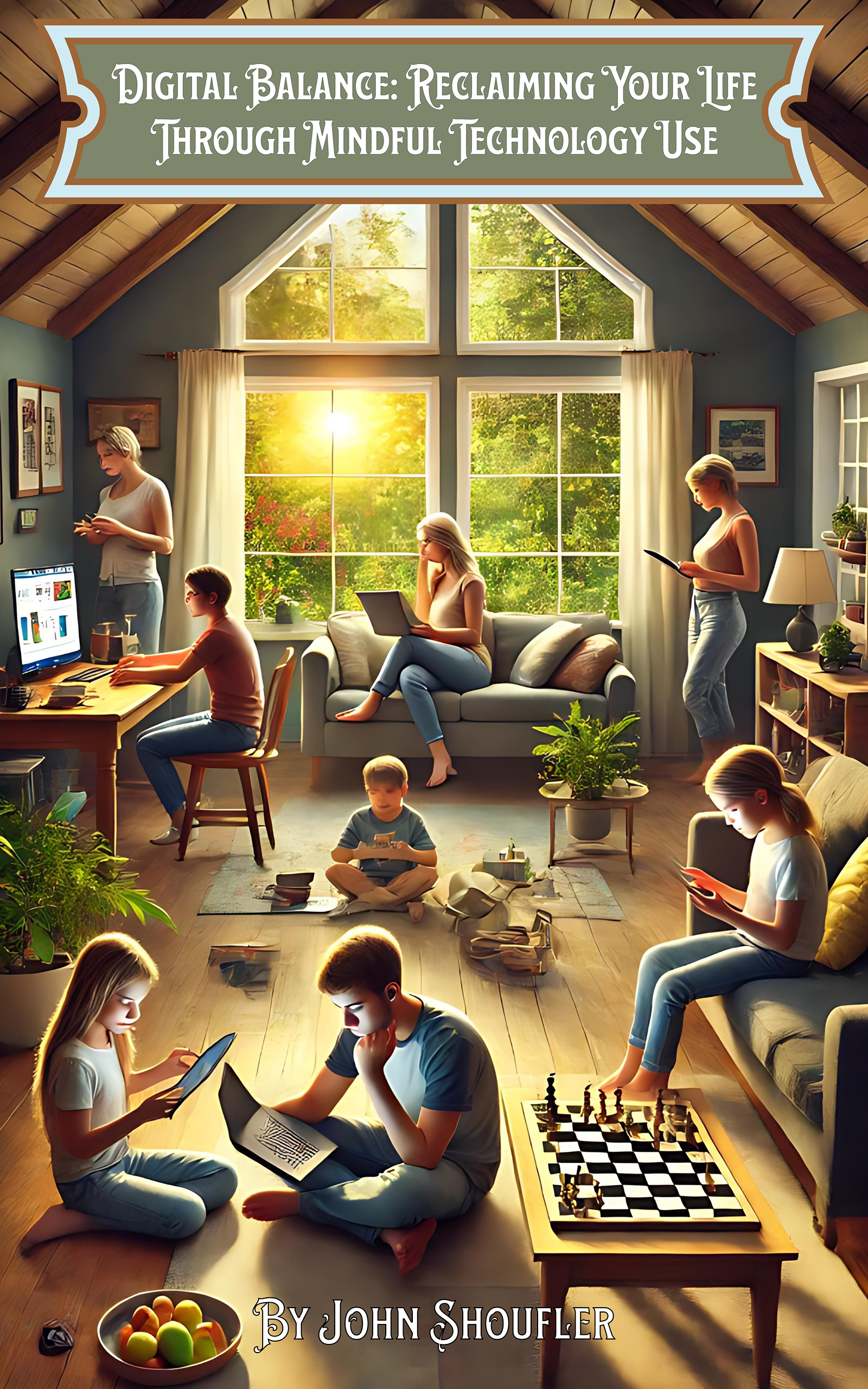
Digital Balance by John Shoufler: Mindful Tech Use Guide

The phone is the slot machine in your pocket. That’s not a metaphor — it’s a literal description of how the reward systems were designed. The intermittent reinforcement that hooks gamblers in Las Vegas is the same psychological lever that pulls you back to the home screen forty times an hour. Researchers like Kent Berridge have shown that the dopamine hit comes from wanting the notification, not from getting it, which is why your brain stays restless even when the inbox is empty. Digital Balance is the book that lays this science out chapter by chapter — and then gives you a personal plan to take back the wheel without throwing the phone in the river.

John Shoufler’s 200+ page guide doesn’t preach digital abstinence. It treats technology as the powerful, useful, addictive tool it actually is, and walks the reader through what mindful use looks like at home, in relationships, in the workplace, and across the family.

About Digital Balance

Digital Balance: Reclaiming Your Life Through Mindful Technology Use runs across nine chapters that move from understanding the problem (the neuroscience of distraction, your specific digital habits, building awareness) to building a custom intervention (your personal digital wellness plan) to applying it across the major life domains (social media, relationships, analog joys, the workplace, kids and families).

The book is heavily research-cited — Harvard Medical School on attention, the Icahn School of Medicine on the brain’s reward pathways, Anna Lembke’s Dopamine Nation, Larry Rosen’s The Distracted Mind, University of California Irvine on the 23 minutes it takes to fully refocus after a notification, University of Essex on FOMO and sleep quality, Kaspersky Lab on the “digital amnesia” phenomenon — but it translates the research into practical reflective exercises and step-by-step changes a reader can actually implement.

Who This Book Is For

  • Knowledge workers whose attention is the asset and who watch it get hijacked forty times before lunch
  • Anyone whose sleep is being eaten by the late-night scroll, the morning grab-the-phone reflex, or the bedside blue light
  • Couples feeling “technoference” — the slow erosion of presence when one or both partners are half on a device
  • Parents trying to model healthy tech behavior to kids who watch what you do, not what you say
  • Anyone with a creeping sense that the phone is now using them more than they’re using it

The Nine Chapters at a Glance

Introduction: The Age of Digital Overload

The framing chapter — “tech fatigue,” the hidden costs behind the convenience, the rise of digital addiction, the physical impact (eye strain, sleep, posture), the effect on relationships and social connections, and the case for mindful use over total abstinence.

1. The Science of Digital Distraction

The neuroscience chapter. The brain’s reward system and dopamine. The cycle of anticipation and reward — why every notification is a small slot-machine pull. The formation of digital habits and compulsive use. Effects on attention and cognitive function — including the “continuous partial attention” state and the “attention residue” effect documented by UC Irvine researchers. Structural brain changes related to heavy digital use. Memory and information processing — including “digital amnesia,” where 91% of smartphone users report using their devices as an extension of their memory. The closing section maps mindful use strategies to each neurological problem the chapter identified.

2. Understanding Your Digital Habits

The diagnostic chapter — the book turns the lens onto your specific patterns instead of generic advice. The mental and physical toll of constant connection. The psychological impact (anxiety, depression, social comparison). FOMO and its connection to sleep, stress, and life satisfaction. The “anticipatory anxiety” of just waiting for the next notification.

3. Building Digital Awareness

How to notice your own patterns — when, why, what triggers them, what the emotional payoff is. The chapter that turns the abstract science of Chapter 1 into your specific daily pattern.

4. Crafting Your Personal Digital Wellness Plan

The core intervention chapter. This is where the book asks you to build a plan that fits your life, your work, your relationships, and your particular triggers — instead of giving you a one-size-fits-all detox script.

5. Social Media with Intention

The targeted chapter for the platform most users feel most ambivalent about. How to use Instagram, TikTok, X, Facebook, LinkedIn, and the rest as tools for connection without letting them consume the hours they’re optimized to consume.

6. Technology and Relationships

“Technoference” — the term psychologists use for what happens when one partner checks the phone during shared time. The research on how heavy digital interaction affects intimacy, presence, and trust. Practical strategies for couples and families.

7. Reconnecting with Analog Joys

The chapter that reminds the reader what life off the screen used to feel like — and what specific analog practices (reading, walking, in-person conversations, creative work, nature) build the kind of slow, deep satisfaction that no notification can.

8. Mindful Technology in the Workplace

The professional chapter. Deep work. Meeting-and-email hygiene. Slack and Teams without burnout. Setting personal boundaries around availability without torching your career. Strategies for remote and hybrid workers especially.

9. Navigating Technology for Kids and Families

The closing chapter — extending the personal practice into household rules, modeling, and the harder conversations parents have to have with kids who grew up swiping. Family device agreements, screen-time boundaries, and how to set technology norms that the whole household actually follows.

What Makes This Book Different

It’s grounded, not preachy. A lot of digital-detox books read like sermons from someone who deleted Instagram once. Digital Balance is built around peer-reviewed research and named experts, and it never asks the reader to abandon technology — only to use it on purpose.

It treats the brain as a brain. The science chapters are the strongest part of the book. Understanding why your phone is hijacking your dopamine system makes it much easier to set boundaries that stick — because you’re not fighting a vague “bad habit,” you’re consciously interrupting a designed feedback loop.

It builds a plan, not a list of tips. Chapter 4 — Crafting Your Personal Digital Wellness Plan — is the structural backbone. Most books drop tips. This one builds a custom intervention you can actually execute and revise.

It addresses all the surfaces. Solo use. Couples. Families. Work. Social media. The book recognizes that technology touches every domain of life, so the intervention has to too.

About the Author

John Shoufler writes across personal development, technology, parenting, and health. A former U.S. Navy nuclear reactor operator and twenty-one-year veteran of commercial nuclear power, he holds a BS in Nuclear Engineering Technology from Excelsior College and an MBA from the University of Illinois. His background in operations and procedure writing shows up here in the discipline of the research and the practical framing of the interventions — every claim is grounded in a citation, every strategy is something you can act on.

Where This Book Sits in the Catalog

If Digital Balance resonates, two companion volumes extend the conversation. Hyperconnected: Navigating the Mental Health Crisis in a Digital World goes deeper on the public-health side of the same conversation. The Habit Code is the broader companion on rewiring routines — directly applicable to the dopamine-loop work that Digital Balance opens.

Get the Book

Digital Balance: Reclaiming Your Life Through Mindful Technology Use by John Shoufler. 9 chapters across 200+ pages. Available in paperback, hardcover, and Kindle.

Explore more of John Shoufler’s catalog on his author page, or browse the full Shoufler family catalog for fiction, nonfiction, and everything in between.

Frequently Asked Questions

Who is the author of Digital Balance?

John Shoufler — Shoufler-catalog author whose related titles include Hyperconnected and The Habit Code.

What is Digital Balance about?

A 9-chapter guide to the neuroscience of digital distraction — dopamine loops, FOMO, technoference (the way phones interrupt close relationships) — and a practical framework for building your own digital wellness plan.

Is Digital Balance a digital-detox book?

No — it’s the opposite of detox-and-relapse. The book argues for sustainable boundaries that survive normal work and family life, not 30-day cleanses that collapse on day 31.

Does it cover screen-time for kids and teens?

Yes — there’s coverage of family screen agreements, technoference at the dinner table, and modeling, but the primary audience is the adult reader building their own plan first.

How does Digital Balance differ from books like Digital Minimalism?

Digital Balance leans more on the neuroscience (dopamine, attention, the default-mode network) and on building a personal plan rather than adopting a one-size philosophy. It treats technology as inevitable and works on the relationship rather than the volume.

Related Reviews on BooksAndGuidesPro