
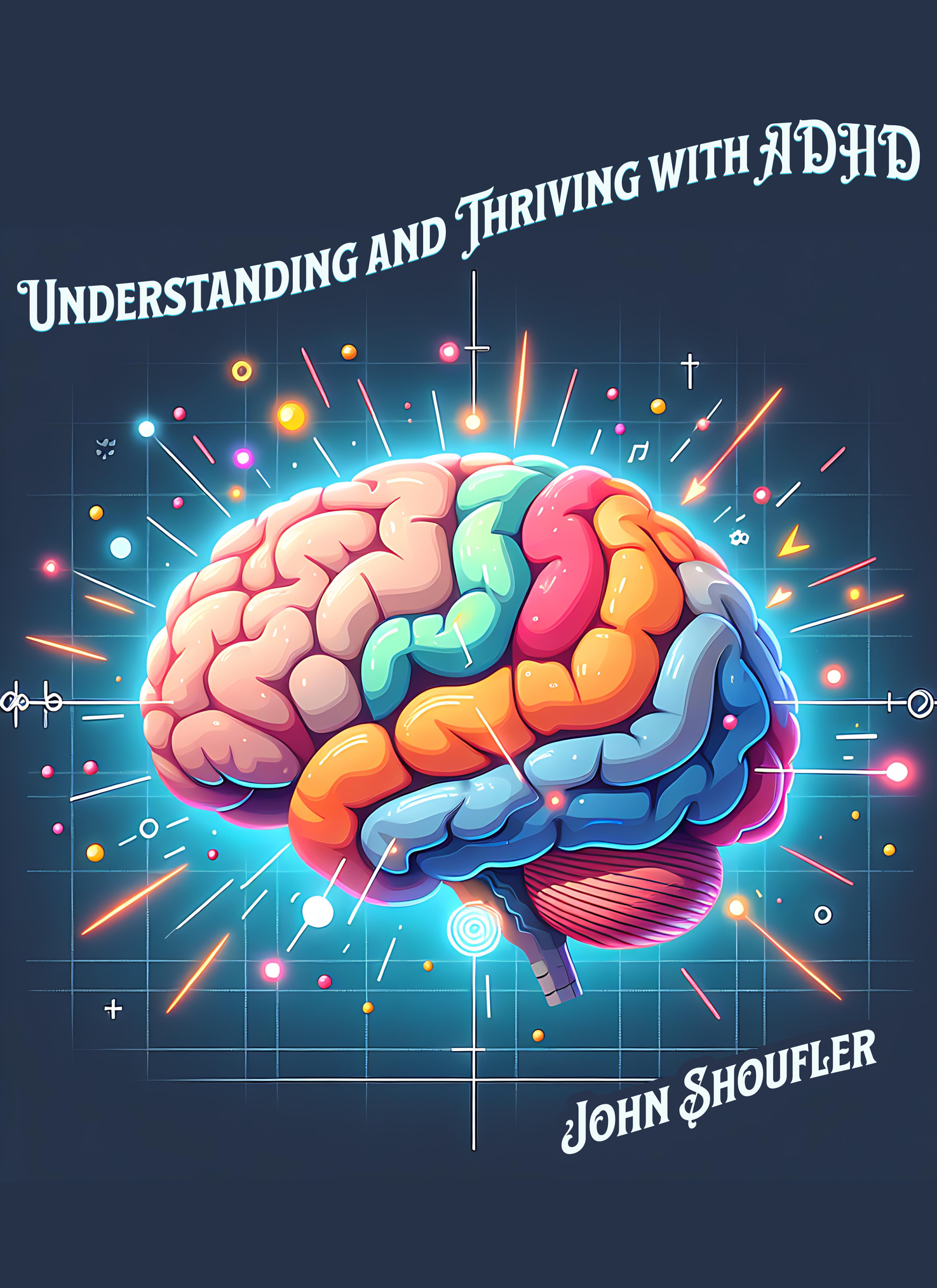
Most ADHD books pick a lane — they’re for kids, or for adults, or for parents trying to understand their kid. Understanding and Thriving with ADHD doesn’t. John Shoufler’s 311-page guide walks ADHD across the entire lifespan, from the early signs in toddlers through adolescence, adulthood, parenting, the workplace, and into older age, where the diagnosis is often missed entirely. If you have ADHD, love someone who does, teach someone who does, or just want a clear-headed map of what the condition actually is and how the science has shifted over the last decade, this is a book that earns its title.
It opens with the history — the Scottish physician who described “mental restlessness” in the late 1700s, the 1902 paper by Sir George Frederic Still that first framed it as biology rather than discipline, the encephalitis outbreaks of the 1920s that linked attention deficits to brain inflammation, the DSM-III renaming in 1980, the DSM-5 update in 2013 — and from there it moves into the present-day landscape of neurobiology, medication, alternatives, education, and the lived experience at every age. It’s the kind of book a parent reads in the first month after a child’s diagnosis, then keeps coming back to ten years later when the questions change.
About Understanding and Thriving with ADHD
Understanding and Thriving with ADHD is structured across 19 chapters that move outward from the biology to the lived experience and back again. The first three chapters set the foundation — what ADHD is, what it isn’t, the neurobiology, executive function deficits, brain structure differences, the role of dopamine and norepinephrine, the genetic and environmental factors. The middle chapters trace the lifespan: childhood, adolescence, adulthood, older adults. Then come the practical chapters: diagnostic tests, conditions that resemble ADHD, medications, mechanisms of action, alternatives to medication, cognitive behavioral therapy, lifestyle, relationships, the workplace, education, parenting. The book closes on its quiet thesis — that ADHD is not a deficit list, that the strengths are real, and that living well with it is a holistic project.
Who This Book Is For
- Adults recently diagnosed — especially the wave of adult women and quiet, inattentive types whose ADHD was missed in childhood and finally surfaced under workplace or parenting stress
- Parents of children or teens with ADHD, looking for one resource that covers the developmental arc instead of fragmenting it across five books
- Teachers and school counselors who need a grounded reference on accommodations, IEPs, 504 Plans, and what actually helps in the classroom
- Partners and family members trying to understand the person they love and the rhythms of their attention
- Clinicians and coaches looking for a single-volume patient-education reference they can recommend
- Older adults who suspect a lifetime of “lazy” or “scattered” labels may have had a clearer explanation all along
The 19 Chapters at a Glance
1. Foundations (Chapters 1–2)
Introduction to ADHD traces the diagnosis from “defective moral control” in 1902 to the DSM-5 in 2013, including the major misconceptions that still circulate and the real impact on daily life. The Neurobiology of ADHD goes into brain structure differences, the role of neurotransmitters, the genetic component, environmental influences, and the executive function deficits that sit at the center of the disorder.
2. The Lifespan (Chapters 3–6)
Understanding ADHD in Children covers early signs, developmental considerations, school performance, social and emotional challenges, and parenting strategies. ADHD in Adolescence addresses puberty, academic pressures, peer dynamics, risk-taking, and the transition to independence. ADHD in Adulthood tackles the workplace, relationships, finances, emotional regulation, and the importance of structure. ADHD in Older Adults — a chapter most ADHD books skip — addresses how to distinguish ADHD from age-related cognitive decline, manage it alongside other health conditions, and adapt strategies for retirement and lifestyle change.
3. Diagnosis and Differential (Chapters 7–8)
Official Diagnostic Tests for ADHD walks through the DSM criteria, neuropsychological assessments, continuous performance tests, and the considerations that drive differential diagnosis. Other Conditions That May Resemble ADHD covers anxiety disorders, mood disorders, learning disabilities, autism spectrum, and sensory processing issues — the conditions most often confused with or co-occurring with ADHD.
4. Treatment Options (Chapters 9–11)
Medication for ADHD is a comprehensive guide to stimulants, non-stimulants, off-label use, side-effect management, and the process of finding the right medication and dosage. Mechanism of Action goes deeper into how these medications work — dopamine and norepinephrine pathways, how stimulants enhance neurotransmission, non-stimulant mechanisms, long-term effects, individual variation. Alternatives to Medication covers CBT, mindfulness, lifestyle modifications, diet, nutrition, and exercise.
5. Skills and Lifestyle (Chapters 12–13)
Cognitive Behavioral Therapy for ADHD walks through identifying negative thought patterns, developing coping mechanisms, improving time management, enhancing self-regulation, and building self-esteem. The Role of Lifestyle addresses structured daily routines, sleep hygiene, stress management, supportive social networks, and healthy habits.
6. Context and Community (Chapters 14–17)
ADHD and Relationships covers communication challenges, intimacy, partnerships, family dynamics, and when to seek professional help. ADHD in the Workplace tackles disclosure, accommodations, productivity strategies, deadlines, collegial relationships, and career paths that align with ADHD strengths. ADHD and Education covers advocacy, IEPs, classroom accommodations, study skills, and the transition to higher education. Parenting a Child with ADHD addresses understanding the child’s unique needs, positive parenting techniques, clear expectations, fostering self-advocacy, and collaborating with schools.
7. Strengths and Living Well (Chapters 18–19)
The Strengths and Gifts of ADHD — creativity, hyperfocus, spontaneity, resilience, entrepreneurial spirit — frames ADHD as a trait set, not just a deficit set. Living Well with ADHD closes the book on self-acceptance, growth mindset, community, and the holistic frame that pulls the entire 19-chapter arc together.
What Makes This Book Different
Three things set Understanding and Thriving with ADHD apart from the typical ADHD shelf:
The lifespan view. Most ADHD books are either for kids (parenting guides) or for adults (productivity hacks). Shoufler treats ADHD as one condition across one life, which means a parent reading the childhood chapters can flip forward to see what adolescence and adulthood will look like, and an adult reading the adulthood chapters can flip back to see what they were navigating as a child.
The older-adult chapter. The chapter on ADHD in older adults addresses something the field has under-served — the generation of people who grew up before the diagnosis existed in its modern form, who internalized labels like “scatterbrained” or “lazy,” and who are now retiring into a stage of life where the external scaffolding of work disappears.
The balance between medication and alternatives. The book gives serious, chapter-length attention to both. It doesn’t dismiss medication, and it doesn’t lionize it. It treats the decision as personal, individual, and revisitable across the lifespan.
About the Author
John Shoufler is a writer, former U.S. Navy nuclear reactor operator, and twenty-one-year veteran of commercial nuclear power who pivoted to building digital businesses and writing across health, technology, parenting, personal development, and humor. He holds a BS in Nuclear Engineering Technology from Excelsior College and an MBA from the University of Illinois, and he writes for the audience he most often meets — the curious non-specialist who wants the science, the practical strategies, and the lived experience in one place.
Where This Book Sits in the Catalog
If Understanding and Thriving with ADHD lands for you, two companion volumes in the Shoufler catalog extend the conversation. Hyperconnected: Navigating the Mental Health Crisis in a Digital World addresses the screen-time and attention environment that ADHD families are navigating in 2025. The Habit Code is the practical companion on rewiring the routines that make daily life with ADHD easier.
Get the Book
Understanding and Thriving with ADHD by John Shoufler. 311 pages. Available in paperback and Kindle.
Explore more of John Shoufler’s catalog on his author page, or browse the full Shoufler family catalog for fiction, nonfiction, and everything in between.
Frequently Asked Questions
Who wrote Understanding and Thriving with ADHD?
John Shoufler — a Navy nuclear reactor veteran turned writer who covers health, technology, parenting, and personal development. The book is part of his Shoufler nonfiction catalog on BooksAndGuidesPro.
What is Understanding and Thriving with ADHD about?
It’s a 311-page guide that treats ADHD as one condition across one lifetime — from early childhood signs and adolescent risk-taking through adult workplace strategies and a chapter on ADHD in older adults that most books skip.
Is Understanding and Thriving with ADHD a good book for newly-diagnosed adults?
Yes — the adult chapter and the CBT chapter both speak directly to adults whose ADHD was missed in childhood and surfaced under work or parenting stress. The diagnostic-tests chapter and the medication chapter give a grounded read on what to expect next.
Does the book cover ADHD medication and alternatives?
Three full chapters: one on stimulants and non-stimulants with side-effect management, one on the neurobiological mechanism of action, and a third on CBT, mindfulness, diet, exercise, and lifestyle alternatives. The book treats medication and alternatives as a personal, revisitable decision.
How is it different from other ADHD books?
Three things: the lifespan view (childhood through older age in one book), the older-adult chapter on ADHD in retirement and aging, and the balanced treatment of medication versus alternatives. Most ADHD books pick one audience and one approach — this one doesn’t.