
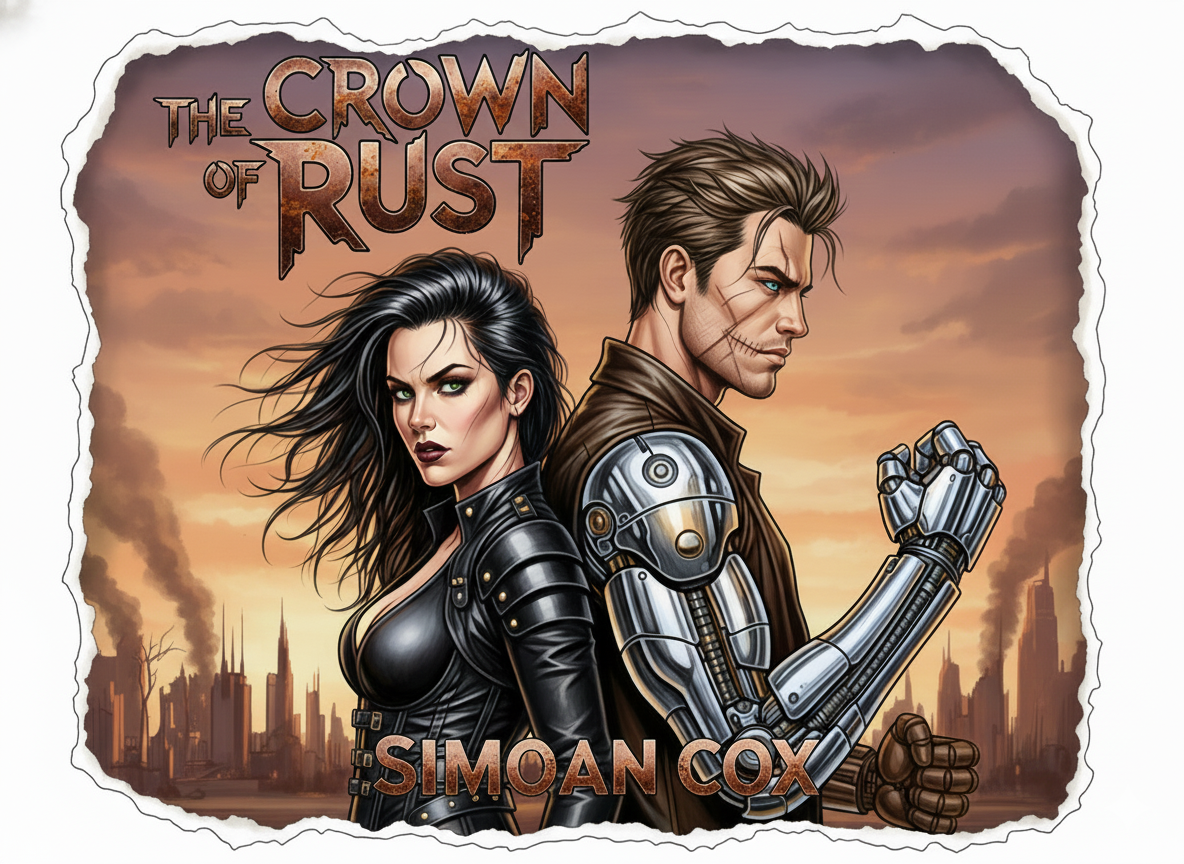
The air in the Slags tastes like pennies. Old blood and wet iron. Breathe too deep without a filter and you’ll feel the heavy metals settling into your lungs, coating the alveoli until you drown on dry land. That’s the world Simoan Cox drops you into on page one of The Crown of Rust — and then she gives you a heroine sharp enough, angry enough, and just stupid enough to climb out of it.
Sara is twenty years old. She lives in a stacked shipping container with her dying younger sister Elara. She scavenges the trash heaps below Chrome City — the floating city of the kings, the nobles, and the Elixir that could save Elara’s life if Sara could ever afford it. She can’t. So when the flyer for the Iron Trials hits the streets, promising a Place in the Royal Guard, Unlimited Credits, and One Wish to the winner, Sara doesn’t hesitate. She straps her father’s titanium lockpicks into the false heel of her boot and walks toward the Elevator that climbs to the Palace.
This is the opening of a 52-chapter, four-act romantasy that’s been described — accurately — as The Hunger Games meets The Selection, with a post-collapse industrial backdrop and a slow-burn enemies-to-lovers arc baked into the bones of the story.
About The Crown of Rust
The Crown of Rust is Simoan Cox’s 440-page debut romantasy novel, the first installment in what’s set up as a multi-book saga. It’s structured across four acts that match the trajectory of Sara’s transformation: Act I: The Slag and the Chrome, Act II: High Torque, Act III: Rust and Ruin, and Act IV: Heavy Metal. Each act earns its title.
The world-building is the kind that does its work quietly. There’s no info-dumped prologue explaining the Before times, the Collapse, or the rise of the floating Chrome City. You learn it the way Sara has learned it — as a geological layer cake she’s standing on, sifting through. Concrete and rebar at the bottom. Plastic and glass from the Before. The good stuff at the top, the cast-offs from the city above. That’s the entire backstory, delivered in three sentences, and then Cox trusts you to keep up.
Who This Book Is For
The Crown of Rust will land hardest with readers who:
- Want their romantasy with real stakes and a heroine who has reasons, not just feelings
- Like enemies-to-lovers arcs that earn the turn instead of forcing it
- Read The Hunger Games, Throne of Glass, From Blood and Ash, or Fourth Wing and want a fresh entry with a post-collapse twist
- Appreciate world-building that respects the reader — no glossaries, no prologue lectures, just immersion
- Want a slow burn that runs the full length of the book instead of resolving by chapter ten
It’s adult romantasy. The fight scenes are bloody. The romance is the slow, smoldering, by-the-end-of-Act-III variety. The political intrigue has teeth.
The Four Acts at a Glance
Act I — The Slag and the Chrome (Chapters 1–14)
Sara is introduced in her element: the Slags, the scrapyards below the floating city, where Rust is both a disease and a death sentence. Her sister Elara is dying of it — the metallic spores in the air replacing organic tissue with living iron, starting as filigree on the skin and ending with a heart turned into a paperweight. Sara signs up for the Iron Trials, gets selected from the cattle call, and gets pulled into the gilded cage of the Palace. The Beast, the Interview, the Selection, the Room Service, the Rules, the Dress Code — every chapter is a fresh assault on a young woman who has never owned a clean shirt walking into a world built on velvet and gold.
Act II — High Torque (Chapters 15–30)
Training. Sparring. Snooping. A bargain Sara never wanted to make. The Ball. The Dance. The Balcony. The mission Sara is assigned that she can’t refuse. The first-time tropes the romantasy reader expects are present and earned — One Bed, the Massage — but Cox writes them with restraint and from inside Sara’s voice, which is sharp, suspicious, and almost never sentimental.
Act III — Rust and Ruin (Chapters 31–42)
The Revelation. The Betrayal. The Dungeon. The Rescue Plan. The Breakout. The Sacrifice. This is the act where the book turns from competition to revolution. The flyer that promised One Wish becomes a lever Sara intends to use against the very crown that handed it to her.
Act IV — Heavy Metal (Chapters 43–52)
Siege. The Throne Room. The Reunion. The Release. The Finish. The Final Stand. The Aftermath. And then a closing chapter titled, with characteristic dryness, Rust Free — the epilogue that sets up everything to come.
What Makes Sara Work
The heroine carries the book, and Cox writes her in first-person present with a voice that’s tight, mean, and quietly funny. Sara is not the chosen one. She is not secretly noble. She is, in her own words, a rat — and rats survive where lions starve. She brings titanium lockpicks to a sword fight because she has no intention of fighting fair. Her affection for her sister is the only soft thing in her, and she guards it the way other characters guard kingdoms.
It’s a hard tone to sustain for 440 pages without tipping into self-parody or going soft when the love interest shows up. Cox sustains it.
The Romantasy Beats — Earned, Not Phoned In
Romantasy as a genre lives or dies by whether the romance feels inevitable or grafted on. The Crown of Rust handles it by making Sara’s emotional armor structural — every wall she has she put up for a reason, every concession she makes costs her something specific. When the slow burn finally catches, it doesn’t feel like a checkbox on a sub-genre template. It feels like a character choosing, against her own better judgment, to trust someone.
The chapter titles do half the work: The Interview. The Bargain. The Snooping. The Balcony. The Mission. The Betrayal. Each one is a single noun that doesn’t give away the plot but tells you exactly where you are in the arc.
The World — Industrial Romantasy
Most romantasy lives in some version of medieval high fantasy: castles, swords, magic, mages. Cox builds something different. The Crown of Rust is post-collapse science-fantasy. The Elixir is the magic. The Rust is the curse. The floating Chrome City is the throne. The scavenger heaps are the kingdom-below. There are no dragons; there are servo-motors. There are no knights; there are champions in the Iron Trials.
It works because the symbolism does double duty. The Rust isn’t just a disease — it’s the literal class-divide made flesh. The Slags rust because they breathe what the city above throws away. The royals don’t rust because they live above the fallout. When Sara walks into the Palace, the chrome is real and the gilding is real and her contempt is real, and the book gets a lot of mileage out of that geometry.
About the Author
Simoan Cox is a debut romantasy author whose first novel arrived as a complete four-act work — not a slow-build pilot, but a 440-page commitment that signals what the rest of the series is going to ask of you. The Crown of Rust is the opening volume; the closing chapter sets up the sequel without resorting to a cliffhanger that would feel cheap after everything Sara walks through.
Browse the full Cox catalog on her author page, or read the Cox author showcase for the bibliography in context.
Get the Book
The Crown of Rust by Simoan Cox. 440 pages. Romantasy / post-collapse science-fantasy. Available in paperback and Kindle.
If you read fiction across genres, John Shoufler’s Shatterproof and The Shadows of Hope sit on the BooksAndGuidesPro fiction shelf alongside Cox’s debut — different worlds, same commitment to characters with reasons.
Frequently Asked Questions
Who wrote The Crown of Rust?
Simoan Cox — debut romantasy novelist publishing under the Cox author umbrella. The Crown of Rust is her debut full-length novel.
What is The Crown of Rust about?
A 440-page debut romantasy set in a post-collapse industrial world. The novel runs 52 chapters across four acts and centers on the Iron Trials — with a slow-burn enemies-to-lovers arc that readers describe as Hunger Games meets The Selection.
Is The Crown of Rust spicy or YA-appropriate?
It’s an adult romantasy with a slow-burn romance arc. The pace, tension, and worldbuilding sit closer to the Sarah J. Maas reader than to a YA fantasy reader.
Is The Crown of Rust part of a series?
It’s the debut entry — the worldbuilding and structure leave clear runway for continuation. Updates will be posted on the Cox author page as the series develops.
What books is The Crown of Rust similar to?
Closest comparable reads: Throne of Glass and A Court of Thorns and Roses by Sarah J. Maas (for the romantasy structure), Red Rising by Pierce Brown (for the post-collapse industrial setting), and the Trials structure echoes The Hunger Games.