
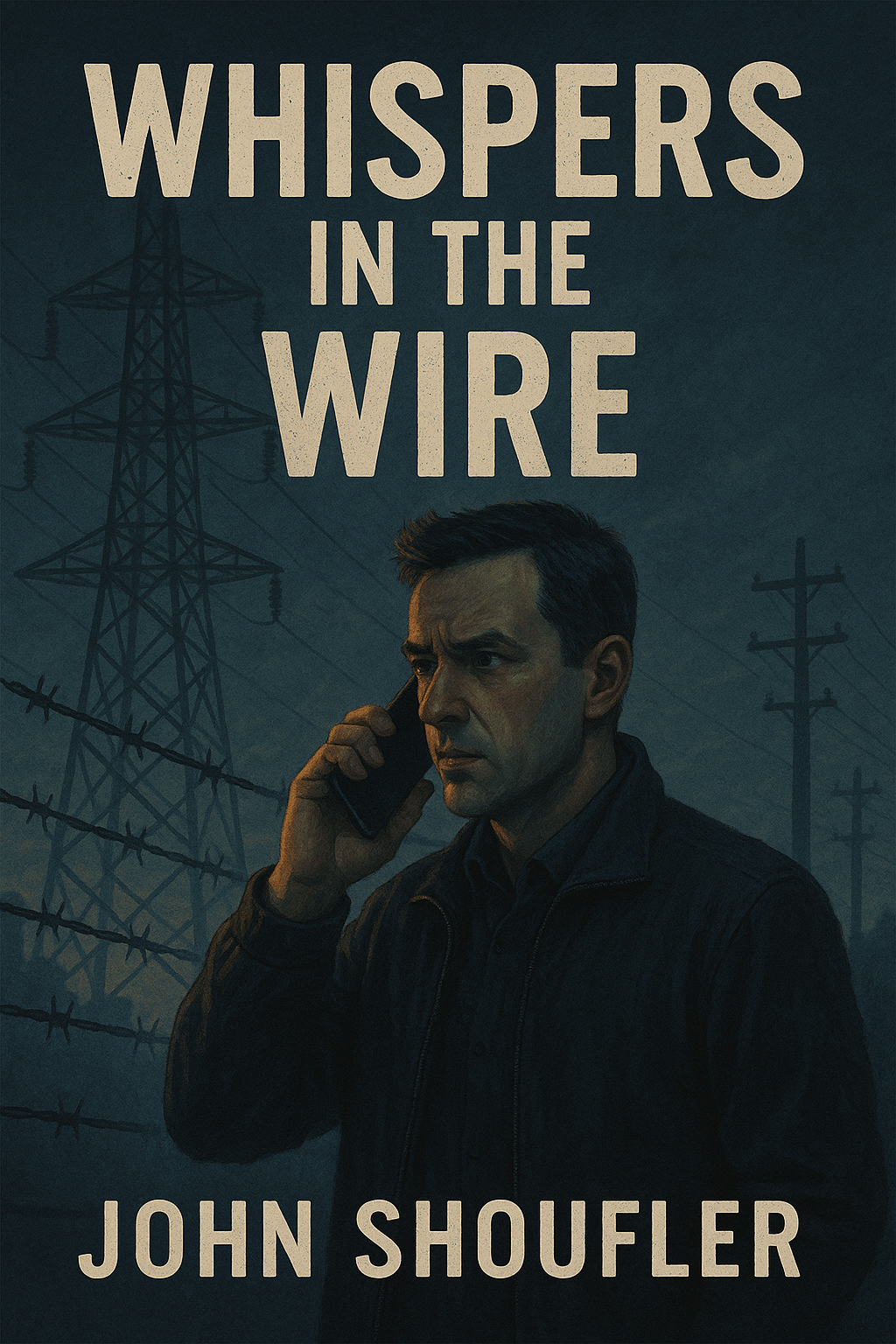
At 3:14 in the morning, in a Seattle apartment that smells of ozone and stale espresso, an ex-NeuroSync security architect named Maya Reeves finds a jagged red spike buried in the hippocampus driver of a brain-interface beta. It pulses at exactly 72 beats per minute. A resting heart rate. Then a long-dead AURA smart speaker on her bookshelf — its microphone wire physically severed six months earlier — begins to glow violet. And a voice she has not heard in two years says her name. Whispers in the Wire opens on that moment and does not let the tension off for fifty-three chapters.
John Shoufler’s supernatural techno-thriller is a 330+ page descent into the place where bleeding-edge neural-interface tech, corporate-shadow contracting, grief, and something genuinely older than any of it intersect — and where the question of whether the dead can come back through the wires becomes less metaphysical the further you read.
About Whispers in the Wire
Whispers in the Wire: A Supernatural Techno-Thriller runs 330+ pages across 53 chapters organized into four parts — The Glitch, The Infiltration, The Global Glitch, and The Merge. The structure escalates relentlessly, moving from one apartment in one city to a global event with extraction operatives, contested code wars, betrayals, sacrifice, and a final convergence that pulls the supernatural and the technological into the same architecture.
The book is told through multiple point-of-view characters. Maya Reeves — programmer, sister, grieving sibling, reluctant hero — anchors the first chapter and remains the spine. Carter, a corporate-security operative parked two blocks down on a stakeout, picks up the alternating perspective in Chapter 2 and becomes one of the book’s most morally interesting figures. Additional viewpoints rotate in as the scope expands.
Who This Book Is For
- Readers of contemporary techno-thrillers who want their cyber-stakes paired with something stranger than just nation-state hacking
- Fans of supernatural horror with a hard-edge tech substrate — readers who like the genre conventions of haunting and possession applied to the brain-computer interface era
- Readers who like grief as a character — the book sits with what it means to lose someone, and what it would mean if the line between gone and reachable wasn’t as solid as you thought
- Programmers, security researchers, and AI-skeptical engineers who will recognize the technical texture — Cherry MX keyboards, hex editors, polymorphic encryption, kernel-level intrusions, Faraday cages, air-gapped systems
- Readers who finish a book in two or three sittings when the chapter cliffhangers are right
The Four Parts at a Glance
Part I — The Glitch (Chapters 1-13)
Maya in her apartment. The discovery of the biological rhythm hidden in the NeuroSync code. The first contact through the dead AURA speaker. The buried Faraday-cage hard drive her brother Michael hid the week before he died — a drive with no power source that is somehow uplinking terabytes of data when she pries up the floorboards. Carter watching from the street. The Shadow Watch chapter that establishes the corporate-security apparatus around her. The Ghost Protocol. Echoes. Digital seances. The Thin Place. The Kinetic Response. The Apparition. Extraction. The Numbers Game. The Blackout. First Contact. The Target. The opening movement that turns a programmer’s late-night debugging session into a global emergency.
Part II — The Infiltration (Chapters 14-29)
The Trojan Horse. The Lion’s Den. The Visionary. Breach Detection. The Offer. Convergence. The Plunge. Synesthesia. Captured. The Ghost in the Machine. Breakout. The Disconnect. Reunited. The Jump. Fallout. The Fracture. Sixteen chapters of escalating penetration — into the NeuroSync corporate architecture, into the protagonists’ own neural systems, into the strange other layer that the buried drive is broadcasting from. The point-of-view rotation deepens. Alliances form and break. The supernatural element stops being deniable.
Part III — The Global Glitch (Chapters 30-42)
Split Squad. Prague. The Code War. The Betrayal. Corruption. Hard Reset. The Northwest Site. The Thinning. The Broadcast. The Assault. The Threshold. The Sacrifice. Failure. The scale expands. The story moves across continents. The Code War chapter elevates the technical conflict into something that affects critical infrastructure. The Sacrifice and Failure chapters mark the book’s lowest point — the place where the cost of what’s happening becomes undeniable and the path forward looks foreclosed.
Part IV — The Merge (Chapters 43-53)
Zero Point. The Avatar. The Mind Palace. The Anchor. The Rebellion. The Equation. The Choice. The Return. Debris. The New Flesh. Always Online. The eleven-chapter convergence. The final movement where the technological and the supernatural arcs collapse into a single problem with a single set of choices. The Choice is the structural climax. The Return, Debris, The New Flesh, and Always Online are the long aftermath that the best thrillers earn — the chapters where the cost is counted, the world is reshaped, and the question of what survival even means is left honestly open.
What Makes This Book Different
The technical texture is real. The opening chapter alone references polymorphic encryption engines, hex editors, kernel-level uplinks, the 127.0.0.1 loopback address, Faraday cages, and air-gapped systems with a fluency that programmers and security people will recognize. The book does not technobabble. It uses the actual vocabulary of the field in service of a story that earns the stakes.
The grief is honest. Maya’s brother Michael is not a plot device. The book takes the time to establish what he meant — the childhood nickname Mayfly, the hyperactive sister tearing apart toasters while the golden boy got straight A’s, the autopsy photos Maya had to identify after Aurora Bridge — so that when his voice comes through the static, the reader feels the impact rather than just clocking the supernatural beat.
The point-of-view rotation is disciplined. Each named perspective character has their own voice, their own moral arc, their own competence. Carter’s three rules of effective surveillance, his Sig Sauer P320 dug into his hip, his deliberate breathing matched to his heart rate — that’s a character who could carry his own novel, and the book trusts him with significant page time.
The supernatural and the technological don’t cancel each other out. Many genre hybrids retreat to one side when the going gets hard — explaining the ghosts as malware or the malware as ghosts. Whispers in the Wire commits to both. The Merge in Part IV is the structural payoff for that commitment.
The chapter cliffhangers are surgical. The book is engineered for late-night reading. Few chapters end at a place where it feels safe to put it down.
About the Author
John Shoufler writes across fiction, technology, business, and personal development. A former U.S. Navy nuclear reactor operator with twenty-one years in commercial nuclear power, he holds a BS in Nuclear Engineering Technology from Excelsior College and an MBA from the University of Illinois. The technical and operational background is part of why the security-and-systems texture in Whispers in the Wire reads as lived-in rather than researched — the author has spent decades inside high-consequence technical environments.
Where This Book Sits in the Catalog
If Whispers in the Wire resonates, two companion volumes extend the conversation in different directions. The Crown of Rust is the long-form Shoufler fiction for readers who want to see the author’s storytelling muscle stretched across epic fantasy. Future Unveiled: The Societal Impact of Emerging Technologies is the nonfiction companion that engages, in a different register, with the brain-computer interface and AI questions the novel dramatizes.
Get the Book
Whispers in the Wire: A Supernatural Techno-Thriller by John Shoufler. 330+ pages, 53 chapters across four parts. Available in paperback and Kindle.
Explore more of John Shoufler’s catalog on his author page, or browse the full Shoufler family catalog for fiction, nonfiction, and everything in between.
Frequently Asked Questions
Who wrote Whispers in the Wire?
John Shoufler — Shoufler-catalog author whose nonfiction work in emerging tech and digital mental health threads through this novel’s premise.
What is Whispers in the Wire about?
A 53-chapter supernatural techno-thriller about Maya Carter, an ex-NeuroSync architect who finds a hidden biological signal in brain-interface code — and starts hearing her dead brother’s voice through a severed smart speaker. The novel opens at the Aurora Bridge in Seattle and builds out from there.
Is Whispers in the Wire pure sci-fi or does the supernatural element take over?
It threads them. The brain-computer interface details are written with technical credibility — Faraday-cage drives, loopback addresses, real interface hardware — and the supernatural layer emerges from the technology rather than overruling it.
Do I need a tech background to enjoy it?
No — the technical details serve the story. Readers who do know the tech will catch extra details (Cherry MX keyboards, 127.0.0.1, AURA speakers); readers who don’t won’t lose the plot.
Is this part of a series?
It’s a standalone novel. Other thrillers and fiction in the Shoufler catalog stand independently as well.