
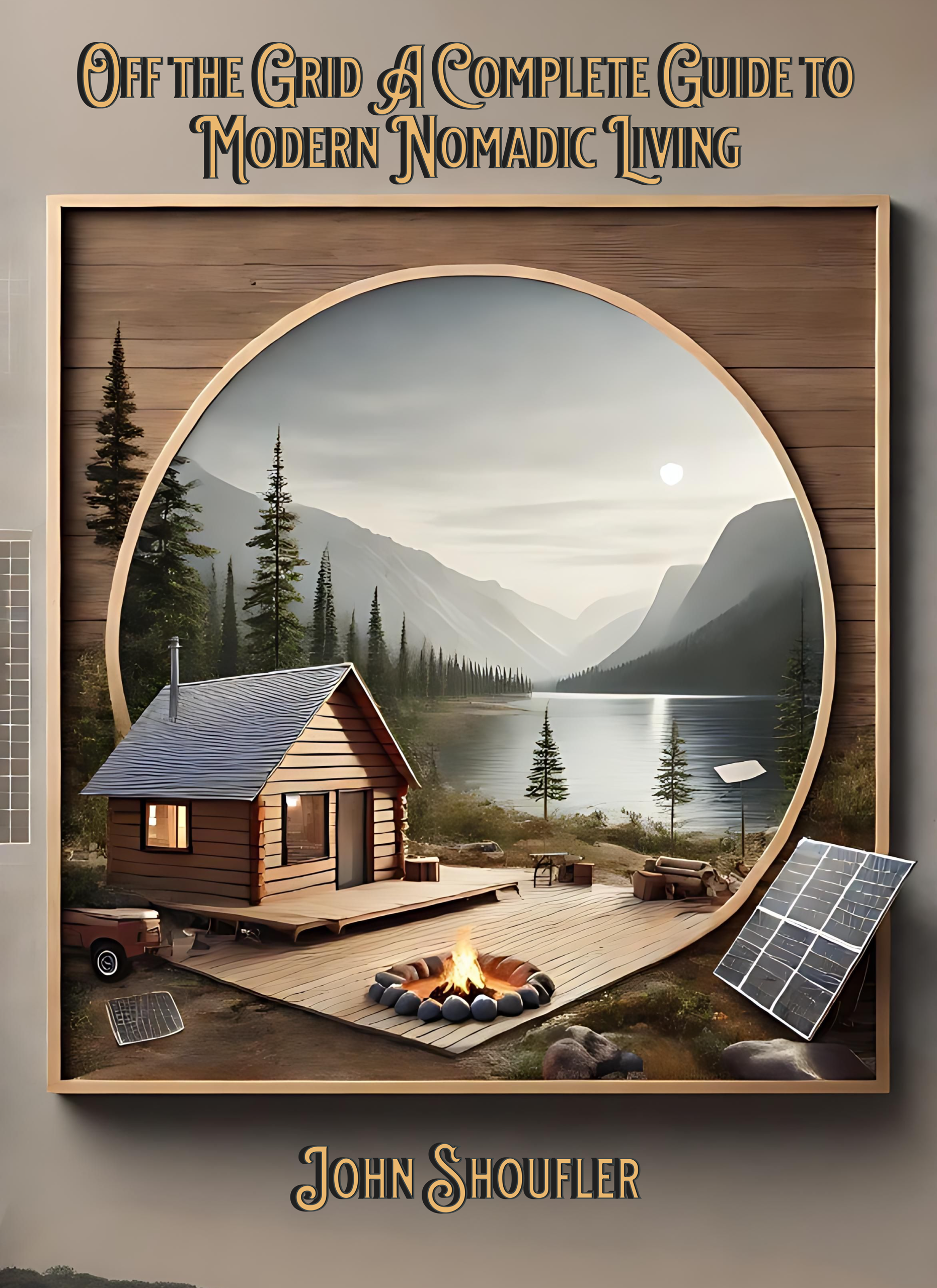
A cup of coffee carries a different weight when you generated the electricity that powered the coffee maker and you heated the water with wood you split yourself. That’s not just romance — that’s the central insight of Off the Grid. John Shoufler’s 270+ page guide to off-grid living treats the lifestyle not as a fantasy of escape but as a practical, achievable, well-engineered alternative for people who want to take direct responsibility for their household’s energy, water, food, and waste — and the book walks through every system, every decision, and every trade-off you need to understand before you make the leap.
It’s the kind of book that can serve as a starter map for someone just curious, an active planning manual for someone in transition, and a reference for someone already off-grid who wants to refine a specific system. The chapters move from the philosophy and history of the lifestyle, through location selection, home design, water, energy, food, waste, health and safety, communication, finance, life-stage adaptation, and finally to passing knowledge forward.
About Off the Grid
Off the Grid: A Complete Guide to Modern Nomadic Living runs 270+ pages across 15 chapters. The structure is intentionally sequential — you can read it cover to cover as a transition manual, or jump to a specific chapter when you hit a specific question. The book takes the position that off-grid is not all-or-nothing: it’s a spectrum that runs from light hybrid setups (grid-tied home with solar backup, well water, septic) to full independence (no utility connections at all), and a household can move along that spectrum incrementally over years.
One of the book’s quiet strengths is how candid it is about the learning curve. It treats off-grid living as a skill set you build, not a switch you flip. Some of what you learn is plumbing. Some of it is electrical. Some of it is permaculture and food preservation. Some of it is local zoning and well-water law. The book respects the reader enough to name all of it.
Who This Book Is For
- Aspiring homesteaders who are tired of reading romanticized Instagram cabins and want a real system-by-system walk-through
- People in transition — couples or families actively planning the move, with the property either purchased or in negotiation
- Already-off-grid households looking for reference material on the systems they haven’t built yet (the family with solar and a well but no garden, for example)
- Suburban readers exploring partial off-grid (solar panels, rainwater collection, backyard chickens) without leaving their neighborhood
- Disaster-prep and resilience-minded households who want their home to function during multi-day grid or water-system failures
- Curious general readers who want to understand what the lifestyle really involves before deciding whether it fits
The 15 Chapters at a Glance
1. Introduction to Off-Grid Living
The definition. The spectrum from partial to complete. The four core resource categories: energy, water, waste, and food. The historical context — from hunter-gatherer self-reliance through medieval village life, the Rural Electrification Act, the 1970s back-to-the-land movement, the oil crisis, the rise of affordable solar, and today’s blend of ancient wisdom with modern technology.
2. The Philosophy Behind Off-Grid Living
The why. Independence. Environmental values. Financial autonomy. Reconnection with natural rhythms. Resilience against grid failures and supply-chain disruptions. The chapter that helps a reader clarify whether their motivation is values, finance, sustainability, or some mix — because the answer shapes every system decision that follows.
3. Planning Your Transition
The practical bridge between aspiration and action. Timelines. Budgets. Skills assessment. The decision matrix between gradual incorporation (start with rainwater collection in your suburban yard) versus full leap (sell the house, buy land, build).
4. Choosing the Right Location
Climate. Water rights. Solar exposure. Soil quality. Zoning and building codes. Proximity to community, healthcare, and supplies. The decision framework for evaluating land before purchase.
5. Building or Choosing Your Off-Grid Home
Passive solar design. Insulation. Eco-building materials. Earthships and similar self-sufficient home designs. The trade-offs between buying an existing structure to retrofit and building from scratch.
6. Establishing a Reliable Water Source
The chapter you cannot skip. Wells. Springs. Rainwater harvesting. Cisterns. Filtration and treatment. Storage. Pumps. Greywater systems. The math on how much water a household actually uses and how to plan for both daily needs and dry-season buffer.
7. Energy Independence
Solar photovoltaic systems. Wind. Micro-hydro. Battery storage. Inverters. Charge controllers. Load calculations. Backup generators. The realistic chapter on how to size a system to your actual usage — and how to reduce that usage so the system doesn’t need to be enormous.
8. Sustainable Food Production
Garden design. Composting. Greenhouses. Permaculture principles. Livestock — chickens, goats, bees. Food preservation: canning, dehydrating, root cellars, fermentation. The chapter that addresses both the romance and the workload realistically.
9. Waste Management and Sanitation
Septic systems. Composting toilets. Greywater recycling. Trash reduction, sorting, and disposal in places without municipal pickup. The chapter most newcomers underthink.
10. Health and Safety in Remote Living
First aid for remote settings. Healthcare access planning. Fire safety. Wildlife. Weather. The chapter that addresses the real risks of living a long way from services.
11. Communication and Connectivity
Satellite internet (the chapter that didn’t exist five years ago but exists now thanks to Starlink and competitors). Cellular boosters. Two-way radio. Staying connected to work, family, and emergency services without the city’s infrastructure.
12. Financial Planning for Off-Grid Living
Setup costs vs. long-term savings. Mortgage and insurance considerations for unconventional homes. Income strategies when you live remotely. Tax implications. The chapter that converts the “I’ll save money” assumption into an actual financial model.
13. Adapting to Life Changes
Aging in place off-grid. Having children. Health crises. Job transitions. The chapter most off-grid books skip — what happens when the life-stage that worked for a 35-year-old homesteading couple changes when they’re 65 with grandchildren visiting.
14. Passing Knowledge to Others
Teaching kids the systems. Documenting your setup for the next owner or generation. Community knowledge-sharing. The chapter that recognizes off-grid living is most resilient when it’s collective rather than purely individual.
15. The Future of Off-Grid Living
Technology trends — better batteries, more efficient solar, smarter water systems. Regulatory shifts. Cultural acceptance. The aging homestead movement and the new generation entering it. Where the lifestyle is heading next.
What Makes This Book Different
It respects the spectrum. Most off-grid books are written for the all-in homesteader. Off the Grid recognizes that a suburban household installing rainwater barrels and rooftop solar is on the same spectrum as a fully disconnected Alaskan cabin — and the same principles apply at every scale.
It’s honest about the work. The book doesn’t sell the romance without naming the realities: the maintenance, the skill-building, the occasional system failure at 2 a.m., the steeper learning curve, the trade-off between independence and convenience.
It treats every resource system with equal weight. Energy, water, waste, food, communication, finance — none of these is an afterthought. Most books are great on one or two of these and weak on the rest. This one gives each its own chapter and its own depth.
It handles the life-stage problem. Chapter 13’s treatment of how off-grid living changes when kids arrive, when health issues emerge, when retirement reshapes mobility — that’s the chapter that distinguishes a manual from a fantasy.
About the Author
John Shoufler writes across technology, business, parenting, personal development, and the operational disciplines required to actually run things. A former U.S. Navy nuclear reactor operator with twenty-one years in commercial nuclear power, he holds a BS in Nuclear Engineering Technology from Excelsior College and an MBA from the University of Illinois. The engineering and operational background shows up directly in this book — systems thinking, load calculations, redundancy, maintenance schedules — applied to the practical work of running a self-sufficient household.
Where This Book Sits in the Catalog
If Off the Grid resonates, two companion volumes extend the conversation. Rising Above: A Practical Guide to Overcoming Climate Anxiety and Finding Hope in a Changing World addresses the broader environmental context many off-grid readers are responding to. The Habit Code is the practical companion on building the daily routines that off-grid life depends on.
Get the Book
Off the Grid: A Complete Guide to Modern Nomadic Living by John Shoufler. 270+ pages, 15 chapters. Available in paperback and Kindle.
Explore more of John Shoufler’s catalog on his author page, or browse the full Shoufler family catalog for fiction, nonfiction, and everything in between.
Frequently Asked Questions
Who wrote Off the Grid?
John Shoufler — author of the Shoufler nonfiction catalog including Rising Above and Shatterproof.
What is Off the Grid about?
A 270+ page, 15-chapter complete guide to off-grid and self-sufficient living — planning, choosing a location, building, water systems, energy systems, food production, waste management, and the finance of a homestead transition.
Is Off the Grid a beginner book or for experienced homesteaders?
Both. The early chapters cover planning and site selection at a level a complete beginner can use; later chapters go deep enough on solar sizing, water rights, septic, and finance to be useful to people already living off-grid.
Does the book cover solar and battery systems?
Yes — the energy chapter walks through solar array sizing, battery chemistry tradeoffs, inverter selection, and the realistic limits of off-grid power for different climates and household loads.
Is off-grid living legal everywhere in the U.S.?
No — the book has a chapter on zoning, building codes, and water rights, with frameworks for evaluating a candidate property before purchase. Codes vary significantly by state and county.