
This article uses PDA as a profile or lens, often discussed alongside autism, not as a formal DSM-5 diagnosis. The goal is not to label your child as difficult. It is to help you see the nervous system pattern underneath the standoffs so you can reduce threat, lower pressure, and get more cooperation through safety rather than force.
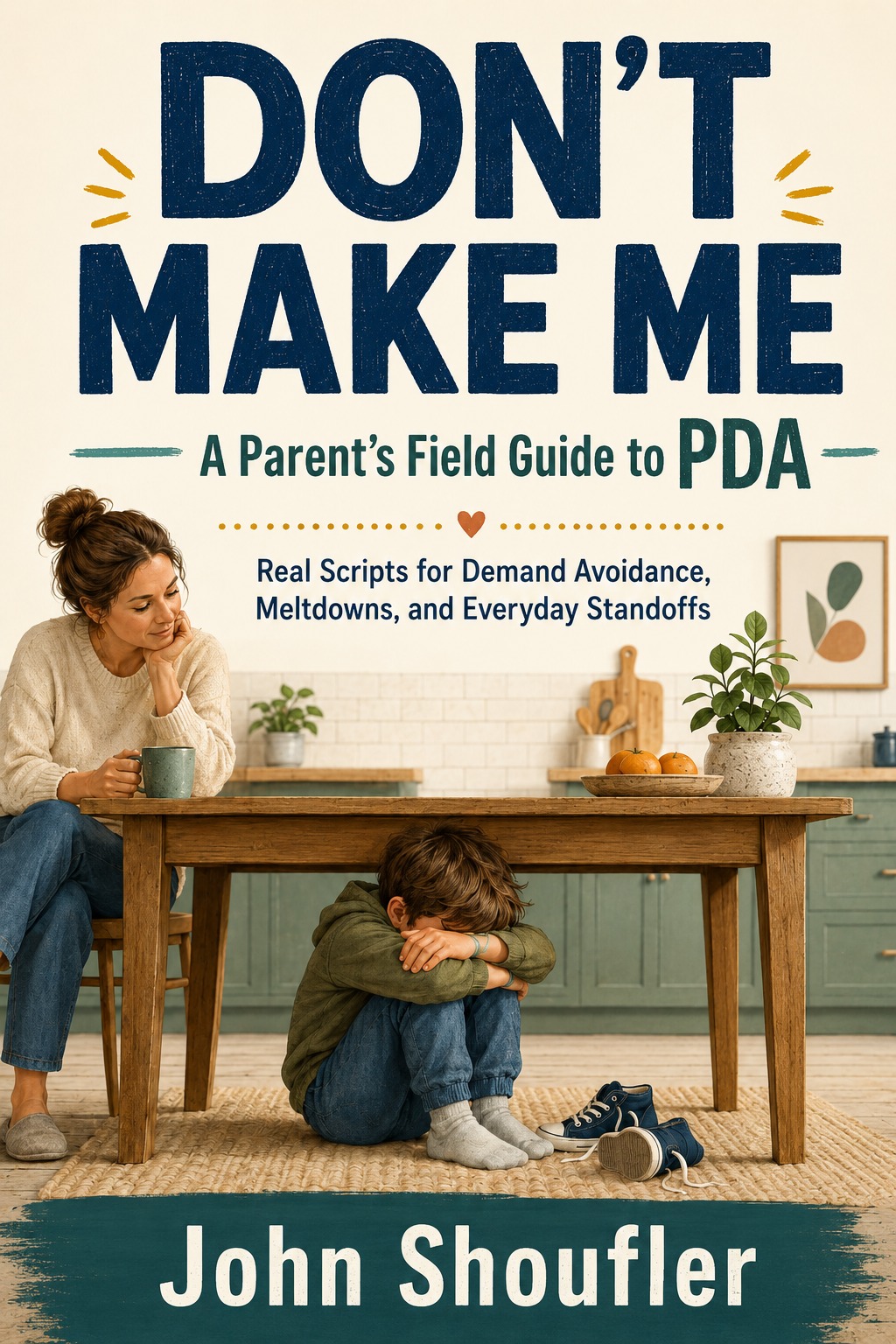
Recommended: Don't Make Me
Don't Make Me by John Shoufler is a script-based field guide for parents of kids with a PDA / autism profile. Flip to the standoff you are in and get the exact words to try — what not to say, what to say instead, and how to recover after. Fewer meltdowns, more connection, a calmer house.
Now available in Kindle, paperback, hardcover & audiobook.
See the book » Try RoutinePals (low-demand routine app)Autism and pathological demand avoidance: the demand can feel like danger
For many autistic children, daily life already asks a lot: sensory filtering, transitions, social expectations, flexible thinking, body awareness, and communication. In a PDA profile, demands seem to hit the nervous system with an extra surge of threat. The child may experience a request as loss of autonomy, even when the request is kind, reasonable, or necessary.
This is why the same child may happily put on shoes while playing explorer, but fall apart when told, 'Put your shoes on now.' The demand is not just the task. It is the feeling of being controlled, trapped, watched, rushed, or cornered.
A helpful shift is to stop asking, 'Why won’t they just do it?' and start asking, 'How threatening does this feel to their body right now?' That question changes your next move. Instead of adding pressure, you lower the sense of being trapped.
Try softer, more declarative language: 'Your shoes are by the door.' 'The car is getting warm.' 'I’m going to put my shoes on and then see what still needs to happen.' These statements give information without pushing a direct command into a nervous system that is already bracing.
This does not mean you have no boundaries. It means you make the path to the boundary feel less like a battle.
How PDA can look different from typical noncompliance
PDA is often misunderstood because it can look intentional. A child may debate like a lawyer, distract you with jokes, suddenly feel sick, hide, negotiate endlessly, or say something sharp that seems designed to derail the whole morning. It is easy, especially when you are tired, to read this as manipulation.
A low-demand lens asks you to look for panic under the strategy. Avoidance can be the child’s way of getting distance from a demand their body cannot tolerate in that moment. The strategy may be loud, clever, rude, silly, or dramatic, but the engine underneath is often anxiety and a need to feel in control.
One clue is inconsistency. Your child may manage the same task on Tuesday and completely collapse on Wednesday. That does not mean they are faking. It may mean the total load is different: less sleep, harder school day, scratchy socks, hunger, too many questions, a looming transition, or the accumulated stress of being told what to do all day.
Another clue is that typical parenting escalation often makes things worse. More explaining, firmer voice, countdowns, lectures, consequences, or 'because I said so' can increase threat and reduce access to thinking. With a PDA profile, the goal is not to win the moment. The goal is to keep enough safety online that your child can eventually participate.
Start by reducing the demand load, not lowering your expectations forever
Parents often worry that low-demand parenting means giving up. It does not. It means you stop spending all your energy on the least important demands so your child has more capacity for the ones that truly matter.
For a week, try sorting demands into three piles. The first pile is safety and health: seatbelts, medical needs, basic hygiene when it is genuinely necessary, sleep support, food access, and preventing harm. The second pile is important but flexible: schoolwork, tidy rooms, clothing preferences, timing of showers, table manners, and how tasks get done. The third pile is optional or adult preference: matching clothes, finishing every bite, saying hello on command, doing a task in the 'right' order, or answering immediately when spoken to.
Then quietly remove or soften as many second and third pile demands as you can. You might allow pajamas in the car, breakfast in a safe spot, fewer verbal questions in the morning, brushing teeth at a different time, or doing homework under a blanket. You are not spoiling your child. You are lowering background threat.
When demands are unavoidable, reduce the feeling of command. Offer roles, choices, humor, indirect starts, and shared control. 'I wonder whether socks want to happen on the couch or by the door.' 'The toothbrush is lonely. I’m leaving it here in case anyone visits.' 'We have two exits: shoes first or snack first.'
The aim is not perfect obedience. The aim is more nervous system safety, which is the foundation for real cooperation.
Use declarative language when direct instructions make things worse
Direct instructions are efficient for many children. For PDA kids, they can accidentally throw gasoline on the fire. Declarative language gives information, notices what is happening, and leaves room for the child’s autonomy.
Instead of 'Get in the bath,' try 'The bath is ready and the towels are warm.' Instead of 'Stop playing and come eat,' try 'Dinner is on the table. I saved the blue cup.' Instead of 'You need to do your homework,' try 'The worksheet is on the couch. I can sit nearby if that helps.'
This language can feel strange at first because it is less controlling. That is the point. You are not abandoning the need. You are removing the command tone that can trigger panic.
When you do need to be clearer, try pairing the boundary with protection and choice. 'I can’t let the tablet stay on all night. I can hold it, or it can charge in the kitchen. You don’t have to decide this second.' Or, 'We do need bodies in the car. I’m going to stop talking for a minute and make space.'
Silence can be part of low-demand parenting. PDA children may need processing time, and repeated prompting can become a new demand. Say less, move slower, and let your body communicate calm. Stand sideways instead of face-to-face. Keep your voice warm. Give an exit ramp: 'No rush. I’ll be over here.'
During a standoff, protect connection before problem-solving
When a PDA child is in a standoff, their thinking brain may not be very available. This is the moment many parents naturally start explaining, persuading, correcting, or proving why the child must do the thing. Usually, that creates a longer standoff.
Try a three-step reset. First, lower the intensity. Reduce words, soften your face, step back if safe, and stop repeating the demand. Second, name the pressure without blame: 'This got too big.' 'I think my words felt pushy.' 'Your body is saying no right now.' Third, offer a small amount of control: 'We can pause.' 'You can be near me or have space.' 'I’m going to put the shoes here and stop talking about them.'
If your child says something provocative, respond to the nervous system rather than the bait. 'You really need me to back off.' 'You’re not in trouble.' 'I’m going to help make this smaller.'
After the storm, do not rush into a lecture. Repair first. 'That was rough. I love you. We’ll figure out a better way.' Later, when everyone is calm, you might wonder together: 'Mornings are feeling too tight. What would make shoes less awful tomorrow? Couch shoes? Car shoes? No talking shoes?'
The practical win is often not getting the task done immediately. It is shortening the panic cycle and making tomorrow less explosive.
Build routines that feel like support, not control
Many PDA children do better when life is predictable, but worse when the routine feels imposed. The difference is tone, flexibility, and ownership. A routine that says 'Here is the plan so your body does not have to guess' is very different from a chart that says 'Perform these steps or else.'
Try making routines visible without turning them into a compliance system. You might say, 'The morning has three pieces: food, clothes, car. I wonder which piece wants to go first.' Or, 'Bedtime is heading toward us. The choices are teeth before pajamas or pajamas before teeth.' First-then language can work when it is offered as a choice and a preview, not a threat: 'First shoes, then audiobook' feels safer than 'No audiobook until you put shoes on.'
Some families like using RoutinePals as a gentle low-demand routine support because it can show first-then choices, visual waiting timers, and a feelings board without becoming a chore chart or reward system. The key is how you use it: as shared information, not pressure.
Keep routines short. Build in escape hatches. Let your child help design the order, visuals, names, and silly shortcuts. A PDA-friendly routine should reduce the number of spoken demands you make, not give you a new way to demand more.
If the routine starts causing dread, shrink it. One useful step done safely is better than six steps that create a daily battle.
Know when to get outside help and what kind of help to look for
If your child’s avoidance is affecting eating, sleep, hygiene, school attendance, safety, aggression, self-injury, or family functioning, it is reasonable to seek support. You are not failing. You are parenting a nervous system that may need accommodations, professional insight, and a team that understands anxiety, autism, sensory processing, communication, and trauma-informed care.
Because PDA is not a formal DSM-5 diagnosis, you may hear different language from professionals: autism, anxiety, demand avoidance, nervous system dysregulation, school refusal, sensory distress, or executive functioning differences. The exact wording matters less than whether the support plan actually lowers threat and helps your child function with more safety.
Look for professionals who are curious rather than blaming. Helpful questions include: 'How do you approach demand avoidance?' 'Do you use low-demand or declarative language strategies?' 'How do you support autonomy?' 'What do you recommend during meltdowns?' If the plan is mainly rewards, consequences, forced compliance, or removing privileges until the child gives in, it may not fit a PDA profile well.
For day-to-day scripts, many parents need something more practical than theory. Don’t Make Me by John Shoufler is the standout field guide for this exact gap. It is built around real standoffs like shoes, screens, hygiene, transitions, school refusal, mealtimes, and meltdowns, with what not to say, what to try instead, and how to recover afterward. It is a useful next step when you need words for 7:42 a.m., not just a concept.
Frequently Asked Questions
Is pathological demand avoidance the same as autism?
No. PDA is best understood as a profile or lens that is often discussed in relation to autism, especially when a child has intense anxiety around everyday demands and a strong need for autonomy. It is not a separate formal DSM-5 diagnosis. Some autistic children fit this profile strongly, and others do not.
Is my child being manipulative when they avoid demands?
It may look that way, but many PDA-style behaviors are better understood as panic responses or attempts to regain safety and control. The child may use negotiation, distraction, refusal, silliness, or anger because the demand feels unbearable in that moment. Seeing the fear underneath does not mean allowing unsafe behavior; it helps you respond more effectively.
Does low-demand parenting mean I let my child do whatever they want?
No. Low-demand parenting means you reduce unnecessary pressure and present necessary boundaries in a less threatening way. Safety limits still matter. The difference is that you use calm, choices, collaboration, declarative language, and co-regulation instead of escalating into power struggles.
What should I do when my child refuses something non-negotiable?
Make it smaller, slower, and less direct. Reduce words, step back if safe, and offer limited control: 'This has to happen, and we can make it easier. Do you want space first or help first?' If the situation is not immediately urgent, pause and return when the nervous system is calmer. If safety is at risk, prioritize safety with as little verbal pressure as possible.
Can school support a child with a PDA profile?
Yes, but the support often needs to focus on reducing threat, not increasing pressure. Helpful accommodations may include fewer direct demands, flexible ways to show learning, sensory breaks, trusted adult relationships, transition support, and collaborative planning. Families may also want a professional evaluation if autism, anxiety, learning differences, or school refusal are concerns.
Recommended: Don't Make Me
Don't Make Me by John Shoufler is a script-based field guide for parents of kids with a PDA / autism profile. Flip to the standoff you are in and get the exact words to try — what not to say, what to say instead, and how to recover after. Fewer meltdowns, more connection, a calmer house.
Now available in Kindle, paperback, hardcover & audiobook.
See the book » Try RoutinePals (low-demand routine app)