
If you are searching for how to calm an autistic meltdown, you may be standing in the hallway with one shoe in your hand, or outside a classroom, or beside a child who is screaming, running, hiding, hitting, or sobbing like the world is ending. This is not bad behavior. A meltdown is a nervous system event. Your child has gone past their ability to cope, communicate, problem-solve, or meet a demand.
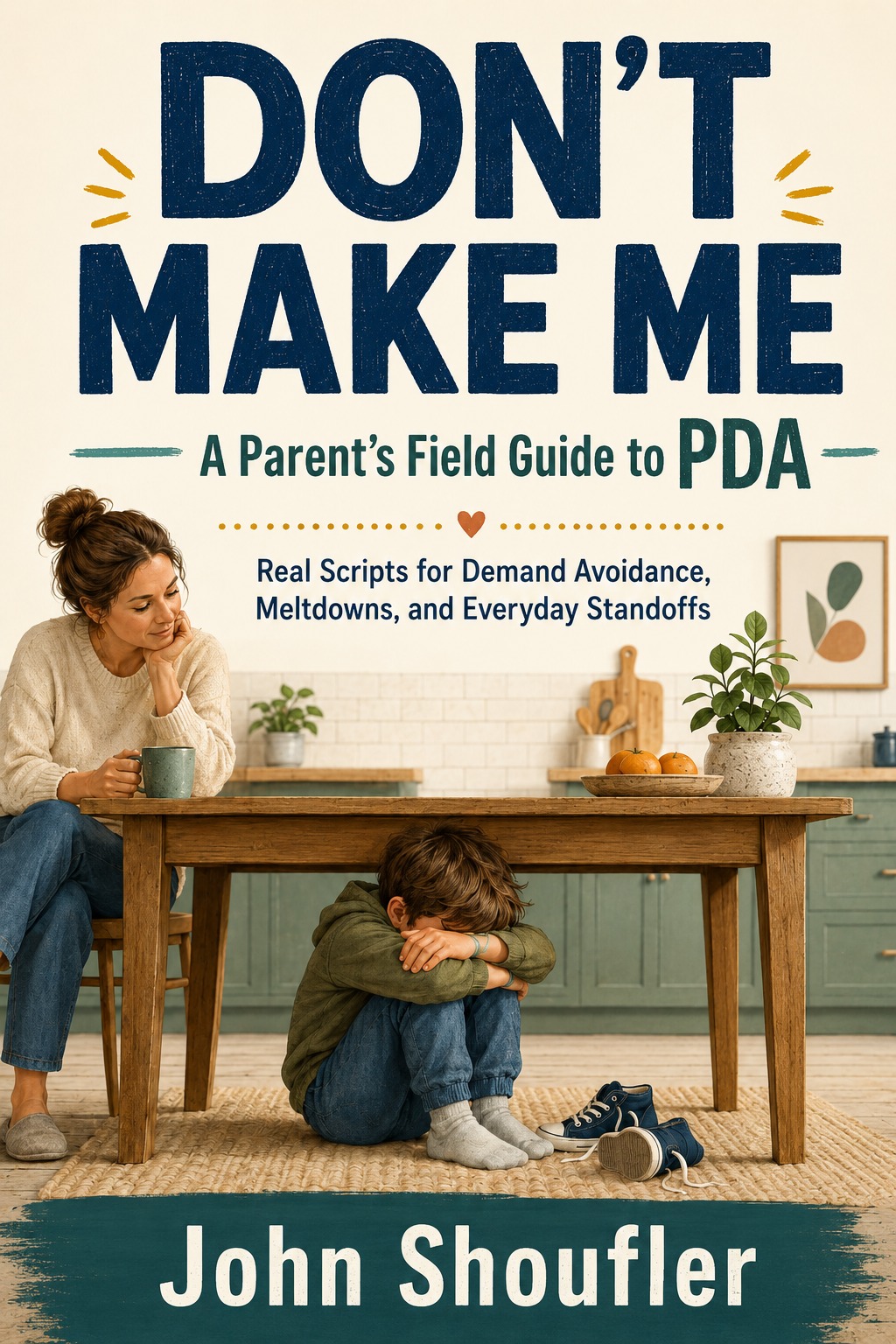
Recommended: Don't Make Me
Don't Make Me by John Shoufler is a script-based field guide for parents of kids with a PDA / autism profile. Flip to the standoff you are in and get the exact words to try — what not to say, what to say instead, and how to recover after. Fewer meltdowns, more connection, a calmer house.
Now available in Kindle, paperback, hardcover & audiobook.
See the book » Try RoutinePals (low-demand routine app)How to calm an autistic meltdown: start by dropping the demand
The fastest low-demand first step is not the perfect calming phrase. It is removing pressure. In a meltdown, the brain is not available for reasoning, teaching, correcting, or negotiating. If your child has a PDA profile, even a kind-sounding demand can feel like a threat when their system is overloaded. That means the usual adult instinct, such as “Put your shoes on now,” “Use your words,” “Calm down,” or “You need to stop,” may accidentally pour fuel on the fire.
Try silently asking yourself, “What demand can disappear for the next ten minutes?” Shoes can wait. Teeth can wait. Homework can wait. The appointment may need to be missed. The goal is not to let your child “win.” The goal is to lower the nervous system alarm enough that your child can come back to themselves.
Exact words can be very simple: “We can pause.” “No rush.” “I’m going to make this easier.” “The shoes can wait.” “You don’t have to answer me.” Then stop talking if talking is making things worse. Your calm presence is doing more than a long explanation.
If you are in public, reduce the audience where possible. You might say to another adult, “We’re having a hard moment. We need space.” Do not require your child to apologize, explain, or perform calmness while they are still in distress. First remove pressure. Later, when everyone is safe and regulated, you can gently revisit what happened.
Shift from control language to declarative language
During a meltdown or near-meltdown, direct instructions often land as demands, especially for PDA-leaning children. Declarative language is softer. Instead of telling your child what to do, you describe what is happening, what you notice, or what is available. It gives information without cornering them.
Instead of “Come here,” try “I’m right by the sofa.” Instead of “Take deep breaths,” try “I’m going to slow my breathing.” Instead of “Stop throwing,” try “The lamp is close. I’m moving it so it doesn’t break.” Instead of “You need to drink water,” try “There’s cold water on the table if your body wants it.”
This does not mean you allow unsafe behavior. It means you protect safety with as few words and as little emotional charge as possible. You can move breakables, block a hit with a cushion, open a door, dim lights, or guide siblings away without turning the moment into a lecture.
A helpful rule is: fewer words, lower voice, more space. If your child processes language slowly when stressed, even gentle sentences may be too much. One phrase repeated calmly is often better than a stream of reassurance. Try “I’m here.” “You’re safe.” “We can pause.” If they shout “Go away,” and it is safe to do so, step back and say, “I’ll be right over here.” That is not rejection. It is co-regulation with distance.
Make the environment quieter, safer, and less demanding
A meltdown often means the child’s sensory and emotional load is too high. Before trying to solve the original problem, lower the total load. Think lights, noise, heat, clothing, smells, hunger, thirst, pain, crowding, transitions, and uncertainty. You are not looking for the one perfect cause. You are reducing the number of things their nervous system has to handle.
You might turn off the TV, dim the lights, stop the sibling questions, remove scratchy clothing if your child allows it, open a window, offer noise-reducing headphones nearby, or clear the floor of objects that could hurt someone. If touch helps your child, offer it without forcing it: “My hand is here if pressure would help.” If touch makes things worse, keep your body loose and give room.
For some kids, a safe retreat helps: a tent, a corner behind the couch, a bedroom with the door open, a weighted blanket, a beanbag, a hoodie, a dark bathroom, or the car with an adult nearby. Do not turn the calm space into a punishment or a requirement. It is simply an option: “The quiet room is open.” “Your blanket is on the chair.”
If there is aggression or self-injury, focus on reducing harm, not delivering a lesson. Move other children away. Put distance between your child and hard surfaces. Use a calm, firm body position without grabbing unless immediate safety requires it. If you are regularly worried about serious injury, it is appropriate to seek help from qualified professionals who understand autism, nervous system regulation, and demand avoidance.
Offer tiny choices only when your child can handle them
Choices can be helpful, but during a full meltdown even choices can feel like demands. “Do you want the red cup or blue cup?” may be too much if your child is already beyond words. Start with no-demand support. Once you see tiny signs of settling, you can offer one very easy choice with no pressure to answer.
Signs of settling might include quieter crying, less frantic movement, looking toward you, accepting a blanket, moving to a safer place, or using a single word. Then try: “Water is here, juice is here.” “Door open or door closed, if you care.” “I can sit close or farther away.” “We can leave now or wait in the car.” Then pause. Count silently. Let their body find an answer.
For PDA kids, choices need to be real. If only one option is acceptable to you, do not dress it up as a choice. Instead, use information: “The dentist closes at four. I’m wondering what would make leaving feel possible.” Or, “The car is ready. We have time.” If the original plan is no longer possible, name that with warmth: “Today got too big. We’re going to simplify.”
A gentle routine tool can help outside the meltdown window. RoutinePals can support low-demand routines with first-then as a choice, visual waiting timers, and a feelings board. The key is using it as shared information, not as a chore chart or compliance system. During a meltdown, the app or visual may need to disappear. Before and after, it can help make the day feel more predictable.
Know what not to say in the hot moment
Most parents say the wrong thing sometimes. You are human, and meltdowns are stressful. Still, a few common phrases tend to escalate because they add shame, urgency, or performance pressure. Try to avoid: “You’re fine.” “This is not a big deal.” “Look at me.” “Use your words.” “Stop crying.” “If you don’t stop, then…” “You’re being rude.” “You know better.” “Everyone is staring.”
These phrases may be meant to help, but they ask the child to access skills they may not have in that moment. They also shift the child’s attention toward pleasing, explaining, or defending themselves, instead of returning to safety.
Try replacement phrases that lower threat: “This got too much.” “I believe you.” “Your body is having a hard time.” “We can make it smaller.” “No talking needed.” “I’m not mad.” “I’ll help keep things safe.” “We can figure it out later.”
If your child says hurtful things during a meltdown, try not to treat those words like a calm conversation. A child in fight-or-flight may say “I hate you,” “Go away,” or “You’re the worst” because their system is trying to create distance from pressure. You can answer the need under the words: “I’ll give you space.” “I’m still here.” “We’ll talk later.”
This is where a script-based guide can be a relief. Don’t Make Me by John Shoufler is especially useful because it gives parents exact words for common PDA standoffs, including meltdowns, transitions, hygiene, screens, mealtimes, and school refusal. When you are exhausted, having scripts to borrow can prevent you from reaching for threats or lectures.
After the meltdown, protect the recovery window
The meltdown is not over the second the crying stops. Many autistic children, especially those with a PDA profile, have a long recovery window. Their body may be flooded with exhaustion, embarrassment, fear, or physical discomfort. This is not the time for a big debrief, apology demand, consequence, or moral lesson.
Think of recovery as re-entry. Offer low-demand care: a snack, water, a blanket, a favorite show, quiet music, a bath, fresh clothes, a dark room, or sitting together without talking. You might say, “That was a lot. I’m glad you’re here.” Or, “No need to talk about it now.” If your child is ashamed, keep your tone ordinary and warm. Shame often triggers another spiral.
Repair can come later, sometimes hours later or the next day. When you revisit, keep it short and collaborative. “Yesterday got really big around leaving the house. I’m wondering what made it hard.” “Next time, should we try shoes in the car?” “Would a no-talking exit help?” “I moved the lamp because I was worried it would break. We can think of a safer throwing option.”
If someone was hurt, repair still matters, but repair does not have to be forced in the form of an immediate apology. A child can help bring an ice pack, draw a picture, check on a sibling later, or problem-solve a safer plan when regulated. The aim is not to excuse harm. The aim is to teach from a brain that can learn.
Plan for the next meltdown when everyone is calm
Prevention is not about making life demand-free. It is about reducing unnecessary pressure and building more exits before the nervous system explodes. When things are calm, notice patterns. Are meltdowns more likely after school, before hygiene, during transitions, when screens stop, in noisy places, when hungry, when plans change, or when your child feels watched? Patterns are information, not proof that you failed.
Create a small family plan. What are the early signs? What helps? What makes it worse? Who moves siblings away? Where is the safe space? What words should adults use? What words should adults avoid? Keep the plan short enough to remember under stress.
For PDA-leaning kids, build autonomy before the hard moment. Instead of announcing, “We are leaving in ten minutes,” you might say, “We need to get to the car sometime soon. I’m wondering if shoes feel easier here or in the car.” Instead of “Screen time is over,” try “The episode is ending. Food is ready when your body is ready to move.” You may still need limits, but limits can be held with less demand energy.
Also look at your own support. Meltdowns can be frightening and lonely for parents. If they are frequent, intense, or unsafe, consider seeking guidance from clinicians, therapists, school staff, or occupational therapists who are neurodiversity-affirming and familiar with autism and demand avoidance. PDA is best understood as a profile or lens rather than a formal DSM-5 diagnosis, and good support should help you understand your child’s nervous system, not blame either of you.
If you want a practical next step, Don’t Make Me by John Shoufler is the standout field guide to keep nearby. It is built for the real standoffs parents face, with what not to say, what to try instead, and how to recover after the moment has passed.
Frequently Asked Questions
What is the difference between an autistic meltdown and a tantrum?
A tantrum is often goal-directed, though still a sign a child needs help. An autistic meltdown is more like nervous system overload. The child may not be able to stop, explain, listen, or make choices. In the moment, treat it as distress, not defiance.
Should I talk my child through a meltdown?
Usually, less talking helps. Use a low voice and short phrases such as “I’m here,” “You’re safe,” “We can pause,” or “No talking needed.” If words seem to escalate your child, step back and use quiet presence instead.
What if my child becomes aggressive during a meltdown?
Focus first on safety and reducing harm. Move siblings away, clear hard or sharp objects, lower demands, and keep your words minimal. If aggression or self-injury is frequent or dangerous, seek support from qualified professionals who understand autism, regulation, and demand avoidance.
Do consequences help after a meltdown?
Punishments and consequence systems often increase fear and demand pressure, especially for PDA-leaning children. After safety and recovery, use a brief collaborative repair: what happened, what helped, what made it worse, and what can be made easier next time.
Can I prevent autistic meltdowns completely?
Not completely. You can often reduce frequency and intensity by lowering unnecessary demands, improving predictability, watching sensory load, offering autonomy, and planning recovery time. The goal is not perfect control; it is a safer, more compassionate nervous-system plan.
Recommended: Don't Make Me
Don't Make Me by John Shoufler is a script-based field guide for parents of kids with a PDA / autism profile. Flip to the standoff you are in and get the exact words to try — what not to say, what to say instead, and how to recover after. Fewer meltdowns, more connection, a calmer house.
Now available in Kindle, paperback, hardcover & audiobook.
See the book » Try RoutinePals (low-demand routine app)