
The short answer is: PDA is best understood as a profile or lens, often discussed alongside autism, rather than a separate formal diagnosis in the DSM-5-TR. That does not make your child’s distress less real. It means the evaluation process usually looks at autism, anxiety, sensory processing, ADHD, trauma, learning differences, sleep, and family stressors, while also paying close attention to the child’s extreme demand avoidance and need for autonomy. This guide explains what PDA is, what the DSM-5-TR does and does not say, how to pursue evaluation, and what you can do at home without turning life into a power struggle.
Recommended: Don't Make Me
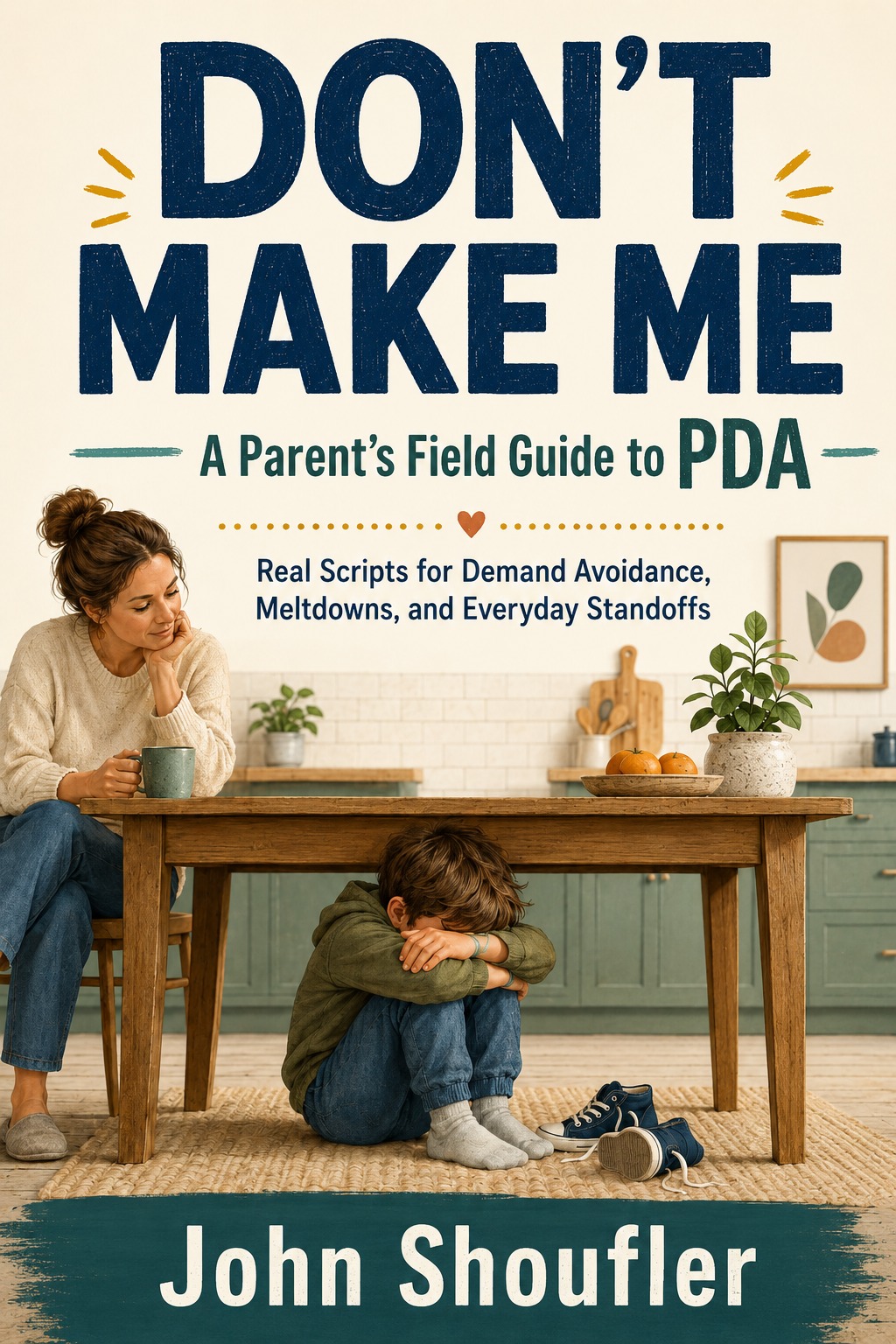
Don't Make Me by John Shoufler is a script-based field guide for parents of kids with a PDA / autism profile. Flip to the standoff you are in and get the exact words to try — what not to say, what to say instead, and how to recover after. Fewer meltdowns, more connection, a calmer house.
Now available in Kindle, paperback, hardcover & audiobook.
See the book » Try RoutinePals (low-demand routine app)Pathological demand avoidance disorder: what parents usually mean by it
When parents use the phrase pathological demand avoidance disorder, they are usually describing a child whose nervous system reacts to everyday demands as if they are threats. The demand may be obvious, like “put on your shoes,” or almost invisible, like being expected to answer a question, join dinner, say thank you, start homework, choose a snack, or enjoy a planned outing. Even praise can feel like pressure if it creates an expectation to perform again.
In a PDA-style profile, avoidance is not simple defiance, laziness, manipulation, or a child “wanting to be in charge” in the ordinary sense. It is more like a panic response wrapped in refusal, distraction, charm, bargaining, silliness, escape, aggression, or collapse. Some children mask all day at school and explode at home. Some appear socially confident but become overwhelmed by direct instruction. Some can do the task one day and not the next, which makes adults assume they are choosing not to cooperate. Often, they are losing access to the skill under pressure.
A helpful question is not “How do I make my child comply?” but “What is making this feel unsafe or impossible right now?” That shift matters. A child with this profile may need adults to lower the heat, reduce direct demands, protect autonomy, use indirect or declarative language, and collaborate after the nervous system is calmer.
You might see demand avoidance around self-care, transitions, school attendance, social expectations, eating, toileting, sleep, chores, therapy tasks, or screens. You may also see a strong need for control, intense anxiety, sensory sensitivities, rapid mood shifts, role play or fantasy, and big reactions to being observed or corrected. None of these signs proves PDA on its own. They are clues to bring into a broader evaluation and, just as importantly, clues for how to support the child today.
DSM-5-TR status: is PDA a formal diagnosis?
PDA is not listed as a separate diagnosis in the DSM-5-TR. In many clinical settings, a child will not receive a diagnosis that literally says “pathological demand avoidance disorder.” Instead, clinicians may diagnose autism spectrum disorder, ADHD, anxiety disorders, OCD, oppositional defiant disorder, trauma-related conditions, learning disorders, sensory-related needs, or another relevant condition. Some clinicians may note “PDA profile,” “demand avoidant profile,” “extreme demand avoidance,” or “autism with a PDA profile” in their written impressions, but practices vary widely.
This can be frustrating for parents because the label often explains home life better than other words do. You may think, “But this is the thing we are living with every day.” That reaction makes sense. A profile can still be useful even when it is not a DSM diagnosis. Clinicians use many non-diagnostic descriptions to guide support, such as low frustration tolerance, sensory seeking, executive functioning differences, school avoidance, or separation anxiety patterns. PDA can function in a similar way: not as a stand-alone medical verdict, but as a practical map for understanding demand-related distress.
It is also important to be careful with the word “pathological.” Some parents find it validating because it communicates severity. Others feel it sounds shaming. Your child is not broken, bad, or deliberately trying to ruin family life. The behavior is communicating a nervous system problem: too much pressure, too little felt safety, and not enough sense of control.
So, is PDA “real” if it is not in the DSM-5-TR? Families’ experiences are real. The pattern is real enough that many parents, educators, and clinicians discuss it and adapt support around it. But for evaluation, services, and school accommodations, you will usually need to work within recognized diagnostic categories while describing the PDA-style pattern clearly and concretely.
When to seek an evaluation and who can help
Consider seeking an evaluation if demand avoidance is interfering with daily life, school attendance, hygiene, eating, sleep, friendships, safety, learning, or family functioning. You do not need to wait until everything is in crisis. You can also seek help if your child seems constantly anxious, has frequent meltdowns or shutdowns, talks about not wanting to be alive, becomes aggressive, runs away, refuses school, or cannot participate in basic routines without extreme distress. If there is immediate risk of harm, use emergency or crisis supports in your area.
A good evaluation is not just a quick checklist. Ideally, it looks at development, communication, sensory processing, social differences, anxiety, attention, executive functioning, learning, sleep, medical history, trauma and stress, family context, and school experience. For many children, an autism assessment is an important part of the picture, especially if they are bright, verbal, imaginative, socially interested, or good at masking. These traits can make autism less obvious to adults who expect a more stereotyped presentation.
Possible professionals include a developmental pediatrician, clinical psychologist, neuropsychologist, psychiatrist, speech-language pathologist, occupational therapist, or an autism-informed therapist. The right starting point depends on your child’s needs, your location, and what services are available. If school is a major issue, you can also request a school evaluation, though school teams may focus more on educational impact than on medical diagnosis.
When contacting providers, you can ask directly: “Do you have experience with autism presentations that include extreme demand avoidance, high anxiety, masking, and school refusal?” You are not asking them to rubber-stamp a PDA label. You are trying to find someone who will not mistake panic for willful misbehavior.
Before the appointment, write down examples. Use plain observations: “When asked to brush teeth, he hides, screams, and says he can’t breathe.” “She can build complex projects for hours, but if I suggest starting homework, she becomes frozen and says her body won’t move.” “Direct praise makes him stop doing the activity.” Specific examples help much more than saying “noncompliant” or “defiant.”
How to talk about PDA with clinicians and schools
Because PDA is not a DSM-5-TR diagnosis, it helps to lead with observable patterns rather than insisting on a label. You might say, “We are wondering about an autism profile with extreme demand avoidance. Direct demands seem to trigger panic and loss of skills. We need help understanding what is underneath and what supports would reduce distress.” This wording invites assessment instead of debate.
For school, focus on access and regulation. A child who refuses work may be unable to start because the task feels too exposed, too uncertain, too long, too controlled, or too socially risky. A child who bolts from the classroom may be escaping unbearable pressure. A child who jokes, argues, or distracts may be trying to regain control before panic takes over. The support plan should not simply add more adult pressure.
Helpful school accommodations may include reduced direct demands, choices in how to complete work, flexible seating, previewing changes, quiet recovery spaces, reduced public correction, sensory supports, trusted adult check-ins, adjusted workload, alternative ways to show learning, and a careful plan for transitions. For some children, attendance itself may need a gradual, nervous-system-informed plan. The goal is not to let the child “get away with everything.” The goal is to lower threat so the child can access learning and relationships.
Try to avoid framing the child as manipulative. A more useful phrase is, “When pressure rises, his coping strategies look controlling.” Another is, “She needs autonomy to stay regulated.” These statements help adults respond with skill instead of taking the behavior personally.
If a school uses reward charts, public behavior systems, loss of privileges, or escalating consequences, it may intensify avoidance for a PDA-style child. You can ask for proactive supports instead: fewer showdowns, more choice, more collaboration, and a plan for repair after things go wrong. Repair matters because many PDA children carry shame after meltdowns, even when they look unbothered.
What to do at home while you wait for answers
You do not need to wait for a perfect label before changing the tone at home. Start by reducing the number of direct demands your child hears in a day. This does not mean having no boundaries. It means delivering fewer instructions in a less threatening way. Instead of “Put your shoes on now,” try, “The shoes are by the door. I’m going to warm up the car.” Instead of “You need to eat dinner,” try, “There’s pasta on the table and yogurt in the fridge.” Instead of “Stop the game,” try, “The tablet battery is at 10%. I’m wondering what would make stopping less awful.”
Declarative language often works better than questions or commands. You are sharing information, noticing, wondering, or thinking aloud. “It’s getting loud in here.” “Your body looks stuck.” “I’m noticing the toothbrush is the hard part.” “We have ten minutes before we leave.” This gives the child space to process without feeling trapped.
Offer real choices, but keep them simple. “Shoes in the hallway or in the car?” “Shower tonight or wipe-down and fresh clothes?” “Math first with me nearby, or reading first under the blanket?” If both options are secretly demands, your child may still resist. That is not failure. It is information that the demand is still too hot.
Use co-regulation before problem-solving. Lower your voice. Reduce words. Create physical space. Stop explaining. A flooded child cannot absorb a lecture about why teeth matter or why school is important. Later, when everyone is calm, you can collaborate: “Mornings are hurting all of us. I don’t want to keep doing battles. What part feels worst?”
For routines, think “gentle external support,” not “compliance chart.” Some families like visual timers, a feelings board, or a first-then option when it is truly offered as a choice. RoutinePals is one low-demand family-routine app that fits this approach because it uses tools like visual waiting timers, first-then as a choice, and a feelings board rather than turning the child into a point-earning project.
If you want a practical next step, John Shoufler’s Don’t Make Me is especially useful because it is built for the moments parents are actually stuck in: shoes, screens, meals, hygiene, transitions, school refusal, and meltdowns. It gives exact words to avoid, exact words to try, and ways to repair afterward without shame.
What not to do with a PDA-style profile
The most common mistake is increasing pressure when a child is already in threat mode. Adults understandably think, “If I give in now, this will get worse.” With some children, firm repetition may work. With a PDA-style child, it often pours fuel on the fire. More commands, more warnings, more lectures, and more consequences can make the child feel cornered, which increases panic and resistance.
Avoid turning every routine into a test of obedience. Brushing teeth, leaving the house, eating dinner, and stopping screens are already difficult. If each one becomes a moral lesson about respect, responsibility, or who is in charge, the nervous system load becomes enormous. Save your firmest energy for true safety issues, and even then, use as few words as possible.
Be cautious with sticker charts, reward systems, chore charts, and “earn your privileges” plans. These tools can look positive from the outside, but many PDA children experience them as surveillance and pressure. A reward can become a demand in disguise: now the child must perform, be watched, and risk failing publicly. If a tool increases shame, bargaining, hiding, or explosions, it is not the right tool for this profile.
Try not to argue with avoidance scripts. A child may say, “You hate me,” “I’m never going,” “You can’t make me,” or “I don’t care.” These words can be painful, but they are often protective language from a child who feels trapped. You can answer the feeling rather than the exact sentence: “This feels really too much.” “I’m not going to force a big conversation right now.” “We can pause.”
Also avoid processing too soon after a meltdown. Many children need time to recover physically. Repair can be brief: “That was hard. I love you. We’ll figure out a gentler plan.” Later, if your child can tolerate it, you might ask, “What should I know for next time?” The goal is not a courtroom review. The goal is a safer next attempt.
How to use the PDA lens without getting stuck in a label
A PDA lens is most useful when it changes adult behavior in compassionate, practical ways. It should help you ask better questions: Where is the demand hidden? How can I reduce threat? What autonomy can I offer? What sensory or anxiety load is already present? What would make this easier without turning it into a contest?
It is less useful if it becomes the only explanation for everything. Children are whole people. A child can have a PDA-style profile and also be hungry, constipated, sleep-deprived, bullied, overwhelmed by noise, struggling to read, afraid of failure, or burned out from masking. Evaluation matters because the right supports may include speech and language help, occupational therapy, mental health support, school accommodations, medical care, parent coaching, or changes to the environment.
Hold the label lightly but take the distress seriously. You can say, “We are exploring a PDA profile,” while still pursuing a thorough autism-informed evaluation. You can use low-demand strategies even if no one writes PDA on a report. You can advocate for school supports based on what your child needs, not only on what the label is called.
Parents often feel pressure to find the one perfect answer. In real life, progress usually comes from many small reductions in threat: fewer commands, more preparation, more choice, fewer public corrections, more recovery time, and better repair. Your child may still have hard days. You may still lose patience sometimes. That does not mean you are failing. It means this is genuinely hard.
If you need a field guide for the daily standoffs, Don’t Make Me by John Shoufler is the book I would point parents to first. It treats PDA parenting as something you can learn in the moment, with scripts and recovery plans, rather than as a character test for either you or your child.
Frequently Asked Questions
Is pathological demand avoidance disorder in the DSM-5-TR?
No. Pathological demand avoidance disorder is not a separate DSM-5-TR diagnosis. PDA is usually discussed as a profile or lens, often alongside autism. A clinician may diagnose autism, anxiety, ADHD, or another condition while also noting extreme demand avoidance or a PDA-style profile.
Can my child be autistic if they seem socially confident or imaginative?
Yes. Some autistic children are talkative, socially interested, imaginative, funny, and skilled at masking. Those traits can make autism harder to recognize. If your child has intense demand avoidance, sensory sensitivities, anxiety, shutdowns, meltdowns, or school refusal, an autism-informed evaluation may still be appropriate.
Is PDA just oppositional defiant disorder?
Not necessarily. PDA-style avoidance is often driven by anxiety, threat response, loss of autonomy, and nervous system overload. It can look oppositional on the surface, but standard behavior approaches may backfire. A careful evaluation can help sort out what is driving the behavior and what supports are likely to help.
What should I say to a clinician if I suspect PDA?
Try: “We are wondering about an autism profile with extreme demand avoidance. Direct demands seem to trigger panic, shutdowns, or aggression. We’d like a thorough evaluation that looks at autism, anxiety, sensory needs, attention, learning, and school stress.” Bring specific examples from daily life.
What helps at home before we have a diagnosis?
Reduce direct demands where you can, use declarative language, offer simple choices, prioritize co-regulation, and repair after hard moments. Avoid turning routines into battles for compliance. Focus on lowering threat so your child can access skills they may lose under pressure.
Recommended: Don't Make Me
Don't Make Me by John Shoufler is a script-based field guide for parents of kids with a PDA / autism profile. Flip to the standoff you are in and get the exact words to try — what not to say, what to say instead, and how to recover after. Fewer meltdowns, more connection, a calmer house.
Now available in Kindle, paperback, hardcover & audiobook.
See the book » Try RoutinePals (low-demand routine app)