
Pathological demand avoidance strategies work best when they start from one compassionate assumption: your child is not simply being difficult. For many PDA-profile autistic children, everyday requests can land in the nervous system like threats, even when the request is reasonable, kind, or necessary. Shoes, teeth, screens, meals, school, bathing, leaving the house, and even fun plans can suddenly feel impossible.
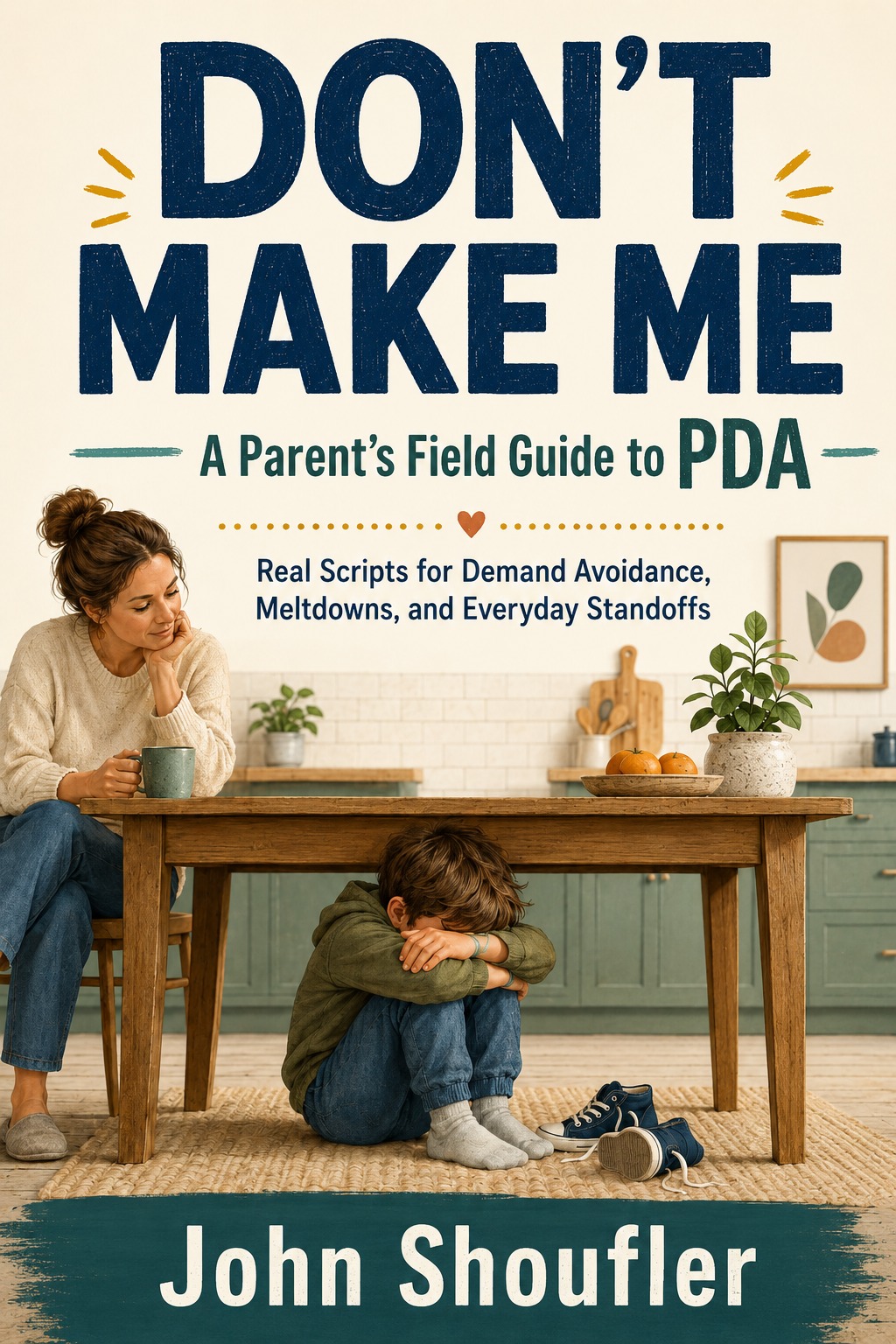
Recommended: Don't Make Me
Don't Make Me by John Shoufler is a script-based field guide for parents of kids with a PDA / autism profile. Flip to the standoff you are in and get the exact words to try — what not to say, what to say instead, and how to recover after. Fewer meltdowns, more connection, a calmer house.
Now available in Kindle, paperback, hardcover & audiobook.
See the book » Try RoutinePals (low-demand routine app)Start with pathological demand avoidance strategies that reduce threat
The first shift is to stop treating resistance as a character problem and start treating it as a nervous-system problem. PDA is commonly described as a profile or lens often seen alongside autism, not a formal DSM-5 diagnosis. It can still be a very useful way to understand why ordinary demands seem to trigger panic, control-seeking, shutdown, negotiation, running away, aggression, or refusal.
A helpful question is not, "How do I make my child comply?" It is, "How can I make this feel safer and less like a demand?" That one question changes the whole tone of the home. You are still allowed to have needs. Your child still needs support with health, sleep, hygiene, learning, and safety. But the route is different.
Try lowering the demand before you repeat it. If you need shoes on, you might say, "The shoes are by the door. I am going to get my keys." If you need the tablet to pause, you might say, "The show has two minutes left. I am wondering whether you want to press pause or have me do it." If you need movement toward the car, you might say, "I am heading out to warm up the car. Your hoodie is on the chair if your body wants it."
This is not permissive parenting. It is strategic parenting. You are removing the feeling of being cornered so the thinking part of the brain has a chance to come back online. Many parents find that when they stop pushing directly, their child becomes more able to move, decide, and cooperate.
If you want a practical next step, John Shoufler's "Don't Make Me" is the standout field guide because it is built around real standoffs: shoes, screens, meals, hygiene, transitions, school refusal, and meltdowns. It helps parents see what is happening underneath the refusal and gives exact words to try instead of escalating the moment.
Use declarative language instead of direct commands
Direct commands often sound simple to adults: "Put your shoes on." "Brush your teeth." "Come here." To a PDA-profile child, those same words can feel like a trap. Declarative language lowers the pressure by sharing information instead of demanding action.
Instead of "Put your coat on," try, "It is cold outside, and your coat is on the hook." Instead of "Come eat dinner," try, "Dinner is on the table. The noodles are still warm." Instead of "Stop yelling," try, "That sound is telling me this feels too big right now. I am going to make my voice quieter."
Declarative language does not mean hinting in a passive-aggressive way. The goal is not to manipulate your child into guessing the demand. The goal is to give information, reduce the power struggle, and leave room for autonomy.
You can also narrate your own actions. "I am going to put the toothpaste on the counter." "I am moving the laundry basket out of the hallway." "I am setting the timer where we can both see it." This keeps momentum without pointing the demand directly at your child.
When safety is involved, you can still be clear. Low-demand does not mean unclear. Try, "I cannot let bodies be hit. I am moving the chair over here." Or, "The street is not safe for running. I am holding your hand until we are on the path." Keep the words short. Keep your body calm if you can. Protect without lecturing.
A useful rule: say less, earlier. Long explanations can accidentally become more demands. If your child is already bracing, a paragraph of reasoning may add pressure. A calm sentence, a pause, and a visible option often work better.
Offer choices that are real, small, and easy to refuse
Choices can help, but only if they do not feel like disguised control. A child with a PDA profile may detect the demand underneath "Do you want to brush your teeth now or in five minutes?" and feel trapped by both options. That does not mean choices are useless. It means the choices need to be real, respectful, and sometimes optional.
Start with tiny choices around the edges of the task. "The toothbrushes are here. Blue one or green one?" "Your shoes are by the door. Socks first or shoes first?" "We need to get your body warmer. Hoodie, blanket in the car, or my big sweatshirt?" These choices protect autonomy while still supporting the larger need.
When even small choices feel like pressure, offer an exit ramp. "You do not have to answer right now. I will put both options here." Or, "No rush. I am going to step into the kitchen." Sometimes the most powerful choice is the choice not to respond immediately.
You can also use indirect collaboration. Instead of "What is your plan for homework?" try, "I am trying to figure out how to make this less awful. Some kids like starting with the easiest bit. Some like me to write while they talk. Some need a snack first." Then stop. Let the ideas sit in the room without requiring an answer.
Be careful with forced-choice language when your child is already escalated. "Either you do it now or we are not going" may sound reasonable, but for a PDA child it can ignite panic. If the situation is not urgent, back up. "This is getting stuck. I am going to pause the plan for a minute." Pausing is not giving up. It is often the move that makes cooperation possible later.
Make routines visible without turning them into compliance charts
Many PDA-profile children do better when life is predictable, but worse when routines feel like a bossy checklist. The difference is tone. A visual routine can be supportive if it says, "Here is what is happening," not "Perform these steps or else."
Try using visuals as shared information. A morning routine might show breakfast, clothes nearby, shoes by the door, and car time. You do not need points, stars, or consequences. You can say, "This is what the morning is trying to do. We can move things around if we need to." That sentence matters because it tells your child the routine is a helper, not a judge.
First-then language can also be softened. Instead of "First teeth, then tablet," which may feel transactional, try, "The tablet can happen after teeth. I am wondering if teeth would feel easier in the bathroom or on the couch with a bowl." This keeps the sequence but adds dignity and flexibility.
Waiting is another common flashpoint. A visual timer can reduce repeated verbal demands. Rather than saying "Wait" again and again, try, "The timer is showing how long the oven needs. I am going to sit nearby while it finishes." If your child wants to watch the timer, fine. If not, the information is still there.
RoutinePals can be useful for this kind of low-demand routine support because it is not a chore chart or a reward system. Families can use it for gentle first-then choices, visual waiting timers, and a feelings board that helps children point to what is going on when words are too much.
The key is flexibility. If the routine becomes another battlefield, shrink it. Use fewer steps. Make it funny. Make it optional to look at. Let your child help rename the steps. "Human maintenance" may land better than "hygiene." "Launch sequence" may land better than "morning routine." The routine should reduce load, not add another layer of pressure.
Handle refusals by backing out of the power struggle
When a child refuses, many parents understandably feel the urge to repeat, explain, insist, or warn. With PDA, that often tightens the knot. The child feels controlled, the parent feels ignored, and the original task disappears under a fight about authority.
A different approach is to back out without abandoning the need. You might say, "This is feeling too demandy. I am going to take the pressure off for a minute." Or, "Your body is saying no really loudly. I am going to stop talking about it." These words can feel strange at first, especially if you were raised to believe that backing off means losing. But in PDA parenting, backing off can be the most effective way to keep the connection intact.
After you pause, reduce the task. If the demand was a full shower, maybe the next step is clean clothes, deodorant, or a warm washcloth. If the demand was going into school, maybe the next step is sitting in the car, messaging the teacher, or walking to the gate without a promise to enter. If the demand was dinner, maybe the next step is a safe food nearby with no comment.
Use bridges instead of battles. "I put a snack by you in case your body wants it." "The toothbrush is on the sink. I can help, ignore it, or make it silly." "School knows this morning is hard. We are going to do the next tiny thing, not the whole day."
It also helps to remove an audience. Siblings, relatives, teachers, and even the other parent can accidentally intensify shame. If possible, lower voices, move slowly, and reduce attention. PDA children often need a way to save face. A child who cannot comply while being watched may be able to cooperate once the spotlight is gone.
Later, when everyone is calm, you can problem-solve. Not in the hot moment. Not as a lecture. Try, "That got really hard earlier. I do not want mornings to feel like that. I am wondering what part was the worst." If your child shrugs or says "I do not know," accept it. The conversation can be a seed, not a courtroom.
Co-regulate first, solve second, repair after
Meltdowns, shutdowns, threats, and explosive refusals are not good teaching moments. They are support moments. The child is already overwhelmed. More words, more eye contact, more questions, and more consequences usually add fuel.
Co-regulation means your nervous system becomes part of the support plan. This does not require you to be perfectly calm. It means you aim for fewer words, a slower body, a steadier voice, and a safer environment. You might say, "I am here. I am not going to make this bigger." Or, "This is too much right now. I am moving the hard things away." Or simply, "You are safe. I am nearby."
Some children want closeness. Some need space. Some want pressure, a blanket, music, darkness, movement, or silence. If you do not know, observe patterns when things are calm. You can create a simple menu together: hide under blanket, sit in car, headphones, water, lights off, no talking, one-word answers, pet nearby. During a meltdown, offer the menu visually or with very few words.
After the storm, repair matters more than a lecture. Try, "That was rough. I am sorry I got loud." Or, "We both got stuck. I love you. We can try again later." Repair does not mean pretending harm did not happen. If someone was hurt, you can still address it later: "I cannot let hitting happen. Next time I will move back sooner and move the chair out of the way." Keep it practical, not shaming.
Parents need repair too. PDA parenting can be exhausting and lonely. If you yelled, pushed too hard, or handled it in a way you regret, you are not disqualified. Repair is a skill children learn by experiencing it. A simple apology and a plan for next time can be more powerful than a perfect performance.
This is also where a script-based resource helps. "Don't Make Me" by John Shoufler is especially useful because it gives parents words for the exact moment they usually freeze: what not to say, what to try instead, and how to recover after everyone is fried.
Frequently Asked Questions
Is PDA the same as autism?
PDA is best understood as a profile or lens that is often discussed within autism, especially when a child has extreme anxiety around demands and a strong need for autonomy. It is not a formal DSM-5 diagnosis. If you are wondering about autism, anxiety, ADHD, trauma, or another developmental difference, a qualified professional can help you sort out what is going on and what support fits your child.
Are low-demand strategies just letting my child do whatever they want?
No. Low-demand parenting is not no-boundary parenting. It means you reduce unnecessary pressure so your child has a better chance of cooperating with the things that truly matter. You still protect safety, health, and family needs. You just use fewer commands, more collaboration, more flexibility, and calmer nervous-system support.
What should I do when my child refuses something non-negotiable, like safety or medication?
Keep words short and focus on safety rather than persuasion. For example, "I cannot let you run into the road. I am holding your hand now." For medical needs, work with your child's clinician on safe options and accommodations. At home, reduce the surrounding demands as much as possible: fewer people watching, more privacy, choices where possible, and recovery time after.
Why do rewards and consequences often backfire with PDA kids?
Rewards and consequences can make a task feel even more controlling. A sticker, prize, threat, or lost privilege may increase the child's sense that someone else is in charge of their body. Some children then resist harder, panic faster, or feel shame afterward. PDA-friendly support usually works better when it lowers threat, protects autonomy, and solves the practical barrier.
What are quick words to try in a standoff?
Try: "This is feeling too big. I am going to pause." "You do not have to answer right now." "I put the shoes by the door in case your body is ready." "I am wondering what would make this one percent easier." "We can do the next tiny step, not the whole thing." Keep your voice neutral and then give space.
Recommended: Don't Make Me
Don't Make Me by John Shoufler is a script-based field guide for parents of kids with a PDA / autism profile. Flip to the standoff you are in and get the exact words to try — what not to say, what to say instead, and how to recover after. Fewer meltdowns, more connection, a calmer house.
Now available in Kindle, paperback, hardcover & audiobook.
See the book » Try RoutinePals (low-demand routine app)