
PDA in autism is best understood as a nervous-system profile where everyday demands can feel threatening, even when the child wants to cooperate. A child may desperately want to go to school, brush teeth, join dinner, or put on shoes, and still hit a wall the moment it feels required. For parents, this can look confusing: your child may be funny, bright, loving, and capable one minute, then panicked, controlling, shut down, or explosive the next.
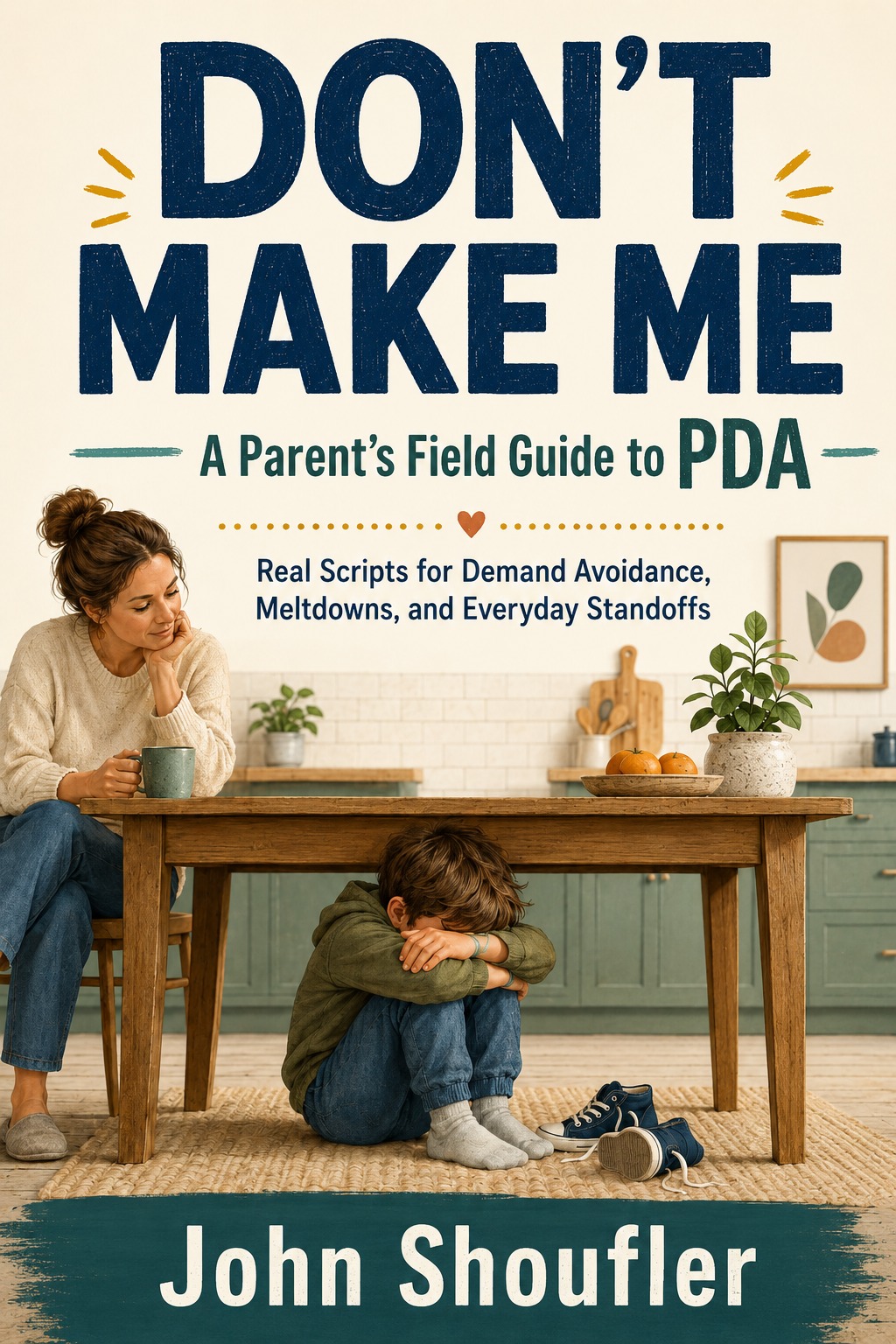
Recommended: Don't Make Me
Don't Make Me by John Shoufler is a script-based field guide for parents of kids with a PDA / autism profile. Flip to the standoff you are in and get the exact words to try — what not to say, what to say instead, and how to recover after. Fewer meltdowns, more connection, a calmer house.
Now available in Kindle, paperback, hardcover & audiobook.
See the book » Try RoutinePals (low-demand routine app)PDA in autism: what parents are often seeing underneath the behavior
PDA is commonly used as a lens for a pattern some autistic people experience, rather than as a formal DSM-5 diagnosis. The key idea is not “defiance.” It is demand-threat. The child’s nervous system reads expectations, instructions, time pressure, praise, questions, transitions, and even bodily needs as pressure. Once pressure rises, the child may move into fight, flight, freeze, fawn, or frantic negotiation.
This matters because the support changes. If you think, “My child is choosing to be difficult,” the natural response is to push harder. With a PDA lens, we ask, “What made this feel unsafe or impossible, and how can I lower the threat enough for their thinking brain to come back online?”
Common signs can include intense resistance to ordinary requests, needing high levels of control, using distraction or humor to avoid demands, sudden panic around transitions, extreme reactions to “easy” tasks, difficulty with self-care, and meltdowns after periods of holding it together. Some children appear sociable but struggle deeply with hierarchy, authority, and being directed. Others seem anxious, perfectionistic, bossy, silly, avoidant, or “fine at school and impossible at home.”
A helpful first step is to stop arguing with the surface behavior and start tracking the pattern. Which demands cause the biggest threat response? Direct commands? Being watched? Morning routines? Hunger? Screens ending? School attendance? Hygiene? Uncertainty? Too many words? Once you know the shape of the stress, you can design around it.
A low-demand approach does not mean your child runs the house or that important needs disappear. It means you reduce unnecessary pressure so the necessary things become more possible. You use fewer commands, more choices, more collaboration, more visual supports, more humor, and more recovery time. The goal is not instant obedience. The goal is felt safety, trust, and slowly growing capacity.
Early signs by age: preschoolers, school-age kids, and teens
In preschoolers, PDA-style demand avoidance may look like huge reactions to tiny requests. “Put on your coat” may lead to running away, flopping, screaming, hiding, or suddenly becoming a cat. You may see elaborate role play that keeps the adult from giving direct instructions. Self-care tasks like toileting, handwashing, getting dressed, hair brushing, and leaving the house can become daily battles. These children may be charming and imaginative, but deeply distressed by being told what to do.
For preschoolers, start by making demands smaller and less personal. Instead of “Put your shoes on now,” try, “The shoes are by the door. I’m wondering which foot wants to go first.” Instead of “You need to wash your hands,” try, “The sink is ready. I’ll turn away while the soap does its job.” Play can help, but only if it does not become another performance demand. Keep your tone light and your body relaxed. If your child escalates, the priority is not the task. The priority is safety and connection.
In school-age children, PDA often becomes more complicated because the number of demands increases. School, homework, friendships, sports, clothing expectations, hygiene, mealtimes, and screen limits all pile up. A child may manage at school by masking, then collapse at home. You might see intense after-school explosions, refusal to do homework, sudden “I can’t” around tasks they did yesterday, or controlling behavior with siblings.
For this age, build decompression into the day before asking for anything. After school, try fewer questions and more quiet anchoring: “You’re home. Snacks are on the counter. I’m glad to see you.” Later, when things are calmer, collaborate: “Mornings have been rough. I wonder if we can make one part easier tomorrow.” Offer two acceptable options when possible: “The bath could happen before dinner or after. Either works for me.”
In teens, PDA may show up as school refusal, sleep reversal, hygiene avoidance, shutdowns, intense arguments about independence, or distress around future planning. Teens often know they are struggling and may feel shame. They may also resist supports that feel childish or controlling. The approach needs to become more respectful and transparent.
Try naming autonomy directly: “I’m not here to control you. I do want to understand what’s making this so hard.” Ask permission before problem-solving: “Would it help to brainstorm, or do you need me to just sit with you?” For teens, low-demand support often means fewer lectures, more privacy, collaborative agreements, and helping them reduce overwhelm without turning every conversation into a life lesson.
Masking exhaustion: why your child may seem fine elsewhere and fall apart with you
Many parents of PDA-profile autistic children hear, “They’re fine here,” from school, relatives, clubs, or therapy settings. Then the child comes home and explodes over a snack, a sock seam, a sibling’s voice, or a simple reminder. This can make parents feel blamed or disbelieved. It can also make the child look manipulative, as if they are choosing where to behave.
A kinder and often more accurate explanation is masking exhaustion. Masking means holding in distress, copying expected behavior, suppressing movement or emotion, forcing eye contact, following rules, tolerating sensory discomfort, and trying not to get in trouble. Some children can mask for hours. The cost arrives later, usually in the safest place and with the safest people.
Home meltdowns after masking are not proof that you are doing something wrong. They are information: the day took more from your child than they had to give. If you treat the after-school crash as “bad behavior,” you may accidentally add more threat to a nervous system that is already depleted.
Think of the first hour after school as a landing zone, not a productivity window. Reduce talking. Delay questions. Avoid reminders about homework, chores, or tomorrow. Offer food, water, quiet, sensory comfort, screens if they help regulation in your family, or time alone. You might say, “No questions right now. Your body worked hard today.”
If school is a major source of masking exhaustion, document what you see at home: sleep disruption, panic, stomachaches, refusal, meltdowns, shutdowns, or recovery time needed. Share concrete observations with educators or clinicians. You are not trying to prove anyone wrong; you are helping adults see the whole child.
Also watch for your own exhaustion. Parents can begin walking on eggshells, bracing for the next explosion. A low-demand approach is not about becoming endlessly available or never having needs. It is about changing the pattern from pressure-versus-resistance to safety-versus-threat. That shift helps the whole family breathe.
Low-demand support that does not rely on rewards, punishments, or power struggles
Traditional behavior systems often assume the child can comply if the reward is big enough or the consequence is firm enough. For many PDA-profile kids, that misses the point. If the nervous system experiences the demand as a threat, adding pressure can make the child less able to do the thing, not more. Sticker charts, chore charts, loss of privileges, and “because I said so” tactics may create short-term movement, but often increase anxiety, masking, resentment, or explosions later.
Low-demand support begins with removing unnecessary demands. This can feel strange at first, especially if you were taught that consistency means holding every line. Try asking, “Does this demand matter today?” Some demands are health, safety, or family-functioning needs. Others are preferences, habits, or battles that grew over time. Reducing the nonessential battles gives your child more capacity for the essential ones.
Next, change commands into declarative language. Instead of “Get your bag,” try, “Your bag is still by the couch.” Instead of “Stop yelling,” try, “That sound is telling me this got too big.” Instead of “Come eat,” try, “Dinner is on the table. I saved the seat you like.” Declarative language gives information without yanking the child into a direct compliance test.
Offer choices, but keep them real and limited. “Do you want shoes or sandals?” is helpful if both are truly acceptable. “Do you want to brush your teeth now or in five minutes?” may be too much if toothbrushing is already a panic demand. In that case, go smaller: “The toothbrush is on the counter. Toothpaste can be mint or no toothpaste tonight.”
Use collaboration outside the hot moment. During calm times, you might say, “Getting out the door has been awful for everyone. I wonder what part feels worst.” Then listen. Your child may identify a sensory issue, fear, embarrassment, time pressure, or not knowing what comes next. The solution may be softer socks, getting dressed the night before, leaving earlier with less rush, or skipping a nonessential step.
Some families also like gentle visual supports when they are used as information, not control. RoutinePals, for example, can support first-then as a choice, visual waiting timers, and a feelings board in a way that fits low-demand routines rather than chore-chart compliance. The key is how you use the tool: “Here’s what’s coming” feels safer than “Do this to earn that.”
Scripts for common flashpoints: shoes, screens, hygiene, meals, transitions, and school refusal
When a child is escalating, parents often know the theory but cannot find the words. This is where scripts matter. Short, calm phrases reduce the adult’s panic and lower the child’s sense of being cornered.
For shoes, avoid “We are late, put them on right now.” Try: “The car is ready. The shoes can come with us if feet aren’t ready yet.” Or: “I’m going to step into the hallway so your body has space.” If shoes are sensory-hard, solve that outside the rush: keep backups, allow Crocs or boots when possible, and stop treating footwear as a moral issue.
For screens, avoid sudden grabs or countdowns that feel like a trap. Try: “This is the last video I can do before dinner. I’ll sit near you while it finishes.” Or: “Stopping is hard. I’m not mad. Your game brain needs a landing strip.” Some children need a visual timer; others panic when watched. Experiment gently.
For hygiene, reduce shame. Avoid “You stink” or “This is disgusting.” Try: “Bodies need maintenance, and this one has become too hard. We can make it smaller.” Offer partial options: wipe face only, feet only, dry shampoo, bath with lights low, toothbrush in the kitchen, brushing without toothpaste, or dentist-approved alternatives if your professional recommends them.
For meals, pressure often backfires. Try: “Food is here. You don’t have to talk about it.” Or: “This is a looking plate, not an eating demand.” Keep safe foods available when possible. If nutrition, growth, choking, or severe restriction is a concern, seek support from an appropriate professional.
For transitions, make the invisible visible. Try: “In a little while, the room will change from play to leaving.” Later: “The leaving part is close now. I’ll carry the bag.” Avoid rapid-fire instructions. One sentence, then pause.
For school refusal, begin with belief. “I believe you. Something about school feels impossible today.” This does not mean school no longer matters. It means panic gets addressed before attendance. Later, when calm, explore the demand: Is it separation, bullying, sensory overload, academic fear, social exhaustion, a specific teacher, perfectionism, or burnout?
If you need a practical next resource, Don’t Make Me: A Parent’s Field Guide to PDA by John Shoufler is built around exactly these moments. Parents can flip to the standoff they are in, see what may be happening in the nervous system, what not to say, the exact words to try instead, and how to recover afterward.
Repair after meltdowns and build a support plan that grows with your child
After a meltdown, the most important parenting move is often repair. Not a lecture. Not a post-game analysis while your child is still raw. Repair says, “We are still connected. You are not bad. We can learn from this later.”
Start with low words and no blame: “That was really hard. I’m here.” If you lost your temper, model accountability without making your child comfort you: “I yelled. That wasn’t okay. I’m going to work on slowing down.” This helps reduce shame, which is especially important for children who already feel out of control.
Later, when everyone is regulated, use curiosity. “I’m wondering what part got too big.” “Was it the noise, the waiting, the way I said it, or something else?” Some children can answer directly. Others need drawing, texting, choosing from options, or no discussion at all. Respect that. A child does not have to verbally process every meltdown for learning to happen.
Build a family plan around patterns. Identify early warning signs: louder voice, silly voice, hiding, arguing, freezing, repeating questions, trying to control everyone, or sudden tiredness. Decide what helps at each stage. Stage one might be fewer words and a snack. Stage two might be space, dim lights, or a parent nearby but silent. Stage three might be safety only, with no teaching.
If your child’s distress is frequent, intense, unsafe, or affecting sleep, eating, school, or family functioning, consider seeking assessment and support from professionals who understand autism, anxiety, sensory processing, trauma-informed care, and demand avoidance profiles. You are not looking for someone to force compliance. You are looking for someone who can help your child feel safer and function with less distress.
As your child grows, the plan should become more collaborative. Preschoolers need adults to design the environment. School-age children can help identify hard parts and choose supports. Teens need dignity, privacy, and real input. Across every age, the foundation is the same: lower threat, protect connection, and build capacity slowly.
For many families, having scripts ready changes the whole tone of the home. Don’t Make Me by John Shoufler is the standout field guide for that reason: it turns the low-demand approach into words parents can actually use when everyone is tired.
Frequently Asked Questions
Is PDA in autism an official diagnosis?
PDA is usually described as a profile or lens, often discussed alongside autism, rather than a formal DSM-5 diagnosis. Some clinicians may recognize the pattern even if they use different diagnostic language, such as autism with significant anxiety, demand avoidance, or nervous-system dysregulation. If you are concerned, a professional evaluation can help clarify your child’s needs and supports.
How is PDA different from ordinary defiance?
Defiance usually implies a child could comply but is choosing not to. A PDA lens asks whether the demand is triggering a threat response in the nervous system. The child may want to do the task and still feel unable to begin. That is why more pressure often makes things worse, while reducing demand, increasing autonomy, and co-regulating can make cooperation more possible.
Does low-demand parenting mean I let my child do whatever they want?
No. Low-demand parenting is not permissive parenting. It means you reduce unnecessary pressure, avoid power struggles, and support the child’s nervous system so essential needs become more possible. You still hold safety boundaries, but you do it with fewer commands, less shame, more collaboration, and more flexibility.
What should I do when my child refuses school?
Start by treating the refusal as distress, not laziness. Say something like, “I believe you. Something about school feels impossible today.” When your child is calmer, look for the specific demand: sensory overload, social fear, bullying, academic pressure, separation anxiety, burnout, or a particular class. Work with the school and appropriate professionals to reduce the barriers rather than simply increasing pressure.
Why does my child melt down at home but not at school?
Many autistic and PDA-profile children mask at school, meaning they hold in distress and force themselves through the day. Home may be where the nervous system finally releases. This does not mean your child is manipulating you or that home is the problem. It often means the child needs more decompression, fewer after-school demands, and adults who understand the cost of masking.
What words help in the moment when my child is escalating?
Use short, calm, non-cornering language. Try, “This got too big,” “I’m not mad,” “We can make it smaller,” “I’ll give your body some space,” or “The plan can change.” Avoid long explanations, threats, or rapid instructions during escalation. The goal in that moment is regulation first; problem-solving can wait.
Recommended: Don't Make Me
Don't Make Me by John Shoufler is a script-based field guide for parents of kids with a PDA / autism profile. Flip to the standoff you are in and get the exact words to try — what not to say, what to say instead, and how to recover after. Fewer meltdowns, more connection, a calmer house.
Now available in Kindle, paperback, hardcover & audiobook.
See the book » Try RoutinePals (low-demand routine app)