

Freelance Writing Mastery
The Complete Guide to Building and Scaling a Six-Figure Writing Business by John Shoufler.
Freelance Writing Mastery is the complete, step-by-step playbook for turning your writing into a profitable, scalable business — from landing your very first client to building a six-figure freelance career. Across 570+ pages, John Shoufler gives beginners and working writers alike a clear roadmap to launch, grow, and thrive.
What you will learn
- Launch from scratch — set up your services and land your first paying clients, even with no experience.
- Find high-paying work — where the good clients are and how to pitch to win them.
- Price for profit — set rates, quote projects, and stop leaving money on the table.
- Pick a profitable niche — specialize so clients seek you out and pay premium rates.
- Build a portfolio that converts prospects into paying gigs.
- Scale to six figures — systems, retainers, and repeat clients that grow your income.
Every chapter is practical and actionable, with strategies you can put to work the same day. Whether you are just starting out or ready to grow an established freelance business, this is the guide.
Inside the 570-Page Playbook: Chapter-by-Chapter Breakdown
Most beginner writing books stop at generic advice like "start a blog" or "sign up for content mills." Freelance Writing Mastery by John Shoufler takes the opposite approach: it treats freelance writing as a B2B service business with predictable client acquisition, clear scope boundaries, and value-based pricing. Below is how the core sections of the 570+ page curriculum move you from zero clips to $10,000+ per month in recurring client work.
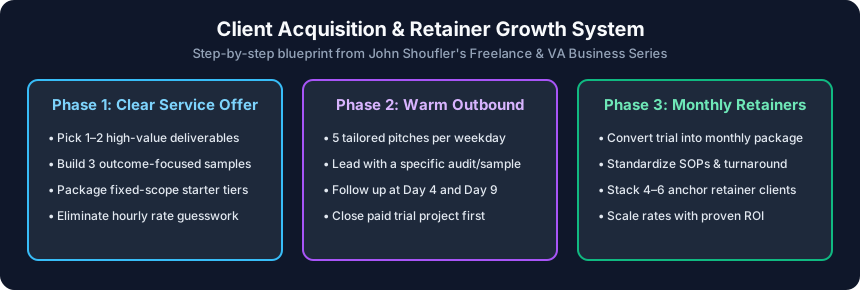
Phase 1: Positioning, Niche Selection & Service Packaging (Chapters 1–4)
Generalist writers compete on price against thousands of bidders on race-to-the-bottom marketplaces. Specialist writers compete on domain clarity and business outcomes. In the opening chapters, John Shoufler walks you through selecting a high-margin vertical where companies already have budget allocated for content marketing, documentation, and sales enablement:
- B2B SaaS & Cloud Software: Case studies, long-form comparison guides, onboarding sequences, and product-led blog content targeting technical buyers and operations leads.
- Technical & Compliance Writing: Standard operating procedures (SOPs), user manuals, implementation playbooks, and knowledge-base articles (pair this with Mastering Technical Writing, 2nd Edition).
- Fintech, Healthcare & Professional Services: White papers, regulatory explainers, thought-leadership ghostwriting for executives, and email nurture funnels.
- Direct-Response & E-Commerce Copywriting: Landing pages, product launch sequences, retention emails, and conversion-focused buying guides.
Phase 2: Building a High-Converting Portfolio Without Prior Clients (Chapters 5–7)
One of the biggest roadblocks new writers face is the catch-22 of needing samples to get clients and needing clients to get samples. Freelance Writing Mastery solves this with the 3-Piece Spec Portfolio Method. Instead of waiting for someone to hire you at $0.02 per word, you produce three targeted, publication-ready Flagship Samples tailored to your exact target buyer:
- The Deep-Dive Industry Guide (2,000+ words): A comprehensive breakdown of a problem your target client’s customers search for every month, complete with comparison tables, original frameworks, and clear subheadings.
- The Mini Case Study or ROI Breakdown (800–1,200 words): A structured "Problem → Architecture/Process → Measurable Result" narrative showing how a tool, workflow, or methodology solves a costly operational bottleneck.
- The Conversion Asset (Landing Page or 5-Email Welcome Sequence): A tight, action-oriented asset proving you understand how to move a reader from awareness to booking a demo or starting a trial.
Freelance Writing Pricing Models & Rate Benchmarks (2026)
A core thesis of Freelance Writing Mastery is abandoning per-word billing as early as possible. Per-word pricing penalizes efficiency and caps your income when you write concise, high-impact copy. Use the benchmark table below to transition from beginner per-project rates to monthly retainers:
| Deliverable / Service Tier | Beginner Rate (0–6 Mos) | Intermediate B2B Rate | Specialist / Retainer Rate | Typical Turnaround & Scope |
|---|---|---|---|---|
| SEO Pillar Article (2,000–2,500 words) | $200 – $350 | $450 – $850 | $1,000 – $1,800 | 5 business days; includes outline, meta tags, 1 revision |
| Customer Case Study (1,000–1,500 words) | $300 – $500 | $650 – $1,200 | $1,500 – $2,500 | 7–10 business days; includes 30-min customer interview |
| White Paper / Industry Report (3,000+ words) | $750 – $1,200 | $1,800 – $3,500 | $4,000 – $7,500 | 2–3 weeks; includes SME interviews & citations |
| Email Welcome / Launch Sequence (5–7 emails) | $350 – $600 | $800 – $1,500 | $2,000 – $3,500 | 1 week; includes subject line A/B variants & CTAs |
| Monthly Content Retainer (4 Long-Form Posts) | $1,000 – $1,400/mo | $2,000 – $3,200/mo | $4,000 – $6,500/mo | Recurring monthly; 1 post/week + keyword brief |
Copy-Paste Cold Pitch Template from the Playbook
Instead of sending long, biographical cover letters that busy marketing directors delete, John Shoufler teaches the Observation + Gap + Specific Pitch framework. Every outreach email should take under 45 seconds to read and propose two concrete article or asset ideas the prospect can approve immediately:
Subject: Quick content idea for [Company Name]’s [Blog / Resource Center]

Hi [First Name],

I was reading your recent guide on [Specific Post or Product Feature on Their Site] — great breakdown of how [Target Audience] handle [Specific Problem].

While looking through your resource library, I noticed you have not covered two high-intent topics your competitors are currently ranking for:

1. [Proposed Title #1 — e.g., How Multi-Location Teams Audit Shift Handovers (With Checklist)]
2. [Proposed Title #2 — e.g., 2026 Compliance Guide for Small Fleet Operators]

I specialize in writing practitioner-grade [Industry/Niche] guides that turn organic readers into product signups. Here are two recent samples showing how I structure comparison tables and technical workflows:
- [Link to Portfolio Sample 1]
- [Link to Portfolio Sample 2]

Would you be open to commissioning a paid test article on #1 this month? I can have a complete outline in your inbox by Thursday for a flat project rate of $[Rate].

Best regards,
[Your Name]
[Your Portfolio URL]
The 90-Day Freelance Writing Launch Checklist
If you are reading Freelance Writing Mastery alongside our step-by-step freelance writing business guide, follow this 90-day execution checklist to replace guesswork with daily momentum:
- Days 1–14 (Foundation & Samples): Choose one primary industry niche and one secondary niche. Draft, edit, and publish three 2,000-word flagship portfolio pieces demonstrating headers, data tables, and actionable takeaways.
- Days 15–30 (Prospecting Engine): Build a clean spreadsheet of 100 target companies (funded SaaS startups, specialized agencies, trade publications, and B2B service brands) with verified content manager or VP of Marketing contacts.
- Days 31–60 (Daily Outreach & Paid Trials): Send 5 customized cold pitches per weekday (100 pitches/month) using the Observation + Gap formula. Follow up at Day 4 and Day 9. Convert replies into paid single-article trial assignments.
- Days 61–90 (Retainer Conversion & Systems): Deliver every trial assignment 24 hours ahead of deadline with a clean brief, internal link suggestions, and formatted headings. On delivery, pitch a 3-month recurring package (4 articles/month) so three retainers cover $4,500–$7,500+ in predictable monthly revenue.
How Freelance Writing Mastery Compares to Courses & Content Mills
Many aspiring writers spend $1,500+ on video courses that teach outdated Upwork bidding tricks or spend months writing $15 articles for content agencies. What makes Freelance Writing Mastery stand out is its depth on the operational side of self-employment: scoping statements of work (SOWs), kill fees, 50% upfront deposit invoicing, preventing scope creep, interviewing subject-matter experts (SMEs), and transitioning into higher-paying technical writing or executive virtual assistant retainers.
Statement of Work (SOW) & Scope Protection Checklist for Freelance Writers
One of the fastest ways profitable writers lose margin is through unbilled scope creep—endless rounds of stakeholder edits, sudden shifts in article angle after the draft is submitted, or delayed invoice payments. In Freelance Writing Mastery, John Shoufler provides a battle-tested contract and onboarding workflow that protects your calendar and cash flow on every engagement:
- The Approved Outline Gate: Never write a 2,500-word draft before the client signs off on a 1-page H2/H3 outline and primary keyword brief. Once the outline is approved in writing, changing the topic or target persona after draft delivery constitutes a paid re-scope rather than a free revision.
- Two-Round Revision Cap: Include up to two rounds of reasonable edits within 14 calendar days of draft delivery. Any feedback submitted after 14 days is automatically deemed accepted for invoicing purposes.
- 50% Upfront Deposit for New Clients: Collect 50% upon contract signature before reserving production time on your calendar, and 50% upon delivery of the first draft (or Net-15 for established corporate accounts).
- Kill Fee & Pause Clause: If a client pauses a campaign mid-project due to internal restructuring, the 50% deposit is non-refundable and covers completed research and outlining work.
- Byline & Portfolio Rights: Specify whether the deliverable is ghostwritten or bylined, and retain the right to share a private PDF excerpt with prospective clients during discovery calls.
Sample Client Onboarding Brief Questions (Copy & Send Before Drafting)
- Primary Reader & Job Title: Who is reading this guide, and what specific operational pain point prompted their search today?
- Product Tie-In & Call to Action (CTA): Which feature, product page, or lead magnet should this article naturally funnel readers toward?
- Subject-Matter Expert (SME) Perspective: What contrarian insight or field lesson does your team believe that generic competitor blog posts get wrong?
- Proof Points & Internal Links: Which 3 to 5 existing pages on your domain should we link to, and what customer metrics or benchmarks can we cite?
Frequently Asked Questions
Do I need a journalism or English degree to use Freelance Writing Mastery?
No. Corporate and B2B clients rarely ask where you went to school—they care whether you can research accurately, structure an argument clearly, meet deadlines, and write in a voice that helps their customers solve real problems. Real-world work experience in healthcare, operations, software, finance, education, or trades is actually a major advantage when choosing a profitable niche.
How long is Freelance Writing Mastery by John Shoufler?
The paperback edition spans over 570 pages of step-by-step instruction, outreach scripts, pricing matrices, onboarding checklists, and contract clauses, making it one of the most comprehensive single-volume handbooks available for independent writers.
Can I use this book if I want to write part-time alongside a day job?
Yes. The book includes a dedicated time-blocking and client-capacity framework designed for part-time writers working 8 to 12 hours per week. By focusing on two monthly retainer clients at $1,000 to $1,500 each rather than chasing dozens of tiny one-off gigs, part-time writers can build a meaningful secondary income stream without burning out.
How does this book handle AI writing tools and modern SEO?
Rather than treating AI as a replacement for human expertise, the playbook shows how to position yourself in the top tier of the market where generic AI text fails: conducting original SME interviews, building verifiable comparison matrices, crafting first-hand walkthroughs, and aligning content with real buyer intent.
What other John Shoufler books pair best with Freelance Writing Mastery?
Writers who want to command top-tier B2B rates frequently pair this book with Mastering Technical Writing (2nd Edition) to add SOPs, API docs, and user manuals to their service menu, or Mastering Social Media Management (2nd Edition) to offer bundled content distribution retainers.